
Top 10 CEOs Redefining Customer Data and Personalization
Stay updated with us
Sign up for our newsletter
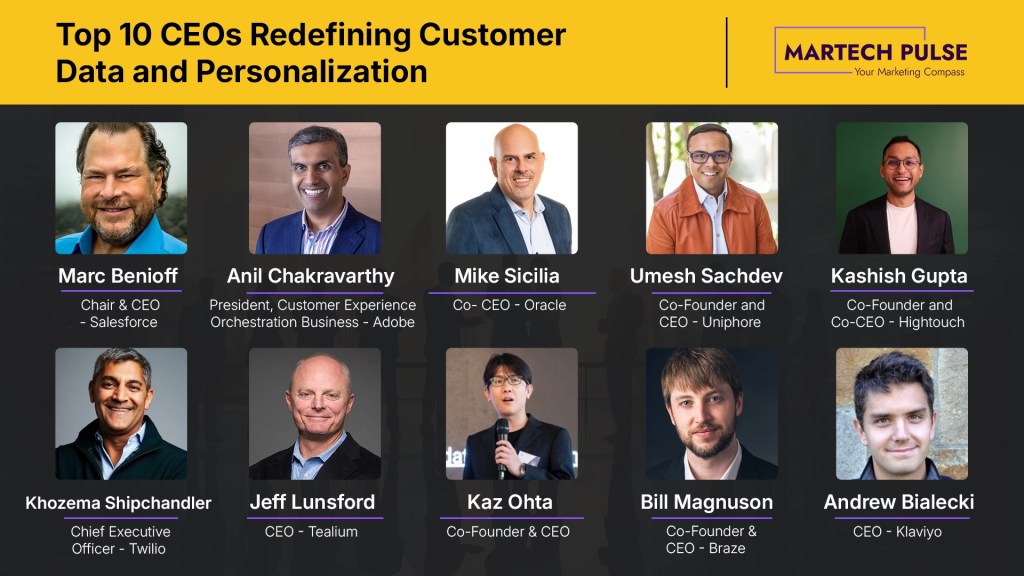
Have you ever opened an app and felt like it just knew what you wanted? That is not something that happened by chance. A person built the system that made it happen. Another person decided it was worth building. In this blog I will look at the Customer Data Platform Leaders who make those decisions. These are the 10 CEOs who are changing how brands collect, understand and use customer data to make every experience feel personal. I have seen how these leaders shape the market.
Before that, though, it helps to know why this matters so much right now. I want you to understand why this topic is important.
Why Customer Data Platform Leaders Matter More Than Ever in 2026?
A customer data platform is essentially a company’s well organized brain. It gathers information from emails, stores, websites, apps, and support chats, then combines it all into a single consumer profile. Teams in charge of marketing, sales, and customer support can then use that profile to treat every individual with respect. It resembles a brain that remembers everyone, in my opinion.
This market is expanding quickly. The market for customer data platforms is projected to expand at a compound annual growth rate (CAGR) of 13.8%, from USD 7.34 billion in 2026 to USD 14.04 billion by 2031. Knowing your customers better is an idea that costs a lot of money. I’ve seen the market expand. The potential excites me.
There is a reason for all that spending. 71 percent of consumers expect companies to deliver personalized interactions and 76 percent get frustrated when that does not happen. The same research found that companies that are great at personalization make 40 percent more revenue from those activities than average players. It shows how much people care about being treated as individuals.
So when people say customer data is the new oil, they are not totally wrong. Data is only useful if someone figures out how to refine it. That is where the Customer Data Platform Leaders on this list come in. I agree that data is powerful and needs a path to value.
Read More – How a Composable CDP Lets You Treat 1,000 Customers Like Your Only One
How We Picked These Customer Experience Leaders?
I did not just pick names. I looked for substance and focused on four things:
- Market recognition. Is the company rated well by analysts like Gartner and Forrester?
- Real numbers. Are customers and revenue actually growing?
- Vision. Is the CEO pushing the industry forward, especially with AI?
- Impact on personalization. Does their tech help brands make experiences feel personal?
The 2026 Gartner report was a big help. It showed a market in the middle of a shakeup. Gartner said the Customer Data Platform market is splitting into platformization and agentification. In simple words, some companies are building huge all in one platforms, while others are betting on AI agents that do the work for you. The CEOs below are leading on both sides. I find this insight useful.
The Top 10 Customer Data Platform Leaders Changing the Game
1. Marc Benioff, Salesforce
You cannot talk about Customer Data Platform companies without starting with Salesforce. Marc Benioff started the company in 1999 and still treats it like a startup that has something to prove. I admire how he keeps the spirit of a startup alive.
Salesforce’s Customer Data Platform used to be called Data Cloud but is now called Data 360. It sits at the center of the company’s AI plans. In the 2026 Gartner Magic Quadrant, Salesforce was the only Leader carried over from the year before and Data 360 grew its paying customers 141% year over year in fiscal Q3 2026. I see this as a smart strategy.
The scale is huge too. Data 360 ingested 32 trillion records in a single quarter. Benioff’s big idea is that AI agents are only as smart as the data you give them. That is why Agentforce and Data 360 recurring revenue now tops $2.9 billion, including $1.1 billion from Informatica Cloud. I believe this scale is remarkable.
2. Anil Chakravarthy, Adobe
Adobe is undergoing a transformation. For eighteen years, Shantanu Narayen was the company’s leader. Now a new person is stepping in. On December 1, 2026, Anil Chakravarthy takes over as president and CEO of Adobe, with Narayen becoming executive chair. It’s a big shift.
Chakravarthy is included on this list because he built up Adobe’s customer experience business. Prior to joining Adobe, he was CEO of Informatica. At Adobe he expanded Adobe Experience Platform and oversaw the Customer Experience Orchestration business. In essence, he has worked with data his entire career. I admire his emphasis on data.
Additionally, the Adobe Real Time Customer Data Platform is becoming more intelligent. In addition to standard CRM data, Adobe is adding conversational intent, audio, video, photos, and documents to its real time customer profile. So a profile will not just say what you bought. It could also understand what you said to a support agent. I think this will improve customer experience.
3. Mike Sicilia and Clay Magouyrk, Oracle
Oracle tried something unusual. In September 2025 Oracle promoted Clay Magouyrk and Mike Sicilia to share the CEO role, while Safra Catz moved to executive vice chair of the board. Magouyrk handles the cloud side, and Sicilia handles the industry applications side, where customer data really matters.
The change seems to be paying off for Oracle. Oracle Unity Data Platform was named a Leader in the 2026 Gartner Magic Quadrant for Customer Data Platforms. Gartner moved Oracle up from Visionary, crediting Oracle’s B2B focus and the fact that its AI Agent Studio comes in the base CDP offering.
4. Umesh Sachdev, Uniphore
Umesh Sachdev’s story is pretty inspiring. He cofounded Uniphore in India. Today Uniphore is a global AI company with dual headquarters in Palo Alto and Chennai. Sachdev made a move into customer data when Uniphore acquired ActionIQ and Infoworks and committed to expanding ActionIQ’s composable CDP.
That bet paid off quickly. Uniphore entered the Gartner Magic Quadrant directly as a Leader, praised for its warehouse native architecture. Big tech is backing Uniphore too. Uniphore raised USD 260 million in its Series F with participation from NVIDIA, AMD, Snowflake and Databricks. That round was priced at $2.5 billion.
5. Kashish Gupta and Tejas Manohar, Hightouch
Hightouch is probably the best underdog story on this list. Tejas Manohar used to work at Segment. He felt the old way of doing things was broken. He remembered that getting customer data into Segment was a hard task for customers. So Manohar and Kashish Gupta built a composable CDP that works straight from a company’s own data warehouse.
The results have been great so far. Hightouch was a new entrant placed directly in the Leader category by Gartner. Hightouch also raised $150M at a $2.75B valuation, led by Goldman Sachs and Bain Capital Ventures. Sacra estimates Hightouch hit $100M in recurring revenue in April 2026 which is not bad for a company that started in a San Francisco “hacker house.”
Read More – Data Activation Strategy: Turning Customer Data Into Revenue (CDP-Focused)
6. Khozema Shipchandler, Twilio
When Khozema Shipchandler took over Twilio, he had a choice to make. After founder Jeff Lawson left in January 2024, Shipchandler had to decide whether to sell Segment or make it part of a stronger platform. He kept it and connected it closely to Twilio’s messaging and voice tools.
That decision is starting to look smart. Twilio completed a big backend rearchitecture of Segment to improve context and memory across every communication channel. Also, Twilio’s voice revenue grew 20% year over year in Q1 2026, its fastest rate in 19 quarters. Shipchandler sees data as the memory that helps every conversation go better.
7. Jeff Lunsford, Tealium
Jeff Lunsford has an unusual background for a tech CEO. He is a former naval aviator who earlier took Limelight Networks public. Lunsford has run Tealium since 2013 and has always pushed the idea that real time data comes first.
Tealium is one of the oldest players in customer data management. Tealium offers over 1,200 integrations and options like a HIPAA compliant private cloud. To be fair, Gartner moved Tealium from Leader to Challenger this year, so Lunsford has some work ahead. His message still lands, though. As he put it, “AI is only as powerful as the data that feeds it.”
8. Kaz Ohta, Treasure AI
Kaz Ohta cofounded Treasure Data back in 2011 and this year he did something bold. In April 2026 the company became Treasure AI, built around an “Agentic Experience Platform.” That rebrand tells you where Ohta thinks the whole industry is going.
At Agentic World 2026, Ohta announced Digital Worker, a governed AI worker for marketing teams. Gartner also liked the company’s flexibility. It highlighted the Hybrid CDP model, which supports both a Complete Mode and a Composable Mode. That means brands can use it either as a full platform or plug it into their own data warehouse.
9. Bill Magnuson, Braze
Braze is not a pure CDP. Braze is a platform for client interaction. Bill Magnuson should be on this list since it depends entirely on first party customer data. Magnuson cofounded Braze and still serves as its CEO.
The growth figures are excellent. As of April 30, 2026, Braze has 2,713 clients, up from 2,342 a year earlier, and 349 of them now make annual payments of $500,000 or more. Revenue for the fiscal year increased by 24.4% to $738.2 million. Magnuson focuses on solutions that operate directly on a brand’s own data within the processes that marketers already use.
10. Andrew Bialecki, Klaviyo
Andrew Bialecki cofounded Klaviyo and now shares the CEO role there. If you have ever received a well timed email from an online shop, it is likely that Klaviyo sent it. Bialecki calls his product an “autonomous B2C CRM,” where the data layer and smart agents work together. Klaviyo achieved $1.2 billion in revenue in 2025, an increase of 32 percent compared with the year before. Today, more than 205,000 brands rely on Klaviyo. The smart part is also effective. Bialecki said customers who use the marketing agent saw open rates rise by 50 percent and revenue per campaign grow by 40 percent.
Read More – First-Party Data Strategy: Winning in a Cookieless World
What These Personalization Technology Leaders Have in Common?
After reading about all ten, I noticed patterns. These personalization technology leaders run different companies, but they agree on a few big ideas.
All of them believe that data comes before tools. Every CEO here says in their own words that smart agents are useless if the data that feeds them is messy. That is why so much money is going into unifying customer data first.
They are betting on tools that personalize customer experience. Salesforce has Agentforce, Klaviyo has Composer, Braze has BrazeAI Operator and Treasure AI has renamed its company. The goal is for tools to decide which message, offer or experience each person should receive, on their own.
They are moving toward composable setups. Hightouch and Uniphore became Gartner Leaders mainly because they let brands keep data in their own warehouse. Even the larger platforms now support this approach.
They focus on real time data. Old school marketing used to send the same email to everyone on Tuesday. Today, customer personalization means reacting in the moment, whether it is a cart that someone just abandoned or a question that was asked to a chatbot five minutes ago.
The Trust Problem in Customer Data Management
A lot of “top CDP” blogs skip this part, but it matters. Personalization works. People are becoming nervous about how customer data is used.
There is some good news. 73% of customers now say companies treat them like an individual, which is a huge jump from 39% in 2023. The bad news is that 71% of customers also feel more protective of their information and 64% believe companies are reckless with customer data.
88% of people are more likely to buy when engagement is personalized in real time, but only 44% of brands say they are executing at that level. Also, only 15% of consumers “absolutely” trust brands with their data and 84% want control over their personalization settings.
This means customer data management is now about trust as much as technology. The customer data platform leaders who win in the long term will be those who make personalization feel helpful rather than creepy.
Read More – Why Personalization Without Data Quality Fails
What Your Customer Data Strategy Can Learn From These Leaders?
You do not need to be a billion dollar company to learn from these CEOs. Here are some simple lessons for any brand building its customer data strategy:
- Clean up your data first. Before you buy smart tools, make sure your customer records are not full of duplicates and missing information. Every leader on this list says bad data leads to bad results.
- Pick the right architecture. If you already have a data warehouse like Snowflake or Databricks, a modular CDP might make sense. If you do not, an all in one platform could be easier.
- Start with one use case. Do not try to personalize everything at once. Pick one thing, such as abandoned cart emails or product recommendations. Do it really well.
- Be open about data use. Tell customers what you collect and why. Give them easy controls. Trust is now part of the product.
- Measure what matters. Track revenue, retention and engagement, so you know if personalization is paying off.
Customer Intelligence Platforms: Where Things Are Headed Next
So what comes after the CDP? Based on what these leaders are building, CDPs are slowly turning into full customer intelligence platforms. These systems will store data, understand it, make decisions with it and even take action on their own.
Forrester sees the shift too. Its Q3 2026 Wave on B2C CDPs describes a market moving past profile building and audience creation toward making decisions, coordinating actions and AI driven action.
In the next few years, I expect we will see:
- AI agents that plan and run full marketing campaigns with only light human review.
- Customer profiles that include voice calls, chats and even videos, not just clicks and purchases.
- More mergers, because smaller CDP companies may be bought by bigger AI firms, such as Uniphore buying ActionIQ.
- Stronger privacy rules that will push brands to rely more on first party data.
Read More – AI-Powered Customer Segmentation: Beyond Static Audiences
Conclusion
The customer data platform leaders on this list are changing how brands understand people. Marc Benioff is turning data into power for AI agents. Anil Chakravarthy is taking over Adobe at a huge moment. Founders like Kashish Gupta and Tejas Manohar are proving that new ideas can beat old giants.
What these leaders share is the belief that great customer experiences start with great data. As AI keeps getting smarter, the gap between brands that know their customers and brands that do not will only grow. If you work in marketing or CX, keep an eye on these customer data platform leaders, because the choices they make today will shape the experiences we all have tomorrow.
Frequently Asked Questions
Which are the top customer data platform companies in 2026?
Based on the 2026 Gartner Magic Quadrant, the top customer data platform companies are Salesforce, Oracle, Uniphore and Hightouch, all named Leaders. Other strong players include Adobe, Tealium, Treasure AI and Twilio Segment. Braze and Klaviyo are also big names in customer engagement because they run on first party data.
What is data driven personalization and why does it matter?
Data driven personalization means using customer information, such as past purchases, browsing behavior and preferences, to create experiences that fit each person. It matters because customers now expect it. Research from McKinsey shows most consumers expect personalized interactions and feel frustrated when brands do not deliver them.
How does AI driven customer personalization work with a CDP?
A CDP collects and unifies customer data into single profiles. AI driven customer personalization then uses those profiles to predict what each customer wants and automatically choose the best message, product or offer. Without a CDP feeding it data, the AI would basically be guessing.
How do I build a strong customer data strategy for my business?
Start by cleaning and unifying the customer data you already have. Next, choose a platform that fits your setup, either an all in one CDP or a composable one that works with your data warehouse. Then focus on one use case, be honest with customers about how you use their data and track results so you can keep improving. Learning from customer experience leaders like the CEOs in this blog is a way to avoid common mistakes.