Top 10 Marketing Leaders Shaping AI Search and GEO
Stay updated with us
Sign up for our newsletter
“AI search and GEO leader” is a job title that did not exist when I started doing this work. Now there is a whole crowd of them, and half my feed is people arguing about what counts as a citation.
What made me care about any of it was my cousin. She wanted a laptop, so she asked ChatGPT, got three brands back, bought one, and was done in about four minutes without opening Google once. When I asked why she hadn’t checked anywhere else, she looked at me like I was slow and said: “why would I, it told me.” That sentence describes where search is heading better than any conference talk I sat through this year. So this post goes through the ten AI search and GEO leaders I actually read: the people who have done real work on how that “it told me” moment gets decided, and who test their claims instead of just posting them.
A few numbers first, so you know I am not exaggerating. ChatGPT passed 1 billion users in June 2026, the fastest growth of any mobile app ever (SensorTower). Google’s AI Overviews reached 2.5 billion around the same time (Google, June 2026). Those are not early adopter numbers anymore; that is most people, including your parents.
Why AI search and GEO leaders matter right now?
A short explainer for anyone who was sent this by their boss with no context.
Generative engine optimization (GEO) means making your content the kind of thing an AI picks up and uses when it writes an answer. The name comes from a 2023 paper by Aggarwal and a group from Princeton, Georgia Tech and IIT Delhi. They tested a range of tactics, and the ones that worked were almost embarrassingly simple: add statistics, add quotes from real people, and cite your sources, for up to 41% more visibility (Aggarwal et al., KDD 2024). Keyword stuffing made things worse by about 10%, which a few agencies I know should read twice.
What made people panic was the traffic. AI referral traffic grew 9.9x in 19 months, with 92.4% of it coming from ChatGPT (Previsible, July 2026), and those visitors convert unusually well: around 14.2%, versus about 2.8% from Google organic (Superlines). The pipe is smaller, but what comes through it is a lot better.
At the same time, when Google puts an AI Overview on a results page, clicks to the normal results fall 61% (Seer Interactive, November 2025). So you are losing on one side and winning on the other, and most dashboards cannot show you either.
And despite all that, most companies have done nothing. In a Centerfield survey of 878 marketers, 63% said their company puts no time or money into GEO, and only a third said they understood it properly (Search Engine Land). The people below are a big part of why it is slowly moving.
Read More – SEO vs AEO vs GEO: The Future of Search Optimization for B2B Marketing in 2026
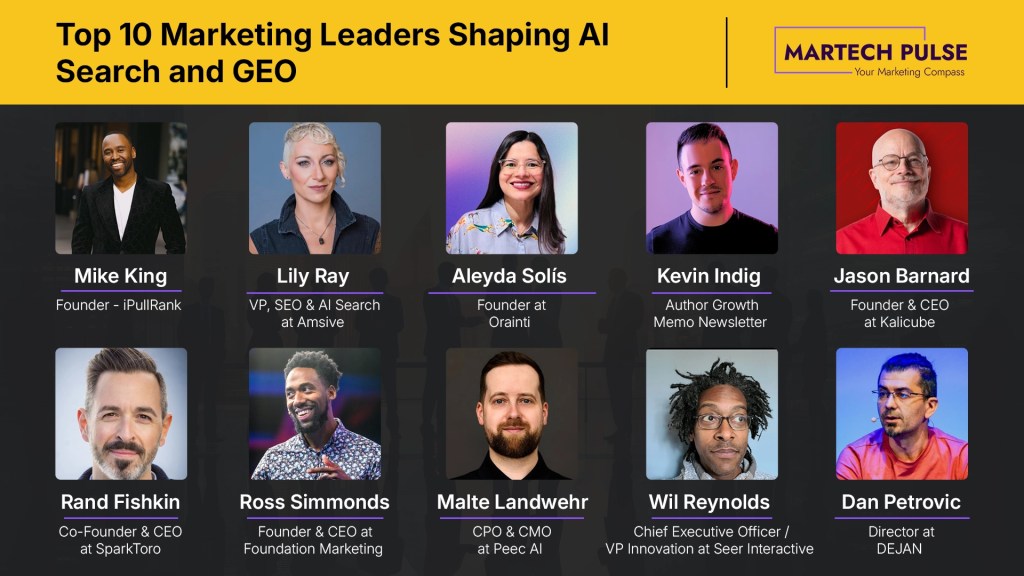
The top 10 marketing leaders in AI search and GEO
The order is loose, so please do not message me about who is number four.
1. Mike King
Mike King runs iPullRank and wrote The Science of SEO. If you follow only one person for the technical side of AI search optimization, it should be him.
He calls his approach “relevance engineering”, which I first took for a rebrand of SEO (we do love a rebrand), but it is more than that. The idea is that a model does not read your page the way a person does: it chops the page into chunks, turns them into vectors and grabs whichever chunk looks most like the question. So you write for the chunk, keeping each passage dense, clear and built around one idea.
The 2024 Google API leak is when he went from respected to required reading. He worked through thousands of leaked ranking attributes and explained them in plain language while everyone else was still posting screenshots.
One stat that supports his argument: 44.2% of ChatGPT citations come from the first 30% of a page (Kevin Indig and Gauge, 2026). Front load your pages, which, yes, I realise this intro has not done.
2. Lily Ray
Lily Ray is VP of SEO and AI Search at Amsive. USA Today named her the most influential SEO in 2022, and nothing since has changed that.
She is the person I trust when everyone else is panicking. When Google drops an update and traffic tanks, her write up is the first thing I open, and her E-E-A-T research (experience, expertise, authoritativeness, trust) is cited everywhere.
On GEO she is something of a wet blanket, and I mean that as a compliment. Plenty of people are selling “AI hacks” at the moment, and she keeps showing that AI citations mostly track ordinary organic strength: rank well and you get cited, rank badly and no trick will fix it. The data agrees with her. Pages ranked number one on Google are cited by ChatGPT 3.5 times more often than pages outside the top 20 (AirOps, 2026). So fix the site before you go chasing GEO marketing trends with a broken one.
3. Aleyda Solís
Orainti is her consultancy, but you probably know her from SEOFOMO, her newsletter, or LearningSEO.io, her free course, or its newer AI counterpart, LearningAIsearch.
Her gift is turning chaos into checklists. The AI search picture changes weekly, and she somehow reduces it to “do these eight things” without dumbing it down. She is also good at translating for executives, in terms like conversion rate, LLM share of voice and citation counts, which are the things a CFO will sign off on. She speaks at most conferences too, so her frameworks get copied quickly, which is fine because they are good.
If you take one thing from her, make it this: build the measurement before the strategy. You cannot improve what you are not tracking.
4. Kevin Indig
Kevin Indig writes Growth Memo, which has more than 22,000 readers, most of whom run marketing teams. He led growth at Shopify and at G2, so he thinks in revenue rather than rankings.
Two of his findings come up in my meetings constantly. The first is that when an AI names a top pick, that becomes the person’s top pick 74% of the time (Growth Memo, April 2026), which means the AI is effectively doing the choosing and the human is mostly nodding. The second, which bothered me more, is what he calls “ghost citations”: the AI links to your page but never says your brand name in the answer itself. 61.7% of LLM citations work this way (Growth Memo), so you are technically “cited” and nobody saw you. His fix is to put your brand name and your claim in the same sentence so the model cannot pull them apart.
5. Jason Barnard
Jason Barnard, The Brand SERP Guy, runs Kalicube. The fact that always gets a reaction is that he coined “Answer Engine Optimization” in 2018, before ChatGPT and before any of this, which is why many lists treat him as the original among AI search and GEO leaders.
His focus is entities rather than pages. You do not optimize a blog post; you optimize how Google and the AI models understand who you are, what you do and who you serve. He has packaged that into the Kalicube Process, which hundreds of brands apparently follow.
For years this sounded abstract, and then it turned out to be how the models work. They cross check you across many sources, and if your LinkedIn, your site and Crunchbase all say slightly different things, they simply do not trust you. Say the same thing everywhere: boring and correct, like most good advice.
Read More – From SEO to AI Visibility: The Next Evolution of Digital Discovery
6. Rand Fishkin
Rand Fishkin co-founded Moz and now runs SparkToro. He is also the person most likely to post a chart that quietly ruins someone else’s conference keynote.
For example, Google still handled 73.7% of US desktop searches in March 2026, against 3.2% for all AI tools combined(SparkToro), and 68.01% of Google searches end with no click at all (SparkToro, June 2026). Zero click was a Google problem long before it was an AI one.
My favourite of his AI search trends experiments: he asked ChatGPT and Google’s AI the same brand question 100 times and found less than a 1 in 100 chance of getting the same list twice (SparkToro, January 2026). So when a tool tells you that you are cited in 40% of answers, what does that actually mean? He asks that often, and nobody has a good reply.
His message is to zoom out. AI is growing fast but it is still a slice, so do not abandon the channels that still pay the bills.
7. Ross Simmonds
Ross Simmonds runs Foundation, a content distribution agency, and wrote Create Once, Distribute Forever. He was one of the first to take the academic GEO paper and turn it into something a content team could do on a Tuesday afternoon.
His view of generative AI in marketing is that everyone is obsessed with their own blog, and the models barely care about it. They read Reddit, YouTube, LinkedIn, review sites and news. If you only exist on your own domain, you are a whisper.
The data on this is fairly brutal. 84% of AI citations come from earned media rather than the brand’s own site (Muck Rack, May 2026), and brands are 6.5x more likely to be cited through third party sources than through their own (AirOps, October 2025). Publishing is step one; getting other people to say it is step two.
8. Malte Landwehr
Malte Landwehr is CPO and CMO at Peec AI, one of the fast growing AI visibility trackers, and was VP of SEO at Idealo, the large European price comparison site, before that. Peec went from about $500K to $5M ARR under him and raised more than $21M (Metehan.ai).
He is less flashy than the others and possibly more useful, because his contribution is method rather than hot takes. Treat AI visibility like a research panel: a fixed set of prompts, run again and again over weeks, measuring the change, and never read anything into a single answer. Given what Rand found about randomness, this is close to the only sane approach.
As a side note, the GEO monitoring tool market is apparently around $2.3B now, up 340% in a year (Superlines). Vendor market sizes deserve a pinch of salt, but the direction is clear. One answer is noise; fifty answers over a month is a signal.
9. Wil Reynolds
Wil Reynolds runs Seer Interactive in Philadelphia, a big data search firm. The 61% click drop from AI Overviews mentioned near the top is their study (Seer Interactive, November 2025), and it now gets quoted in roughly every boardroom conversation about AI search trends, usually by someone who looks worried.
Wil is a hype corrector by nature. He pulls enormous amounts of query data, looks at what people actually want, then applies that to AI search optimization. He is also refreshingly open about agencies needing a new business model once “we got you more traffic” stops being the pitch.
His advice is to track the business outcome rather than the vanity number. Fewer clicks that convert better is still a win, which is obvious, yet I still see decks reporting sessions as if it were 2015.
10. Dan Petrovic
Dan Petrovic runs DEJAN in Australia and is easily the most experimental person on this list, and it is not close.
He fine tunes his own models to study query fan-out, which is when an AI quietly runs several searches in the background to answer your one question. He has used mechanistic interpretability (looking inside the model) to map how brands are linked to topics, running more than 100,000 inference passes to do it (Metehan.ai).
You and I will never go that deep, and it does not matter. His work tells the rest of us what the machine is actually doing instead of what we assume it is doing. The practical lesson: the AI splits your question into smaller ones, so cover the smaller questions around your topic as well as the main one.
Read More – Is Answer Engine Optimization Killing Traditional SEO? A Practical Guide
What these AI search and GEO leaders agree on?
They argue constantly, and I mean daily, in public, with charts. But strip that back and nearly all of them say the same four things.
Fundamentals still win. ChatGPT cites 88.46% of the URLs it retrieves through web search (Ahrefs, 2026), so if you cannot be found, you cannot be cited.
Entities beat keywords. Jason and Mike come at this from opposite ends and meet in the middle: the model wants to understand what you are.
Third party mentions are the new backlinks. Ross, Kevin and Lily reach the same conclusion from the same data.
Measure carefully. Rand and Malte disagree on plenty, but both say AI answers are noisy, so look at patterns over time.
AI search trends these leaders are watching for 2027
These are the themes that keep showing up in their newsletters.
Agents, meaning AI that browses, compares and buys for you. Several of them warn that long forms, CAPTCHAs and heavy JavaScript can block an agent completely, so go and check yours.
Platform spread. ChatGPT still sends about 87.4% of AI referral traffic (Conductor, January 2026), but Google AI Mode passed 1 billion monthly users in June 2026, so that split could move quickly.
Budget. About 12% of SEO budgets now go to AI search optimization, and 43% of brands have a dedicated AI search person (Superlines). Both figures are climbing.
Trust. The share of people who say AI is more helpful than normal search dropped from 82% in 2025 to 54% in 2026(Fractl, July 2026), and 62% still check Google right after an AI recommends something (Yext, April 2026). People are using AI and Google together, in either order, rather than one instead of the other.
Read More – How to Build an AI-Driven SEO Framework from Scratch
How to use what the marketing leaders in AI search are teaching?
If you want to do something this month instead of bookmarking this, here is where I would start.
Pick 30 to 50 prompts your customers would actually type into ChatGPT or Perplexity and track them weekly. That is Malte’s idea.
Open your top 20 pages and move the real answer into the first third. That is Kevin’s data. Add real stats, named quotes and source links to the pages that matter. That comes from the original GEO paper and is still the most proven tactic there is, which is a little funny given how simple it is.
Check that your brand description matches across your site, LinkedIn, Crunchbase, Wikipedia if you have a page, and review sites. That is Jason’s rule.
Get mentioned somewhere you do not own: podcasts, guest posts, Reddit threads where you are actually helpful, roundups like this one. That is Ross’s rule.Keep doing normal SEO. Lily and Rand would both tell you that is still where the volume is.None of this is hard. It is just consistent work, and almost nobody is doing it yet.