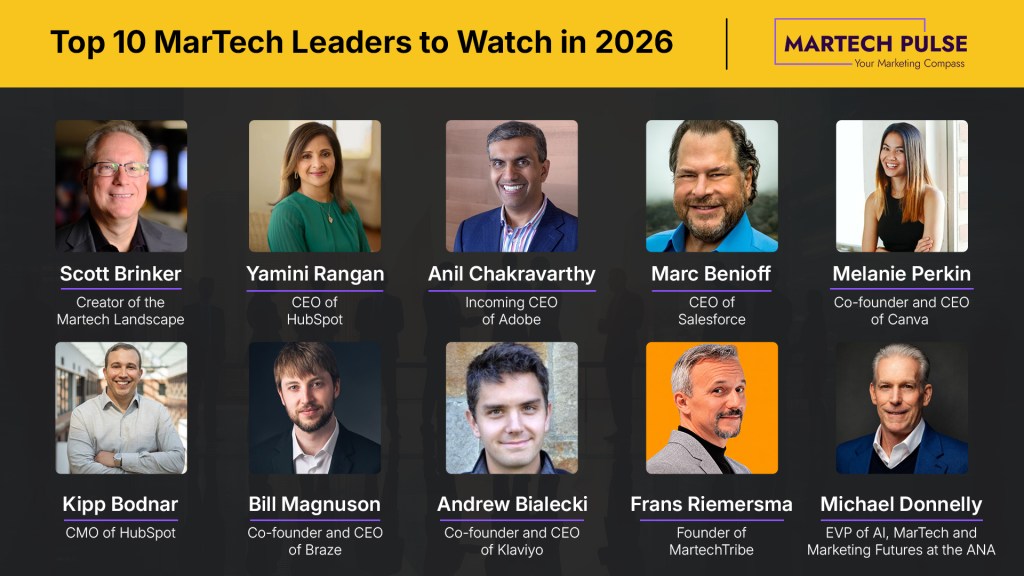
Top 10 MarTech Leaders to Watch in 2026
Stay updated with us
Sign up for our newsletter
I started researching MarTech leaders 2026 because I kept seeing the same few names everywhere. On LinkedIn, in podcasts, in earnings news. At some point I wanted to know who these people actually are and why everyone keeps quoting them. So I made a list.
Marketing is kind of weird right now. There are more tools than ever but the industry isn’t really growing the way it used to. The total number of martech products landed at 15,505 in 2026, which is only 0.79% more than the year before. Big companies are spending around 7.8% of revenue on marketing, which is barely different from last year. So nobody has extra money to throw around.
When things are tight like that, the people making good decisions get noticed a lot more. That’s basically what this list is.
Why Marketing Technology Leaders Matter So Much This Year?
My honest opinion is that 2026 is a confusing year to be a marketer. AI got added to pretty much every tool you can think of and now everyone has to figure out which parts actually help.
A Gartner survey found CMOs are putting 15.3% of their marketing budgets into AI. But only 30% of them say they’re ready to really scale it. That’s a lot of money going into something most teams aren’t ready for yet.
Money is a problem too. 56% of CMOs said they don’t have enough budget to pull off their plans for 2026. And the slice that goes to martech keeps getting smaller. It’s down to 19.4% of marketing budgets this year.
Then there’s data, which I didn’t expect to matter this much when I started reading about this stuff. In one report 56.3% of marketers said bad data quality was their biggest challenge. Also 73% of companies have an AI policy now but only 8% feel fully confident about how they manage AI. Kind of funny when you think about it. Everybody wrote rules and nobody’s sure they work.
So marketing technology leaders have a harder job than they used to. Selling software is the easy part. Helping companies change how they work is the hard part.
Read More – Building a Modern MarTech Stack: Tools, Strategy and Integration
How I Chose These MarTech Industry Leaders?
I didn’t want to just copy other lists, even though I did read a bunch of them. I looked for people whose decisions this year will probably affect what normal marketers do next year. Some run huge companies. A couple are researchers. One works at an industry association. To be one of the MarTech industry leaders here, I figured you needed real influence and not just a big following.
The order is my opinion, so you might disagree with it, and that’s fine.
The Top 10 MarTech Leaders 2026 List
1. Scott Brinker, Creator of the Martech Landscape
You’ve probably seen his work even if you don’t know his name. Scott Brinker makes that famous giant slide with thousands of tiny company logos on it. He started it in 2011 when there were about 150 tools. By 2025 it was up to 15,384 solutions, and 77% of the new ones added were AI-native.
He also came up with something called Martec’s Law. The idea is that technology moves really fast but companies are slow to change. I read that and immediately thought of every group project I’ve ever done.
His 2026 report compares the industry to a caterpillar turning into a butterfly. Right now we’re stuck in the cocoon part, where it’s messy and nothing looks finished. I think that’s a pretty accurate way to describe things. He’s number one because basically everybody else on this list reads his stuff.
2. Yamini Rangan, CEO of HubSpot
Yamini Rangan has been CEO of HubSpot since 2021 and the company has grown alot under her. Revenue went up 18.2% to $3.1 billion in 2025, and HubSpot reached almost 300,000 customers early this year.
The thing I find most interesting about her is the pricing. HubSpot started charging for some of its AI agents based on results. So if the agent actually solves a support ticket or finds a qualified lead, that’s when you pay. Most software doesn’t work like that. You usually pay whether it helps you or not.
It sounds like a small change, but I think it’s smart. Lots of small businesses are nervous about AI because they don’t want to waste money on something that doesn’t work. This makes it way less scary to try.
3. Anil Chakravarthy, Incoming CEO of Adobe
Adobe announced in September that Anil Chakravarthy will become president and CEO on December 1, 2026. Shantanu Narayen, who ran Adobe for a really long time, is moving to the executive chair.
Most people think of Photoshop when they hear Adobe. But Anil has been running the side of Adobe that marketers use, like GenStudio and Adobe Experience Platform. He also led the deals to buy Workfront and Semrush. That platform was already powering over one trillion customer experiences a year back in 2025, which is a number I can’t even really picture.
Picking him as CEO says a lot about where Adobe thinks the money is going. I’m curious what he changes in his first few months.
Read More – How CMOs Evaluate New Marketing Technology Investments
4. Marc Benioff, CEO of Salesforce
Marc Benioff has been around forever and he’s still one of the loudest voices in tech. You can’t really make a list of marketing technology executives without him.
His big focus right now is Agentforce, which is Salesforce’s AI agent platform. It’s closed around 29,000 deals and makes about $800 million in yearly recurring revenue. He likes to call it a digital labour platform.
But here’s what makes him interesting to watch. Even with those numbers, Salesforce stock dropped around 30% this year. Investors seem worried that AI agents could actually hurt the old way of selling software, where companies pay per user. So Benioff is kind of betting the company on this working. Whatever happens, everyone else in the industry will learn from it.
5. Melanie Perkins, Co-founder and CEO of Canva
Melanie Perkins started Canva after she noticed how hard design software was for normal people. She was tutoring students and saw them struggle with programs that were way too complicated. Her pitch got rejected by more than 100 investors, which is crazy now.
Canva ended 2025 with 265 million monthly users and eight straight years of being profitable. I use Canva for school projects, and I’m pretty sure most people my age do too. Now big companies use it for branding and marketing campaigns as well.
What I like about her is that she keeps things simple. A lot of martech is super powerful and also super confusing. She proved simple can win.
6. Kipp Bodnar, CMO of HubSpot
Kipp Bodnar is HubSpot’s chief marketing officer, so he’s on the actual marketing side and not just building software. He’s one of the most influential marketing leaders when it comes to strategy.
He and Kieran Flanagan created something called Loop Marketing. It has four stages (Express, Tailor, Amplify and Evolve) and it’s meant for a world where people get answers from AI instead of clicking on websites. When he introduced it, he said 60% of searches never leave Google. He’s also talked about click-through rates on AI search results falling somewhere around 60 to 70%.
Earlier this year he said he thinks 2026 will be the biggest year of change in marketing history. I thought that sounded a little dramatic at first. After reading about all of this for a while, I’m not so sure it is.
7. Bill Magnuson, Co-founder and CEO of Braze
Braze is the company behind a lot of those app notifications and emails you get from brands. Bill Magnuson started it in 2011, back when it was called Appboy, which is honestly a way funnier name.
Braze has been doing really well in 2026. In its fiscal first quarter it made $211 million, up 30% from the year before. That was also the fourth quarter in a row where growth sped up.
There was one example I thought was cool. A company called Cleo used Braze’s AI to redo their welcome emails and got 81% fewer unsubscribes. Magnuson keeps saying AI should work with a brand’s own customer data, and that example kind of proves his point.
8. Andrew Bialecki, Co-founder and CEO of Klaviyo
Klaviyo started out as an email tool for online stores. Now it’s way bigger. Andrew Bialecki has kept it growing even though it’s already a large company.
In the third quarter of 2026, Klaviyo brought in $387.2 million, up 25%, with more than 211,000 customers. Bialecki also said customers using their AI marketing agent saw open rates go up 50% and revenue per campaign go up 40%. Those are big jumps.
Something he did this year that surprised me was Klaviyo Headless. It lets other AI tools, like ChatGPT and Claude, pull data out of Klaviyo. Most companies try to keep you inside their platform. He went the other way, which is a bold move compared to other MarTech leaders 2026 has seen.
Read More – The Strategic Value of AI in Enterprise Marketing Operations
9. Frans Riemersma, Founder of MartechTribe
I almost didn’t know who Frans Riemersma was before writing this, which is kind of unfair because his name is on some of the most important reports in the industry. He writes the State of Martech reports with Scott Brinker. He also started MartechTribe and MartechMap.com.
His focus is on real companies and what tools they actually use. Not what vendors claim. That helps teams see if they’re overspending or using too many tools, which matters a lot when budgets are shrinking.
I think of Brinker as the big picture person and Riemersma as the person who double checks everything.
10. Michael Donnelly, EVP of AI, MarTech and Marketing Futures at the ANA
Michael Donnelly works at the Association of National Advertisers. He doesn’t sell a product. His job is helping big brands learn how to deal with AI and new tech through guides, training and groups where marketers share what’s working.
Honestly I think this kind of role is underrated. Gartner found that half of US consumers would rather buy from brands that don’t use generative AI in their customer messages. That surprised me. It means brands can actually lose people by using AI the wrong way. Someone like Donnelly helps companies figure out where that line is.
What These Marketing Technology Executives Have in Common?
After reading about all ten, I noticed they mostly talk about the same stuff, just in different ways.
Almost all the company leaders are building AI agents that do real tasks. HubSpot, Salesforce, Braze, Klaviyo, Adobe. Every single one. It’s not a side feature anymore for any of them.
They also keep bringing up data. Some call it first-party data and some call it context, but it’s the same idea. AI is only useful if it knows about your customers.
The other thing I noticed is that a few of them admit the old way doesn’t work anymore. Bodnar said it about inbound marketing. Brinker basically says the whole industry is mid-change. I respect that more than leaders who act like everything is fine.
Lessons From Influential Marketing Leaders You Can Actually Use
You don’t need to run a huge company to learn something from influential marketing leaders like these. A few things stood out to me.
If your team pays for tools nobody really uses, it’s probably time to cut them. Martech budgets are shrinking anyway so you might be forced to soon.
Clean up your data before buying some shiny new AI product. Pretty much every expert I read said the same thing about this, and when that many smart people agree it’s probably true.
Check if your brand shows up when you ask ChatGPT or Gemini about your industry. This is what people mean by AEO. A lot of companies haven’t even looked yet.
And be careful with AI-written content. Remember that half of consumers would prefer brands that don’t use it. Use it where it actually helps.
Read More – Why Martech Stack Complexity Is Hurting Marketing Teams
Final Thoughts
When I started this, I thought it would just be a list of famous CEOs. It ended up being more about how much marketing is changing and how different people are handling it. Some are betting huge on AI agents. Some are trying to keep things simple. Some are just trying to help everyone else keep up.
If you’re trying to stay ahead this year, following these MarTech leaders 2026 is a good place to start. Anil Chakravarthy is about to take over Adobe, Benioff’s Agentforce bet is still playing out, and Brinker’s next report will probably change how we talk about all of this again. Lots to watch.
FAQs About MarTech Leaders 2026
Who are the top marketing technology leaders in 2026?
Some of the biggest names are Scott Brinker, Yamini Rangan from HubSpot, Anil Chakravarthy from Adobe, Marc Benioff from Salesforce and Melanie Perkins from Canva. They either run platforms that millions of marketers use or create research the industry depends on.
What makes someone one of the MarTech industry leaders?
It’s mostly about impact. MarTech industry leaders usually run widely used tools, create new marketing frameworks or publish research companies rely on. This year, how they’re handling AI matters a lot too.
How are top marketing leaders in 2026 using AI?
Top marketing leaders in 2026 are using AI agents for things like customer support, finding leads, building campaigns and personalizing messages. Many are also focused on getting their brands to show up in AI answers from tools like ChatGPT.
Why should I follow influential marketing leaders and marketing technology executives?
Following influential marketing leaders and marketing technology executives helps you see trends early. What they launch and predict usually affects where budgets go and what skills marketers need next.