
Building a Modern Martech Stack: Tools, Strategy & Integration
Stay updated with us
Sign up for our newsletter
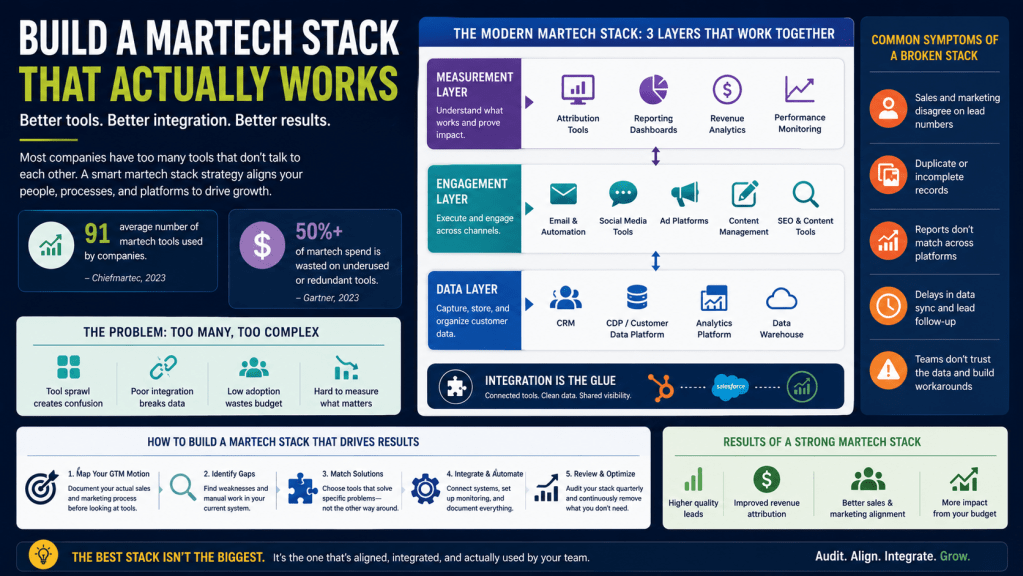
We got brought in by a SaaS company about eight months ago. Mid-sized, around 200 employees, solid product, decent marketing team. They had HubSpot on the marketing side and Salesforce on the sales side and the two had apparently never had a proper conversation with each other in the three years both tools had been running.
The marketing team was taking care of leads moving the leads through sequences marking the leads as qualified and passing the leads over to the sales team. The sales team was receiving the leads. Sometimes the sales team was getting the right leads and sometimes the sales team was getting leads that had already been called twice. Sometimes the leads had missing information that made the contact record much useless. The real problem was the marketing technology tools, specifically the fact that two important tools were not working together correctly and nobody had noticed for months.
This kind of situation is not unusual. A study found that companies use an average of 91 marketing technology tools and most companies say they are not getting the value from most of the tools. The marketing technology tools have become a expensive and underused thing at most companies and the answer is not to get more tools. The answer is to get the tools to work together better and to have a plan for what the company actually needs.
What a Modern Martech Stack Is Actually Made Of?
The term martech stack can mean things to different people. To be clear a marketing technology stack is all the software tools that a marketing team uses to plan, execute, measure and optimize their work. This includes everything from your CRM to your email platform to your analytics to your ad management to your content tools.
When we think about stack strategy we think about it in layers. At the bottom you have your data layer. This is where the tools that capture, store and organize customer information are. Your CRM is here. Your CDP if you have one and your analytics platform.
Above the data layer is your engagement layer. This is where the actual marketing happens. This includes email platforms, marketing automation, social tools, ad platforms, SEO tools and content management. These are the tools that your team uses every day and where most of the budget goes.
And above that sits your measurement layer. Attribution tools, reporting dashboards, revenue analytics, anything that helps you understand what’s working and make decisions. Most companies underinvest here relative to how much they spend on the engagement layer, which is why so many marketing teams struggle to prove impact.
A solid marketing technology stack strategy means being intentional about what you have at each layer, making sure the layers talk to each other, and reviewing the whole thing regularly instead of letting it grow unchecked.
The Martech Tools List Problem: Why More Is Usually Worse
Companies that have a lot of marketing tools are not usually the ones that are doing a job with their marketing. It is usually the way around.
The way that marketing technology stacks get too big is pretty easy to understand. A new person joins the marketing team. They want to use the tools they used at their job. A sales person from a company shows them a tool and they try it out then they add it to what they’re already using without getting rid of anything. Sometimes they need a tool for a project so they buy it. Then the project is over. After a while they have a lot of marketing tools that do things that are not fully integrated and are not used much. This costs them money and confusion.
We looked at the list of marketing technology tools that one of our clients was using. They had 23 marketing tools that they were paying for. The marketing team only used about eight of them regularly. Two of the marketing tools had not been used in over six months.
This is something that happens a lot. A research found that companies that sell to businesses waste significant of their marketing technology budget on marketing tools that are not used very much or are redundant. This research was done in 2023. Usually the best thing to do is to clean up the marketing tools they are already using before they add any marketing tools.
The best marketing technology stack is not the one, with a lot of marketing tools. It is the one that makes sense. It has marketing tools that work well together and the people who are supposed to use them actually do use them. The marketing technology stack should have marketing tools. They should be better integrated and actually used by the marketing team. The goal is to have a marketing technology stack that’s coherent and helps the marketing team do their job better.
Martech Stack Strategy: How to Actually Build One
When we work on martech stack strategy with a client the starting point is never “what tools do you need.” It’s “what do you actually need to be able to do, and what does your team actually have the capacity to run.”
That distinction matters because a lot of martech purchasing decisions happen in reverse. Someone sees a demo, gets excited about capability, buys the tool, and then discovers their team doesn’t have the bandwidth or the skills to use it properly. HubSpot is a good example of this. It’s a genuinely powerful platform with a huge range of capability. It’s also a platform that a huge number of companies use at about 20% of its potential because nobody has been trained properly and nobody owns the configuration.
The right sequence for building a martech stack strategy is:
Start with your go-to-market motion. What does your actual sales and marketing process look like? Where do leads come from? How do they move through the funnel? What does the handoff between marketing and sales look like? What do you need to measure? Map that out before you look at a single tool.
Then find the weaknesses in your marketing tech plan. Where does your current marketing tech plan system fall apart? Where are things done manually in your marketing tech plan that could be automated? Then match solutions to weaknesses in your marketing tech plan, not the way around. We need our lead scoring in HubSpot to pass specific details to Salesforce at the point of hand over so sales has information before they make the first call in our marketing tech plan.” That specificity makes tool evaluation much easier for your marketing tech plan.
Marketing Technology Stack Integration: Where Everything Usually Breaks
Integration failures can happen in a ways. For example you get records because the same contact is being created in two separate systems at the same time. Or you have missing data because some fields are not mapped correctly. Then there are sync delays because the trigger conditions are not set up right.. You also have reporting discrepancies because each tool is counting things in a slightly different way. None of these problems are really bad on their own. When they all happen together they make people lose trust in the data. When that happens people stop using the data. That means the money spent on both systems is basically wasted.
A study by Salesforce found that the best marketing teams are 1.5 times more likely to have their marketing and sales technology fully integrated than teams that do not do well. This is according to the Salesforce State of Marketing report from 2023. The good teams are not better because they have tools. They are better because they make their tools work together.
Here is a simple checklist to follow for any integration:
* Define what data needs to be moved between which systems and, in which direction
* Set up monitoring so you know when the sync breaks, than finding out months later
* Document the configuration so that when the person who set it up leaves someone else can take care of it
* Review the integration every quarter because both systems update regularly and integrations that worked fine six months ago can sometimes break without anyone noticing. This way you can make sure your integration is always working the way it should.
A Salesforce study found that high-performing marketing teams are 1.5 times more likely to have fully integrated their marketing and sales technology than underperformers. That gap exists not because the good teams have better tools. It’s because they actually made their tools work together.
The practical checklist for any integration: define what data needs to move between which systems and in which direction. Set up monitoring so you know when the sync breaks rather than finding out months later. Document the configuration so that when the person who set it up leaves, someone else can maintain it. Review it quarterly because both platforms update regularly and integrations that worked six months ago sometimes break silently.
Martech Stack Strategy for Different Company Stages
One thing that’s worth saying clearly: the right martech stack for a 20-person startup is not the right martech stack for a 500-person company and the right martech stack for a product-led growth SaaS is not the right one for an enterprise sales motion.
Early stage, you need very little. A CRM, an email tool, a basic analytics setup. The instinct to buy more tools earlier than you need them is almost always wrong because you don’t yet have enough volume or process clarity to get value from complexity. HubSpot’s free tier handles more than most early stage companies actually need.
Growth stage is where martech purchasing tends to accelerate and where the most mistakes happen. Revenue is coming in, there’s budget, things are moving fast, and the tendency is to buy tools to solve problems that are actually process problems in disguise. Before adding to the stack at this stage, audit what you have.
Enterprise is where the integration problem becomes most acute because the number of tools is highest, the number of teams touching those tools is highest, and the consequences of data inconsistency are most expensive. The priority at this stage is governance: who owns each tool, who is responsible for integration health, how are new tools evaluated and added, how are old tools removed.
The Martech Tools List Audit: What We Actually Check
When we do a stack audit for a new client the process is pretty much the same every time. We start by making a list of every tool that the client is currently paying for even if they do not remember signing up for it. Then we figure out which teams use each tool and how often they use it. After that we look at where the tools do the things. Then we check how each tool connects to the tools and if those connections are working right.
The end result is usually a list of tools that the client should be using a list of connections between tools that need to be fixed or set up and a document that says who is in charge of what from now on.
For one client that uses SaaS, the list of tools meant going from 23 tools to 14. We did not get rid of the tools because they were bad but because the team did not have the time to use 23 tools correctly and using so many tools was causing more problems than it was solving. It took six weeks to fix the connections between tools. We rebuilt the connection between HubSpot and Salesforce from the beginning with the settings and monitoring. Within three months the arguments between the sales team and the marketing team about the quality of leads had almost stopped, because both teams were looking at the data.
That is what a good martech stack strategy actually does. It does not just give the client tools on paper. It makes the tools the client is using more useful in life. The martech stack strategy makes the tools more useful, for the client. The client gets more out of the tools they are using.
Frequently Asked Questions
What should a modern martech stack include as a minimum?
At minimum a CRM for managing contacts and pipeline, a marketing automation or email platform for nurture and outreach, an analytics tool for tracking website and campaign performance, and some form of integration layer connecting them. Everything else depends on your specific go-to-market motion. The mistake most companies make is building beyond this minimum before they’ve made the minimum work properly.
How do you fix a marketing technology stack that’s become too bloated?
Start with a full audit of what you have, who uses it, and how often. Identify overlapping tools and consolidate where possible. Then map your integrations and find out which ones are actually working versus which ones are theoretically connected but practically unreliable. Fix the integration problems before adding anything new. In our experience most companies don’t need more tools. They need their existing tools to work together.
What’s the most common martech stack strategy mistake?
Buying tools before defining process. A tool is only as useful as the process it supports. If you don’t have a clear defined lead handoff process, buying a better CRM won’t fix your lead handoff problem. It’ll just give you a more expensive place to lose leads. Map your process first, identify the specific gaps, then find tools that address those gaps.
How do you know when your martech stack integration is broken?
Usually by the symptoms rather than the break itself. Sales and marketing disagreeing about lead numbers. Duplicate contacts in your CRM. Reports that don’t match between platforms. Data fields that should be populated but aren’t. If your teams have stopped trusting the data and started maintaining their own spreadsheets, that’s the clearest sign that your integration has failed and people have found workarounds instead of fixing the actual problem.