TOFU, MOFU, BOFU: How to Map Content to Every Stage of the B2B Funnel
Stay updated with us
Sign up for our newsletter
The very first time I heard someone say “TOFU, MOFU, BOFU” in a marketing meeting I genuinely thought they were talking about food.
Like who puts TOFU in a work presentation?
But no, it is actually one of the most useful frameworks in all of B2B marketing and once you get it, you kind of start seeing it everywhere.
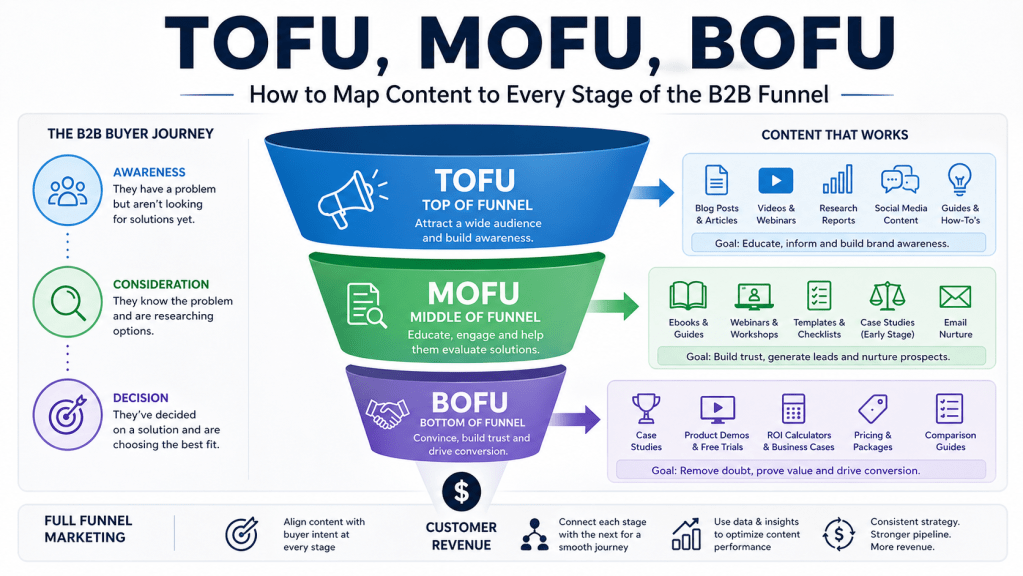
TOFU, MOFU, BOFU stands for Top of Funnel, Middle of Funnel, and Bottom of Funnel. It is a way of describing where someone is in their buying journey and what kind of content they actually need at that point. And this matters a lot because the content that works really well for someone who just discovered they have a problem is completely different from the content that works for someone who is about to pull out their credit card.
Most B2B marketing teams create content without really thinking about which stage it is for. They just make blogs and ebooks and hope something converts. But when you actually map your content to the right marketing funnel stages, everything gets smarter. The right people see the right stuff at the right time, and your whole pipeline starts moving a lot more smoothly.
This blog is going to break down TOFU, MOFU, BOFU properly, explain what content works at each stage, and show you how to build a B2B funnel strategy that actually connects awareness to revenue.
What TOFU, MOFU, BOFU Actually Means and Why It Matters
Right so before we get into the content specifics, let us make sure the framework actually makes sense.
Think of a funnel shape. Wide at the top, narrow at the bottom. At the very top you have loads and loads of people who might eventually be interested in what you sell but right now they do not even know your company exists. These are your TOFU people, the top of the funnel crowd.
In the middle of the funnel you have people who know they have a problem and are now actively looking at different ways to solve it. They are comparing options, doing research, probably reading a lot of content. These are your MOFU people and they are starting to get serious.
At the very bottom of the funnel you have the people who have basically already decided they want to buy something. They are just figuring out which specific company or product to go with. These are your BOFU people and they are the closest to becoming actual customers.
The reason this matters so much for your B2B funnel strategy is that each group needs completely different things from you. If you give TOFU content to a BOFU person, they get bored and leave. If you give BOFU content to a TOFU person, you come across as pushy and they run away. Getting the content funnel mapping right is what stops both of those things from happening.
Marketing Funnel Stages: What Is Actually Happening at Each One
The Top of Funnel: Awareness and Education
TOFU is the widest and busiest part of the funnel. This is where most of your potential audience lives. They might be experiencing a problem that your product solves, but they have not started seriously looking for solutions yet.
Your job at the TOFU stage is not to sell but to be genuinely helpful and to make your brand look like the smartest, most trustworthy source of information in your space. You want people to find your content, get real value from it, and walk away thinking “okay these guys actually know what they are talking about.”
The marketing funnel stages do not all move at the same speed either. TOFU is the slowest because you are planting seeds and you cannot rush that. Someone might read your blog today and not become a customer for another eight months. That is completely normal.
The key is that without TOFU, your middle and bottom of the funnel dry up eventually because there is nobody new coming in.
The Middle of Funnel: Consideration and Evaluation
MOFU is where things start getting more interesting. These people have acknowledged they have a problem and they are now actively trying to understand their options. This is the stage where your B2B funnel strategy needs to shift from pure education to a mix of education and demonstration. You are still teaching people things but now you are also showing them how your way of doing things works and why it makes sense.
MOFU is also where lead capture usually happens. Someone downloads a detailed guide, signs up for a webinar, or fills out a form to get a template. They are engaged enough to give you their contact information in exchange for something valuable. This is a big deal because it means you can now follow up with them through email or remarketing ads.
The middle of the funnel stage is probably the most underinvested part of most B2B marketing programs. Teams spend loads on TOFU blog content and loads on BOFU sales materials but the middle bit gets ignored. That is a problem because it means people fall out of the funnel between awareness and decision, which wastes all the TOFU work you did to get them there in the first place.
The Bottom of Funnel: Decision and Conversion
BOFU is where the magic happens in terms of revenue but it is also the smallest audience. By the time someone is at the bottom of the funnel, they have done most of their research, they know roughly what they want, and they are choosing between a shortlist of options that probably includes you and two or three of your competitors.
Your job at the BOFU stage is to remove every possible reason someone might have to not choose you. Doubt, confusion, concern about price, worry about implementation, fear of making the wrong choice. All of those things need to be addressed directly.
This is also the stage where sales and marketing need to work really closely together. A lot of BOFU content gets used by sales reps in their conversations with prospects. Case studies get sent in emails. Pricing pages get visited right before a demo call. ROI calculators get shared in proposals. The content funnel mapping at the bottom of the funnel is as much about enabling your sales team as it is about directly converting prospects.
Read More – Aligning Sales and Marketing for Scalable B2B Lead Generation Success
Content Funnel Mapping: What Content to Create for Each Stage
Here is what content actually works at each stage of the TOFU MOFU BOFU framework.
TOFU Content: Cast Wide, Give Value, Build Trust
At the top of the funnel your content needs to attract a big audience and give them something genuinely useful without asking for much in return. This is not the place for gated content or aggressive calls to action.
Blog posts and articles are the backbone of most TOFU strategies. Specifically the kind that answer questions people are actually searching for on Google.Social content works really well for TOFU too, especially on LinkedIn for B2B companies. Podcast episodes, YouTube videos, and original research reports are also strong TOFU plays. They take more effort to produce but they build a lot of credibility and they tend to reach people in more depth than a quick blog post.
The thing all good TOFU content has in common is that it teaches something real. It is not thinly veiled advertising. It is actually useful information that someone would want to read or watch even if they were never going to buy from you.
MOFU Content: Go Deeper, Show the Way, Capture Leads
Middle of funnel content is where you go beyond surface-level education as the users are not beginners anymore. They know what the problem is. Now they need help understanding what the right approach looks like.
Detailed guides and playbooks work really well here because they go deep on a specific topic that is relevant to your buyer’s problem. An ebook titled “The Complete Guide to Building a B2B Revenue Operations Function” is perfect MOFU content for a RevOps software company.
Webinars are one of the best MOFU formats in B2B. They create a live environment where people can ask questions, they position your team as real experts rather than just a brand, and they give you a natural next step to follow up with attendees afterwards.
Email nurture and comparison content sequences are how you deliver MOFU content to people who have already raised their hand. Once someone downloads something or registers for a webinar, the nurture sequence keeps them engaged with relevant content until they are ready for a more direct conversation.
BOFU Content: Remove Doubt, Prove Value, Close
Bottom of funnel content is where you get specific and direct. These people want to know if your specific product can solve their specific problem, how much it costs, how long it takes to implement, and whether other companies like theirs have had success with it.
Case studies are probably the most powerful BOFU asset you can have. A well-written case study that features a company similar to the prospect, describes a problem similar to theirs, and shows a clear before-and-after result is incredibly persuasive. It does the “social proof” thing that humans are naturally wired to respond to. If it works for them, it can work for me.
Product demos and free trials let people experience the thing themselves rather than just reading about it. For a lot of B2B buyers, a demo is the thing that tips them from interested to ready to buy. Or it is the thing that convinces them your product is not quite right, which is also fine because it is better to find that out before the sale than after.
ROI calculators and business case templates help BOFU prospects justify the purchase internally. Remember in B2B there are usually multiple decision makers. Pricing pages, comparison sheets against specific competitors, and detailed implementation guides all live in the BOFU world too. They answer the final practical questions that stand between interest and a signed contract.
Full Funnel Marketing: Making All Three Stages Work Together
Here is the thing about TOFU MOFU BOFU that a lot of teams miss. The three stages only really work when they are properly connected. A great TOFU content strategy that dumps people into a broken MOFU experience is a waste. Amazing BOFU assets mean nothing if there is no pipeline flowing into them.
Full funnel marketing is the idea that you think about all three stages as one connected system rather than three separate projects. The content you create at the top should naturally lead people toward the middle. The middle stage content should qualify people and move them toward the bottom. And the bottom stage content should connect smoothly to your sales process.
One of the most practical ways to implement full funnel marketing is to audit what you have. Go through all your existing content and categorise it by stage. Most teams find they have loads of TOFU blog content, almost no MOFU content, and a handful of BOFU assets. That tells you exactly where to focus your content creation efforts next.
Another important part of full funnel marketing is making sure your paid distribution strategy matches the stages too. Retargeting campaigns are a great example. If someone visits a TOFU blog post, you retarget them with a MOFU piece of content. If they downloaded the MOFU guide, you retarget them with a BOFU case study or a demo offer. This keeps people moving through the funnel in a natural and non-pushy way.
Getting your marketing and sales team aligned on the handoff between MOFU and BOFU is also really important. At some point a prospect moves from being someone marketing is nurturing to being someone sales should be talking to directly. That transition needs to be smooth and it needs to happen at the right moment, not too early and not too late.
Common Mistakes in B2B Funnel Strategy
The biggest mistake in B2B funnel strategy is treating the funnel like it is perfectly linear. In real life people jump around. Someone might read a BOFU case study before they ever read a TOFU blog post. Someone might attend a MOFU webinar and then go cold for three months before coming back ready to buy. The funnel is more of a rough map than a strict sequence, and your content strategy needs to be flexible enough to serve people wherever they show up.
Another common mistake is making TOFU content that is secretly BOFU content in disguise. If your “educational” blog post is really just a long advertisement for your product, people can tell and they bounce. Trust takes a long time to build and it disappears very quickly the moment someone feels like they are being sold to when they just came to learn something.
The third mistake is not having enough content variety at each stage. One blog post is not a TOFU strategy. Three case studies are not a BOFU strategy. You need enough content at each stage that different types of buyers can find something that resonates with them, because different people in the same buying committee might need different formats and different angles to get comfortable.
FAQ: TOFU, MOFU, BOFU and Content Funnel Mapping
What is the difference between TOFU, MOFU, BOFU content and how do the marketing funnel stages connect?
TOFU content is for people who are just becoming aware of a problem and is focused on education with no sales pressure. MOFU content is for people actively evaluating solutions and helps them understand the right approach while building a relationship with your brand. BOFU content is for people ready to make a purchase decision and focuses on proving your product is the right choice.
How do you build a B2B funnel strategy around TOFU MOFU BOFU when your buying committee has multiple decision makers?
Different people in the buying committee are often at different funnel stages at the same time. The technical evaluator might be deep in MOFU research while the CFO is still at TOFU awareness level. A good B2B funnel strategy creates content for each type of stakeholder at each stage. So instead of one BOFU case study, you have a technical case study, a financial ROI breakdown, and an executive summary that each speaks to a different person in the room.
What does content funnel mapping actually look like in practice?
Content funnel mapping is the process of taking all your existing and planned content and organising it by which funnel stage it serves and which buyer persona it speaks to. In practice it usually starts with a spreadsheet where you list every piece of content, tag it as TOFU, MOFU, or BOFU, note the persona it is for, and then identify the gaps.
How does full funnel marketing change your paid media strategy?
Full funnel marketing means your paid media cannot just be bottom-of-funnel conversion campaigns. You need paid distribution at every stage. At TOFU you use paid social and content amplification to get your educational content in front of new audiences. At MOFU you use retargeting to serve deeper content to people who have already engaged with you. At BOFU you use highly targeted ads with specific product and case study messaging aimed at people who are clearly in decision mode. Each layer of paid media supports and feeds the next.