
Account Based Marketing: Strategy, Execution and ROI for B2B Teams
Stay updated with us
Sign up for our newsletter
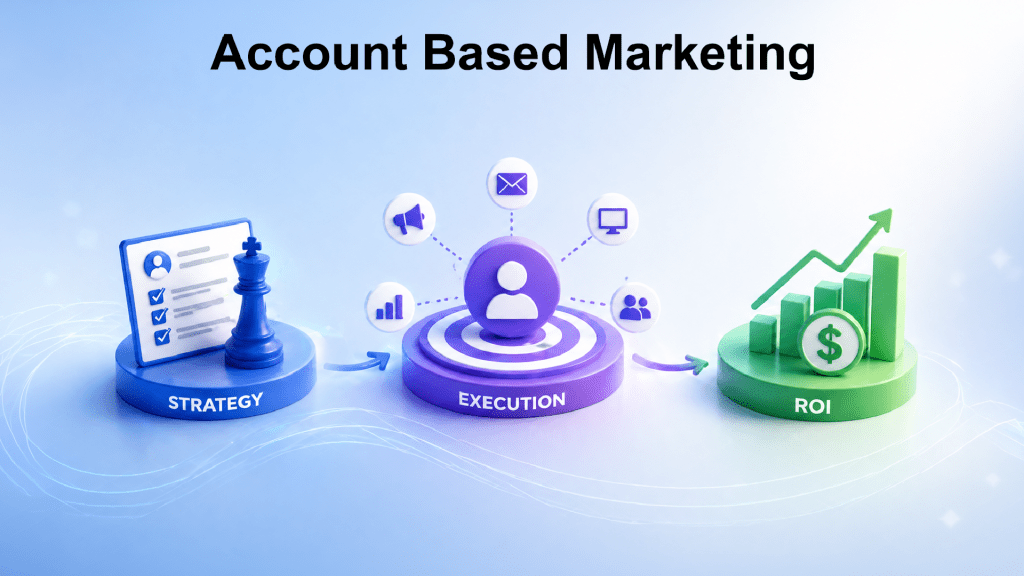
Account based marketing is one of the smartest moves a B2B team can make right now. Instead of throwing your budget at thousands of random leads and hoping some of them stick, account based marketing flips the whole thing around. You pick the exact companies you want as customers first, and then you build your entire marketing and sales effort around just those companies. That is it. It sounds simple but most B2B teams still are not doing it properly. This blog breaks down everything you need to know about account based marketing, from building the strategy to running real campaigns to measuring your return.
What Account Based Marketing Actually Means for B2B Teams
Account based marketing is a focused approach where your marketing and sales teams agree on a list of high value target companies and work together to win those specific accounts. Instead of generating a huge pile of leads and sorting through them, you start with the answer. These are the companies we want. Now let us go get them.
This works really well in B2B because the sales cycles are long, the deal sizes are big, and the number of people involved in a buying decision is large. You are not trying to convince one person to tap buy now. You are trying to get five or six people at a company to all agree that your product is the right choice. Account based marketing is built for exactly that kind of situation.
The reason so many B2B companies are switching to account based marketing is that it stops the waste. When you know exactly who you are targeting, every piece of content, every ad, every email, and every sales call has a purpose. Nothing is random. Everything is pointed at the accounts that actually matter.
Read More – Lifecycle Marketing Strategies Powered by CRM Automation
Building a Solid ABM Strategy Before You Do Anything Else
A good ABM strategy starts with your ideal customer profile. You look at your current best customers, the ones who pay the most, stay the longest, and get the most value from what you sell, and you figure out what they all have in common. What industry are they in. How big are they. What problems do they usually have. What tools are they already using. The more specific you get, the better your ABM strategy will work.
Once you have your ideal customer profile locked in, you build your target account list. This is just a list of real companies that match the profile. Most teams start with 50 to 200 accounts depending on how big their sales team is. You can use tools like LinkedIn Sales Navigator or ZoomInfo to find companies that fit, or you can do it manually if you are just getting started.
The next part of your ABM strategy is deciding how to tier your accounts. Tier one accounts are your absolute dream customers. You spend the most time, money, and personalization on these. Tier two accounts are strong fits that get industry level personalization. Tier three accounts are possible fits that get more automated outreach while you figure out if they belong higher up the list. This tiering system makes sure you are spending your best energy on the accounts with the highest potential.
Your ABM strategy also needs to answer who the key people are inside each target account. In B2B you are usually trying to reach a buying committee, not just one person. You might need to influence the VP of Marketing, the IT director, and the CFO all at the same time. Knowing who those people are before you start is what separates a real ABM strategy from just sending cold emails.
How to Run B2B ABM Campaigns That Actually Get Attention
Once your strategy is in place, you need to actually run B2B ABM campaigns that reach your target accounts. The best b2b ABM campaigns use a mix of channels so that key people at your target accounts are seeing your message in multiple places at the same time.
LinkedIn is one of the most powerful channels for B2B ABM campaigns because you can upload your target account list and LinkedIn will only show your ads to people who work at those exact companies. You are not wasting money on random clicks. Every impression is going to someone who actually works at a company you want to sell to.
Email personalization is another big part of running strong B2B ABM campaigns. Instead of sending a generic newsletter to thousands of people, you write emails that speak directly to the situation of each target account. You might mention a challenge specific to their industry, reference something their company recently announced, or share a piece of content that is relevant to what they are working on. That level of specificity gets responses in a way that mass emails never will.
Direct mail is also making a big comeback in B2B ABM campaigns. Sending a physical package to a senior decision maker at a target account cuts through all the digital noise. Some companies send a relevant book, a creative kit, or even a simple handwritten note. When every other vendor is hitting people with emails and ads, something physical stands out and gets remembered.
Account Based Marketing Examples That Show What Good Looks Like
Looking at real account based marketing examples is one of the fastest ways to understand how to run your own program. One of the most popular account based marketing examples is the personalized landing page strategy. Companies use tools that detect which company a website visitor is coming from and then show them a version of the site that speaks directly to their industry or company situation. When someone from a manufacturing company lands on your website and sees content about manufacturing challenges, it feels like you built the site just for them. That kind of relevance drives action.
Another one of the most effective account based marketing examples is the executive dinner strategy. You invite 10 to 15 senior leaders from your top target accounts to an exclusive dinner or small event. There is no pitch at the dinner. The whole point is to build real relationships and have honest conversations about challenges in the industry. Then your sales team follows up in the weeks after with personalized outreach that references what was discussed. Companies that run this kind of program regularly report deal sizes 3 to 4 times larger than their typical inbound deals.
A third account based marketing example that works really well for smaller teams is the benchmark report strategy. You create a short data-driven report that shows how companies in a specific industry are performing on metrics your product helps improve. You promote that report only to people at your target accounts. When they read something that feels specifically relevant to their world and their competitors, they pay attention and they start associating your brand with being genuinely helpful.
Measuring ABM ROI the Right Way
Measuring ABM ROI is different from measuring regular marketing performance. In regular marketing you count leads, clicks, and downloads. In account based marketing you measure at the account level. The question is not how many leads did we get. The question is how many of our target accounts are engaging, moving through the pipeline, and becoming customers.
The main metrics for ABM ROI are account engagement rate, pipeline value from target accounts, win rate on target accounts versus non-target accounts, and average deal size from target accounts. When your abm strategy is working, all of these numbers should be noticeably better than your regular marketing numbers. Most companies that run ABM properly see their win rate on target accounts jump by 20 to 40 percent and their average deal size go up significantly.
One important thing to understand about ABM ROIis that it takes time to show up. B2B sales cycles are long. You might be running great campaigns for three or four months before you start seeing closed deals from your target accounts. But the pipeline you are building during that time is very real and very valuable. Most teams start seeing meaningful ABM ROI data after about six months of running the program consistently.
To track ABM ROI properly, make sure your CRM has a way to tag accounts as ABM targets from the very beginning. Then you can run reports that compare how those accounts perform versus regular inbound leads. Over time this data will clearly show whether your account based marketing program is delivering better returns than your old approach, and in most cases it will.
Frequently Asked Questions
Q: What is account based marketing and how is it different from regular B2B marketing?
A: Account based marketing is a focused strategy where you pick specific companies you want as customers and direct all your marketing and sales effort at just those companies. Regular B2B marketing tries to reach as many people as possible and then filters them. Account based marketing starts with a small list of ideal accounts and builds everything around them from day one.
Q: How do I build an ABM strategy if I am just starting out?
A: Start by defining your ideal customer profile based on your current best customers. Then build a target account list of 50 to 100 companies that match that profile. Tier them by priority, identify the key decision makers at each account, and then build your content and outreach around those specific people and companies. That is the foundation of a solid abm strategy.
Q: How long does it take to see ABM ROI?
A: Most teams start seeing meaningful abm roi after 3 to 6 months of running the program consistently. B2B sales cycles are slow so you need to give it time. Track account engagement and pipeline creation in the early months as leading indicators that your strategy is working even before deals start closing.
Q: What are the best account based marketing examples for a small team with a limited budget?
A: Small teams can start with personalized LinkedIn ads targeting a company list, customized email sequences that reference each account’s specific situation, and content like benchmark reports built around target industries. These account based marketing examples do not require a huge budget and can still produce strong results when executed consistently.