Tactics That Improve Conversion Rate Optimization at Scale
Stay updated with us
Sign up for our newsletter
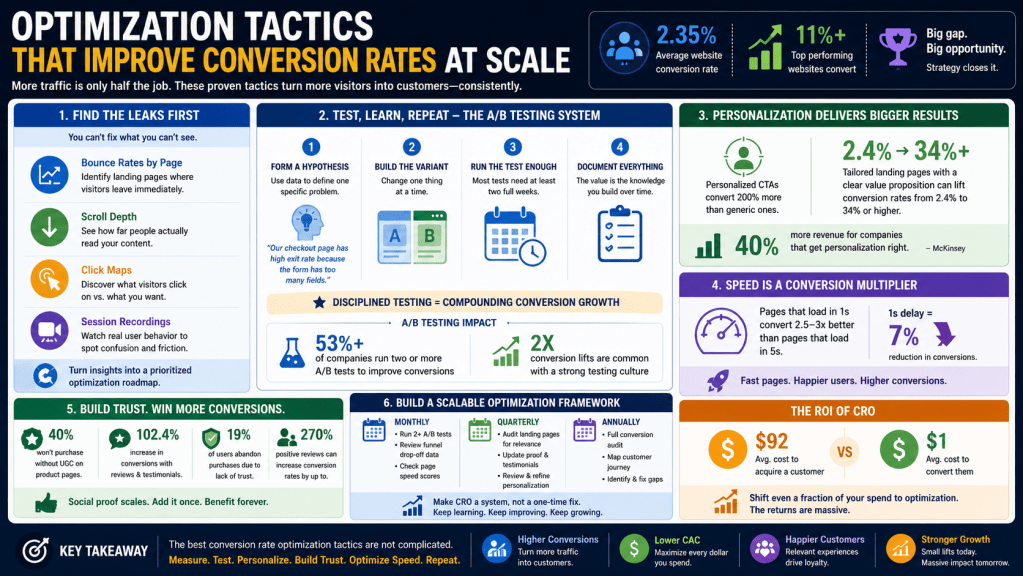
Most marketers spend a lot of money on ads to get traffic to their website. Getting traffic is only half the job. The other half is making sure that traffic actually does something when it lands on your website. This is what conversion rate optimization is about. It is the process of figuring out why people are leaving your website without converting and then fixing it step by step at scale. The average website conversion rate across industries sits at just 2.35%, but the top performing websites are converting at 11% or higher. That gap is not luck, it is a strategy. If you want tactics that actually move the needle across hundreds of pages and thousands of visitors this is for you.
Why Most Businesses Are Still Getting Conversion Rate Optimization Tactics Wrong?
Before getting into what works it is worth understanding why many businesses are still stuck at mediocre conversion numbers. More than 53% businesses spend less than 5% of their total budget on conversion rate optimization. That is an imbalance. Companies are spending a lot of money getting people to their website but doing nothing to make those people stay and convert. The other big mistake is treating CRO tactics like a one-time project. You run one test, change a button and call it done. But real conversion rate optimization is not a project, it is a system. It runs continuously and learns from data. It gets better over time. Businesses spend an average of $92 to acquire a customer but just $1 to convert them. Flip even a fraction of that spend toward optimization and the returns are massive.
Website Conversion Optimization Starts With Understanding Where People Drop Off
You cannot fix what you cannot see. The first step in website conversion optimization is mapping out your funnel and identifying exactly where visitors are leaving. This means looking at:
Bounce rates by page to see which landing pages are failing immediately. If someone lands and leaves in under 10 seconds, the page is not matching their intent.
Scroll depth to understand how far people are actually reading. If 70% of your visitors never scroll past the hero section, your above-the-fold messaging needs serious work.
Click maps and session recordings to see what people are clicking on versus what you want them to click on. Sometimes visitors are clicking on non-clickable elements repeatedly, which means they expect something to be there that is not.
Once you know where the drop-offs are happening, you have a prioritized list of problems to solve. That list is your optimization roadmap. Without it, you are just guessing.
Scalable Optimization Through Systematic A/B Testing
The reliable CRO tactic at scale is A/B testing but it has to be done with discipline. A lot of companies conduct two or more A/B tests to improve conversion rates. The ones doing it well are not just testing things. They are testing based on hypotheses backed by user data. Here is how scalable optimization through A/B testing actually works:
Step 1: Form a hypothesis
Based on your funnel data, pick one problem. For example “Our checkout page has an exit rate because the form has too many fields.”
Step 2: Build the variant
Change one thing at a time. If you change three things at once you will never know which one caused the improvement.
Step 3: Run the test enough
A lot of teams kill tests early because they see early results and get excited. Statistical significance matters. Most tests need at least two full weeks to account for weekly traffic patterns.
Step 4: Document everything
The real value of A/B testing is not the winning variant. It is the knowledge you build over time about what your audience responds to. This kind of testing is what separates teams that see small lifts from teams that double their conversion rate optimization over a year.
Personalization Is One of the Highest-Impact Conversion Improvement Strategies
Generic pages convert generically. That is just how it works. One of the biggest conversion improvement strategies for scaling CRO is personalization, and the data on this is really hard to ignore. Personalized calls to action convert 200% more than generic ones and tailored landing pages with clear value proposition can lift conversion rates from 2.4% to 34% or higher. What does personalization at scale actually look like? It is not about writing a page for every single visitor. It is about using segmentation to show different content to different audience segments. For example a company might show a homepage headline to visitors coming from a paid ad versus visitors coming from organic search. A study by McKinsey found that companies that get personalization right can drive 40% more revenue than their competitors. That is not a gain but an advantage.
Page Speed Is a Non-Negotiable Part of Conversion Rate Optimization
This one still gets overlooked even in 2026. Page speed is not just an SEO factor. It is a direct conversion rate optimization factor. Pages that load in one convert two and a half to three times better than pages that load in 5 seconds. The flip side: a one-second delay in page load time results in a 7% reduction in conversions. For a website doing ten thousand conversions a one-second slowdown costs you 700 conversions a month every month. That is how expensive slow pages are.
Website conversion optimization for page speed means running audits, compressing images, removing unnecessary scripts and using a content delivery network. These tasks have a measurable impact on your conversion numbers.
Building a Scalable Optimization Framework for the Long Term
The real magic of conversion rate optimization at scale is in building a framework that runs all of them continuously. A basic scalable optimization framework looks like this:
Monthly: Run at least two A/B tests on your highest-traffic pages. Review funnel drop-off data. Check page speed scores.
Quarterly: Audit your landing pages for messaging relevance. Update proof with fresh testimonials. Review personalization. Update them based on new audience data.
Annually: Do a conversion audit across the entire site. Map the customer journey from touch to conversion and identify gaps.
This kind of rhythm keeps your conversion improvement strategies from going stale. The brands that treat conversion rate optimization like a living system rather than a one-time fix are the ones that consistently outperform their benchmarks.
Social Proof and Trust Signals as Conversion Rate Optimization Tactics That Scale
One of the underrated CRO tactics is just making your website feel more trustworthy. Visitors who do not trust you will not convert, no matter how good your copy is. 40% of shoppers say that they won’t purchase if there isn’t UGC on the product page. User-generated content like reviews and testimonials can increase conversions by 102.4% and 19% of users abandon purchases because of a lack of trust. The good news is that trust signals scale well. Once you add them they work for every visitor without any effort. Things like customer reviews and star ratings placed near your calls to action case studies with numbers and trust badges for payment security on checkout pages. A lot of consumers trust reviews as much as personal recommendations and positive reviews can increase conversion rates by up to 270%. If you are not actively collecting and displaying reviews you are leaving a lot of conversion potential on the table.
FAQs – Conversion Rate Optimization
What are the effective conversion rate optimization tactics for a high-traffic website?
For high-traffic websites the most effective conversion rate optimization tactics are A/B testing at scale personalized landing pages and page speed optimization. These three compound over time. Deliver the highest return because they affect every single visitor.
How does website conversion optimization differ from improving user experience?
Website conversion optimization is more specific than general user experience improvement. User experience is about making the site easier to use. Conversion rate optimization is about identifying friction points in the conversion funnel and removing them in a way that is measurable. Good user experience supports conversion rate optimization. They are not the same thing.
Can scalable optimization work for businesses or is it only for enterprise teams?
Scalable optimization is absolutely achievable for teams. The key is prioritization. Of trying to test everything at once small businesses should focus their conversion rate optimization efforts on their highest-traffic pages first. Two or three high-quality tests per month will compound significantly over a year.
What are the best conversion improvement strategies to start with if you’re new to conversion rate optimization?
The best entry-level conversion improvement strategies are: setting up funnel tracking, adding social proof near your primary call, to action simplifying your forms and running your first A/B test on your headline copy. These four changes alone can produce lifts before you even get into more advanced personalization or segmentation work.