How AI Personalization Engines Improve Customer Engagement?
Stay updated with us
Sign up for our newsletter
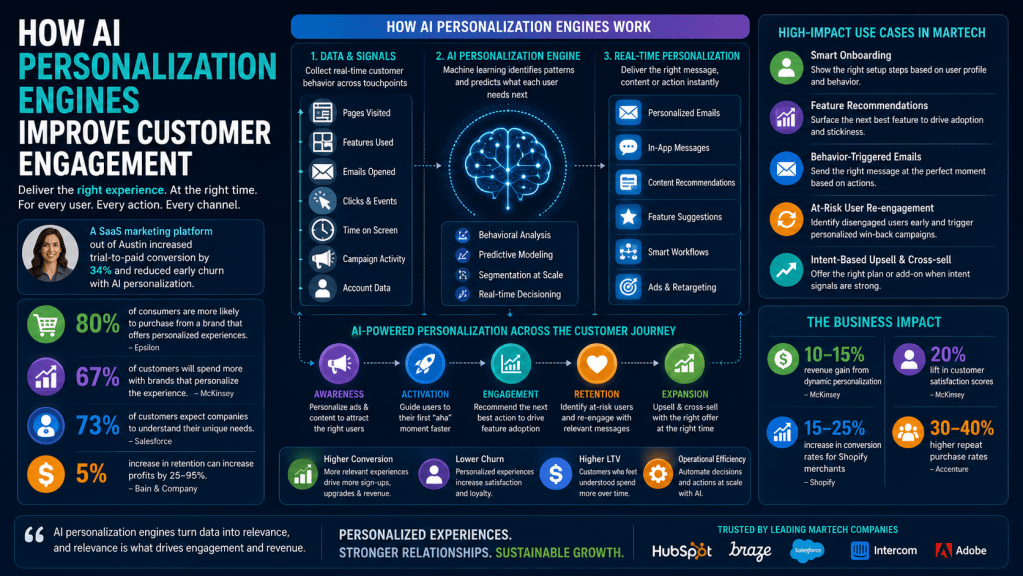
A SaaS marketing platform out of Austin had a problem most US martech companies know well. Decent open rates. Acceptable click-throughs. But somewhere between the click and the conversion, people were disappearing. The team had tested new subject lines, new send times, and new copy. Nothing moved the needle. Then they rebuilt their entire engagement layer around AI personalization engines, not the shallow kind where a first name drops into a subject line, but the real version where every email, every in-app prompt, and every content recommendation is shaped by what each individual user has actually done. Six months in, their trial-to-paid conversion had climbed 34% and early churn had dropped sharply.
That is not an anomaly. It is what happens when AI personalization engines are built into the core of a martech product rather than bolted on as an afterthought. According to Epsilon, 80% of consumers say they are more likely to purchase from a brand that offers personalized experiences. For martech companies selling to professional marketers who already know what good personalization looks like, that expectation is not a nice-to-have. It is the bar.
What AI Personalization Engines Are Actually Doing?
AI personalization engines ingest behavioral signals, pages visited, features used, campaigns launched, emails opened, time on screen, and run machine learning across all of it to determine what each user needs to see or hear next. The decision is instantaneous: show this feature, send this message, surface this use case, trigger this workflow. It happens across every user at the same time and gets sharper as more data flows in.
This is categorically different from rule-based personalization, which can only respond to scenarios a human thought to write a rule for. AI personalization engines find patterns nobody looked for: correlations between behavior in week one and outcomes in week eight that no marketing team would have found manually. That is where the results that actually move revenue start.
Customer Engagement AI: Relevance Is the Whole Game in Martech
The martech space has a relevance problem most companies in it are too close to see. A 10-person agency running client campaigns on a tight budget has almost nothing in common with an enterprise demand gen team managing a $5 million media budget across 14 channels. When both log into the same platform and see the same onboarding flow, the same feature prompts, and the same email sequence, one of them feels like the product was not built for them. In US martech, where buyers are evaluating three or four competing tools simultaneously, the product that feels most relevant wins.
Customer engagement AI fixes this by making the product adapt to the user rather than the other way around, and it works best across the full customer lifecycle, not just at sign-up. Customers who feel a product is relevant to their needs spend 67% more than new customers. In martech, where expansion revenue from existing accounts is often the primary growth engine, that lifts compounds quickly.
How Recommendation Engines Drive Feature Adoption in Martech Platforms?
Most martech products have a feature adoption problem. Users sign up, learn one or two core workflows, and never touch the rest. The features that would actually change their results sit unused because nobody surfaced them at the right moment. This is exactly what recommendation engines are built for.
A well-configured recommendation engine inside a martech platform watches what each user is doing and identifies the next most valuable feature for that specific person. A user running A/B tests on subject lines for three weeks gets a prompt about multivariate testing. A user with high click-through but low conversion gets a nudge toward landing page optimization tools. A user who just hit their contact limit gets a timely upgrade prompt. None of that comes from a customer success manager remembering to check in. It comes from behavioral signals being processed automatically. 35% of Amazon’s revenue comes directly from its recommendation engine. For martech platforms where feature adoption predicts retention, a well-built recommendation engine delivers the same compounding effect.
Dynamic Personalization Across the Martech Customer Journey
Most martech companies are doing static personalization: segment users by plan tier or company size, build a generic experience per segment, update it when someone remembers to. It is better than nothing but it does not respond to what a user did five minutes ago. Dynamic personalization updates in real time. The dashboard a user sees Monday reflects the campaign they were building Friday. The email they received Wednesday was triggered by a workflow they started but did not finish. The webinar invite in their inbox matches exactly what they have been trying to do on the platform for two weeks.
Companies using advanced dynamic personalization report revenue gains of 10 to 15% and a 20% lift in customer satisfaction scores. In martech, where satisfaction scores are a leading indicator of renewal and expansion, that 20% lift is a revenue signal, not just a feel-good metric.
AI Customer Experience: What It Looks Like Inside a Martech Product
Here is a scenario that plays out constantly. A marketing director at a mid-sized B2B company signs up for a free trial. She logs in four times in the first week, spends most of her time in campaign analytics, and never touches the automation builder. The trial ends. She does not convert.
A proper AI customer experience setup reads those signals in real time. The system recognizes she is deep in analytics but has not connected it to the automation features that would make those numbers actionable. It triggers a personalized in-app walkthrough showing how companies with her exact profile use automation to improve the metrics she is already tracking. It sends a targeted email at the moment her engagement is highest, not on day three because a drip sequence said so.
That is what AI customer experience actually means: a system that reads individual behavior and responds with the right thing at the right moment, across every user simultaneously. Salesforce found that 73% of customers expect companies to understand their unique needs while 90% say that experience a company provides is equally important. In martech, where your buyers are professional marketers who know exactly what good personalization looks like, meeting that bar is not optional.
AI Personalization Engines and the Retention Math in Martech
Acquisition gets most of the attention in martech growth conversations. Retention is where the math gets interesting. The average US SaaS company spends five to seven times more acquiring a new customer than keeping one. For martech platforms where annual contracts are the norm, losing a customer is not just lost ARR. It has lost expansion potential on top of it.
AI personalization engines improve retention by making the product feel more valuable the longer someone uses it. Without personalization, power users hit a ceiling where the platform starts feeling like a commodity. With it, the product surfaces advanced capabilities when users are ready for them and communicates in ways that match where each person actually is in their journey. Bain and Company found that a 5% increase in retention rates increases profits by 25 to 95%. For a martech platform with a healthy base of annual subscribers, that improvement shows up directly in net revenue retention, which is the number most US martech investors watch more closely than almost anything else.
The Bottom Line
The Austin platform from the opening of this piece did not stumble into those results. They made a deliberate decision to treat AI personalization engines as core product infrastructure rather than a marketing add-on. They unified their user data, identified the behavioral signals that predicted conversion and churn, and built personalization into every touchpoint.
That is the whole playbook. The technology is accessible. The business case is documented. The gap for most US martech companies is execution: data that is not unified, teams that are not aligned, or a tool deployed without clarity on what specific user behavior it was supposed to change. AI-powered personalization helps businesses deliver more relevant shopping experiences, leading to higher sales and customer engagement. Gartner predicts that companies using AI personalization will outsell competitors by 20%, while Shopify merchants often see conversion rates improve by 15–25%. Businesses also report 30–40% higher repeat purchase rates, along with increased order values and customer loyalty. Get the foundation right and AI personalization engines stop being a roadmap line item and become the engine your retention and revenue run on.
FAQ – How AI Personalization Engines Improve Customer Engagement?
How do AI personalization engines improve customer engagement for martech platforms?
AI personalization engines improve customer engagement AI outcomes by making every interaction relevant to what a specific user has actually done inside the product, not their plan tier or company size. The engine surfaces the feature, content, or workflow each person needs next, which increases feature adoption, reduces churn, and accelerates expansion revenue.
What makes recommendation engines different from a standard onboarding flow?
Standard onboarding flows show every user the same sequence regardless of behavior. Recommendation engines watch what each user does and surface suggestions based on those specific patterns. A user who skips straight to reporting gets different recommendations than one who starts in the campaign builder. That behavioral relevance is what drives the activation and adoption numbers that predict long-term retention.
Can dynamic personalization work for smaller martech companies?
Dynamic personalization is accessible well below enterprise scale. Platforms like Braze, Segment, Appcues, and Intercom make behavior-triggered personalization achievable with small teams. The real constraint is data volume, not budget. AI personalization engines need enough behavioral signals to find patterns worth acting on. Start with two or three high-impact use cases like trial activation and at-risk re-engagement before expanding to a broader strategy.
How do you measure whether your AI customer experience investment is working?
The metrics that matter for AI customer experience in martech are feature activation rate, trial-to-paid conversion, 90-day retention, and net revenue retention. If AI personalization engines are genuinely improving the experience, those numbers move within a 90 to 180-day window. Open rates and clicks are directional signals, not the goal.