
Marketing ROI: How to Measure It From Individual Campaigns All the Way to Revenue Impact
Stay updated with us
Sign up for our newsletter
Someone from finance or the CEO walks in and asks “so what is all this marketing spending actually doing for us?” and the marketing team kind of freezes. They have a bunch of numbers ready. Impressions, clicks, email open rates, follower counts. But those numbers do not actually answer the question. The question was about money. And that is what marketing ROI is all about.
Marketing ROI, which stands for return on investment, is basically the answer to that question. It tells you whether the money you are putting into marketing is actually coming back as revenue, or whether you are just spending cash and hoping for the best. And I am going to be real with you, most marketing teams are not measuring it properly. They think they are, but they are not.
This blog is going to walk through how to actually measure marketing ROI properly, from individual campaign ROI tracking all the way up to understanding the total revenue impact of your marketing efforts. It is going to make sense even if numbers are not really your thing, I promise.
Why Most Marketing Teams Get Marketing ROI Wrong
So the first thing to understand is why this is so hard in the first place.
The problem is that marketing ROI sounds simple. You spent this much, you made this much, so the ROI is this percentage. Easy right? Except it is really not, because marketing does not work in a straight line. Someone might see your ad in January, read your blog in March, attend your webinar in May, and then finally buy something in August. So which of those things gets the credit for the sale? All of them? Just the last one? The first one?
This is the part where most teams mess up. They either measure only the last thing that happened before a sale (which undersells most of their marketing) or they try to measure everything and get so confused by the data that they end up measuring nothing useful at all.
The other big mistake is measuring marketing ROI at the campaign level only and never zooming out to see the bigger picture. Yes you need to know if your paid search campaign is profitable. But you also need to know if marketing as a whole is contributing to revenue growth. Both views matter and they tell you different things.
How to Measure Marketing ROI: The Basic Formula First
Right so before we get into the complicated stuff, let us start with the basic formula because it is actually pretty simple.
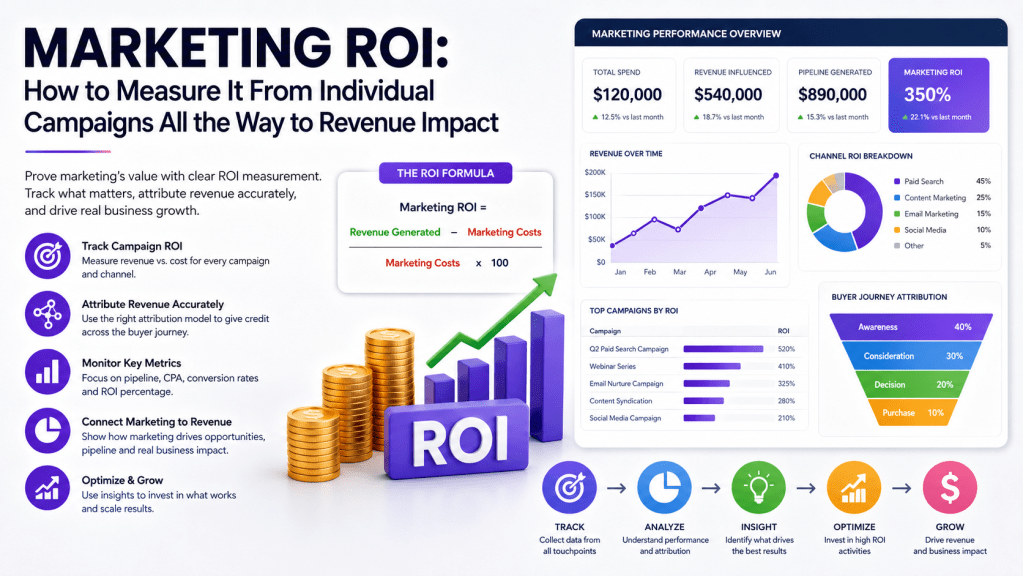
Marketing ROI equals revenue generated minus marketing costs, divided by marketing costs, multiplied by 100 to get a percentage.
So if you spent 10,000 dollars on a campaign and it generated 50,000 dollars in revenue, your marketing ROI is 400 percent. That means for every dollar you put in, you got four dollars back. That is a good number.
But here is the thing. That formula only works cleanly when you can directly connect a specific campaign to a specific sale. And in most B2B situations, that is actually really hard because of the whole long buying journey thing we talked about earlier.
So knowing how to measure marketing ROI properly means you need to think about it in layers. There is campaign-level ROI, which is about individual campaigns and channels. There is program-level ROI, which looks at a group of campaigns or a whole channel like content marketing or paid ads. And then there is overall marketing ROI, which is the big picture view of what marketing is contributing to the whole business.
Each layer gives you different and important information.
Campaign ROI Tracking: Getting the Numbers Right for Each Campaign
Let us start at the campaign level because that is where most teams begin.
Campaign ROI tracking is about measuring how much revenue a specific campaign generated versus how much it cost to run. Sounds simple but there are a few things you have to get right for the numbers to actually mean something.
First, you have to include ALL the costs. Not just the ad spend or the tool cost. You also need to factor in the time your team spent creating the campaign, any freelancer costs, design costs, software costs, all of it. A lot of teams just look at the money they spent on ads and ignore all the hours of work that went into building the thing. That gives you a completely wrong picture of the real cost.
Second, you need to decide how you are going to attribute revenue to the campaign. This is where it gets tricky. If someone clicked on your Facebook ad and then bought something three weeks later after also reading two blog posts and talking to a salesperson, how much of that sale belongs to the Facebook campaign? There is no perfect answer but you need to pick a method and stick with it consistently so your numbers are at least comparable over time.
Third, you need to track the right conversions. For B2B companies especially, the sale often does not happen directly from the campaign. The campaign might generate a lead, and then that lead gets nurtured and eventually closes. So your campaign ROI tracking needs to connect all the way through to closed revenue, not just stop at the lead stage.
A tool like a CRM combined with your marketing platform is really helpful here because it lets you follow a lead all the way from their first touch with a campaign through to when they actually become a customer.
Read More – Account Based Marketing: Strategy, Execution and ROI for B2B Teams
Revenue Attribution Marketing: Giving Credit Where Credit Is Actually Due
Okay so this is the part that gets complicated but it is also the most important part of measuring marketing ROI properly.
Revenue attribution marketing is about figuring out which marketing activities actually contributed to a sale. Because almost no sale in B2B happens from a single interaction. There are multiple touchpoints and someone has to decide how to split the credit between them.
There are a few different ways to do this and they all have good and bad sides.
First touch attribution gives 100 percent of the credit to the very first thing that brought someone into your world. So if someone first found you through a Google search, Google search gets all the credit for the eventual sale. This is useful for understanding what is building your top of funnel awareness but it completely ignores everything that happened between that first touch and the sale.
Last touch attribution is the opposite. It gives 100 percent of the credit to the very last thing someone did before buying. So if they clicked a sales email right before signing up, that email gets all the credit. This is also misleading because it ignores all the earlier stuff that built up their trust and interest.
Linear attribution splits the credit equally between every single touchpoint. So if there were five touchpoints, each one gets 20 percent of the credit. This is more fair but it treats a quick homepage visit the same as a long webinar attendance which probably is not right either.
Time decay attribution gives more credit to the touchpoints that happened closer to the sale, and less credit to the earlier ones. The idea is that the things that pushed someone over the edge matter more than the things that happened months ago. This makes some sense but it can undervalue your awareness-building content which is actually super important.
And then there is position-based attribution, also called U-shaped, which gives a lot of credit to the first and last touchpoints and splits the remaining credit among everything in the middle. This one is popular with a lot of B2B marketing teams because it values both the thing that created awareness and the thing that closed the deal.
The honest truth is that no attribution model is perfect. The best approach is to understand how your specific buyers make decisions and pick the model that most accurately reflects that journey. Revenue attribution marketing is never going to be 100 percent accurate but it gives you a much better picture than just guessing.
ROI Metrics Marketing Teams Should Actually Be Tracking
There are two types of ROI metrics marketing teams need: the ones that tell you if campaigns are working, and the ones that tell you if marketing as a whole is contributing to the business.
For campaign and channel level tracking, the key metrics are cost per lead, cost per opportunity, and cost per acquisition. Cost per lead tells you how much you are paying to get someone to raise their hand. Cost per opportunity tells you how much it costs to get someone into an actual sales conversation. And cost per acquisition is the total cost to turn someone into a paying customer. You want to see these numbers going down over time as you get better at targeting and messaging.
You also want to track pipeline generated by marketing, which is the total value of all the sales opportunities that marketing activities created. This is a really important number because it connects marketing directly to revenue potential even before deals have closed.
For the bigger picture, you want to look at marketing’s percentage of pipeline, which shows how much of the total sales pipeline marketing is responsible for generating. Most strong B2B marketing teams are responsible for somewhere between 40 and 70 percent of the pipeline. If that number is way lower, marketing might not be pulling its weight. If it is close to 100 percent, sales might not be doing enough outbound.
You also want to track revenue influenced by marketing, which is slightly different from revenue generated by marketing. Influenced revenue includes deals where marketing played a role but was not the only factor. This gives you a fuller picture of marketing’s actual impact on the business.
And then there is the overall marketing ROI percentage, which is the big number that answers the question “is marketing worth it?” For most B2B companies, a marketing ROI of 300 to 500 percent is considered healthy, meaning for every dollar spent on marketing, three to five dollars comes back in revenue.
How to Build a Simple Marketing ROI Tracking System
So knowing all of this is great but you also need to actually be able to track it. Here is how to set up a basic system that works even if you are not a massive company with a huge analytics team.
Step one is making sure your CRM and your marketing platform are connected and talking to each other. If your marketing tools do not pass data to your CRM and your CRM does not pass data back, you are going to have huge gaps in your tracking. Most modern tools like HubSpot or Salesforce can connect to marketing platforms pretty easily.
Step two is setting up UTM parameters on all your campaign links. UTM parameters are basically little tags you add to the end of URLs that tell your analytics tools where a visitor came from. So if someone clicks a link in your email newsletter, the UTM tag tells Google Analytics or whatever you are using that this person came from the email campaign. Without these, you have no idea which campaigns are driving traffic and leads.
Step three is building a simple spreadsheet or dashboard that pulls together your cost data and your revenue data in one place. You need to be able to see how much you spent on each campaign or channel and how much revenue is being attributed to each one. Even a basic spreadsheet works for this if you do not have a fancy BI tool yet.
Step four is agreeing with your sales team on how you are going to attribute revenue. This is really a conversation, not a technical thing. You need to get everyone aligned on the rules so that when you report marketing ROI numbers, everyone trusts them.
Step five is reviewing these numbers regularly, at least once a month, and actually making decisions based on them. There is no point in tracking marketing ROI if you are not going to use it to shift budget away from things that are not working and toward things that are.
Read More – Building a Marketing Dashboard: Metrics Every CMO Should Track
The Difference Between Short-Term and Long-Term Marketing ROI
Here is something that trips a lot of people up when they are trying to measure marketing ROI properly.
Some marketing activities have a really fast payback. If you run a paid search campaign and someone clicks the ad and buys something that same week, the ROI is easy to calculate and it shows up quickly.
But other marketing activities take a really long time to show returns. SEO is a perfect example. You might spend months and a decent amount of money creating content and building links, and see basically no revenue impact for the first six months. But then it starts to compound and after a couple of years it might be your highest ROI channel by far.
If you only measure short-term marketing ROI, you will end up cutting all your long-term investments and only doing stuff that pays back immediately. That might look good this quarter but it kills your growth over time.
The way to handle this is to think about marketing investments the same way you think about any other investment. Some are short-term and liquid, like paid ads. Some are long-term and compound, like content and brand building. You need a mix of both and you need to evaluate them on appropriate time horizons.
Common Mistakes That Mess Up Your Marketing ROI Numbers
Since we are being honest about this stuff, let us quickly go through the mistakes that make marketing ROI numbers useless.
Not including all costs is probably the most common one. If you are only counting your ad spend and ignoring your team’s time, your tools, your agency fees, and everything else, your ROI numbers are going to look way better than they actually are. That is great for feeling good but terrible for making real business decisions.
Mixing up correlation and causation is another big one. Just because sales went up in the same month you ran a big campaign does not mean the campaign caused the sales increase. Maybe it was a seasonal trend or maybe sales did a great job with outreach that month. You need to actually connect the dots between specific marketing activities and specific revenue outcomes, not just assume that things that happened at the same time are related.
Only measuring what is easy to measure is also really common. It is easy to measure clicks and downloads. It is hard to measure the impact of your brand awareness efforts or your thought leadership content. But hard to measure does not mean not important. If you only count the easy stuff you are going to end up undervaluing huge parts of your marketing.
FAQ: How to Measure Marketing ROI Properly
What is a good marketing ROI for a B2B company?
Most B2B marketing teams aim for a marketing ROI of 300 to 500 percent, which means three to five dollars back for every dollar spent. But this really varies a lot depending on your industry, your sales cycle length, and your business model. The more important thing is that your ROI is trending in the right direction over time and that you can justify the marketing investment to leadership with real revenue numbers.
How does campaign ROI tracking work when sales cycles are really long?
This is one of the hardest parts of measuring marketing ROI in B2B. The way most teams handle it is by tracking pipeline influence rather than closed revenue only. So instead of waiting six months for a deal to close before you count anything, you track when a campaign influenced a deal entering the pipeline. You then apply your average win rate to estimate the eventual revenue. It is not perfect but it gives you a much faster feedback loop.
What is revenue attribution marketing and why does it matter?
Revenue attribution marketing is the process of figuring out which marketing activities contributed to a sale. It matters because it tells you which parts of your marketing are actually working and which are not. Without proper attribution, you might be cutting campaigns that are actually really important to the buying journey because they do not look good on a last-touch basis. Good attribution helps you invest smarter.
Which ROI metrics marketing teams should prioritise if they are just getting started?
If you are just starting to properly track marketing ROI, focus on three things first. Cost per acquisition by channel, pipeline generated by marketing, and marketing’s percentage of total revenue pipeline. These three numbers together give you a clear enough picture to start making good decisions without needing a massive analytics setup to get there.