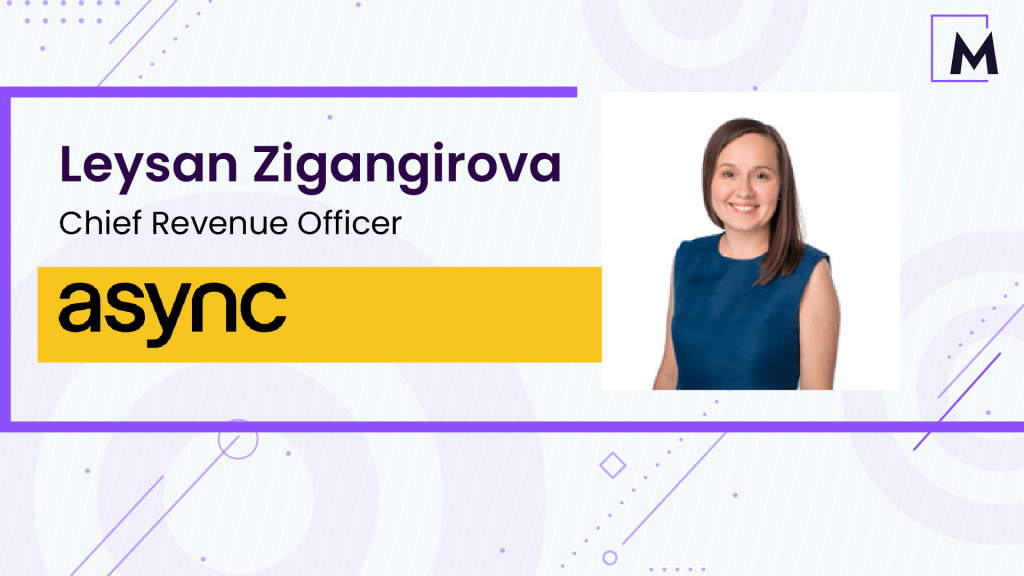
Async, CRO Leysan Zigangirova’s Exclusive Interview with MarTech Pulse on AI Content Creation
Stay updated with us
Sign up for our newsletter
AI is rapidly reshaping modern marketing. From your perspective, what fundamental shift is happening in how marketing teams move from communications-focused functions to revenue-driving business units?
Honestly, the shift started before AI entered the picture. For a long time, marketing had a convenient escape hatch: “We don’t directly control revenue.” The product isn’t good enough, sales aren’t closing – not our problem. I think that mindset is genuinely dead now, and the people still holding onto it are a liability. Every CEO I mentor or talk to is looking for a CMO who’s willing to co-own the number. Do not share it ceremonially; actually own it. And most marketers still aren’t ready for that conversation. I see it constantly: “Our brand health metrics are green.” Okay, but your sales aren’t growing. What exactly is the point? Marketing, product, and sales as separate silos is a 2010s construct. In any digital business, they’re one mechanism – or they should be.
Many brands are investing in AI, yet outcomes differ significantly. What separates companies using AI for basic efficiency from those using it to build lasting market advantage?
AI does not create an advantage by itself. Access to AI is no longer a differentiator, and most companies already use it for efficiency: faster content production, cheaper creatives, quicker experimentation. But a lasting advantage arises when AI is embedded in the company’s operating system. When it is connected to proprietary customer data, workflows, product signals, and institutional knowledge, it starts compounding into something much harder to replicate.
Strategic direction still has to come from humans. But the companies that combine human judgment with AI-driven execution will learn and adapt faster and ultimately outpace the rest.
Read More – How AI Tools Are Empowering E-Commerce Content Creators to Scale Without Burnout
Async is positioned to help teams execute faster in an AI-first era. How does the platform turn marketing ideas into scalable content, campaigns, and measurable growth outcomes?
What makes Async valuable for marketing teams is that it compresses the distance between an idea and a market-ready asset.
In most teams, the bottleneck is not lack of ideas. It is the amount of time and coordination required to turn one idea into multiple pieces of content that are actually ready to publish, test, and scale.
Async helps remove that bottleneck. Teams can take raw footage, a recorded thought, or a creative concept and turn it into polished content much faster, whether that means editing video through chat, generating assets with AI, adding subtitles, dubbing, voiceovers, or producing multiple variations for different channels and formats.
The business impact is speed and volume of iteration.
When production becomes dramatically faster, teams can test more messages, respond to trends more quickly, repurpose more efficiently, and get more value from every content input.
Read More – Why AI Video Content Boosts Engagement and Conversions
Personalization now defines customer expectations. How does Async help brands create relevant, localized, and high-performing experiences across channels without adding operational complexity?
The hard part of personalization is not creating more content. It is creating more versions without losing consistency, quality, and control.
That is where most brands struggle. The moment you need to adapt one message across markets, languages, channels, or audience segments, you are no longer dealing with one campaign, you are dealing with a content system.
What Async helps with is making that system more manageable. Instead of handing off separate tasks across multiple tools and teams, brands can work from one core asset and adapt it into different formats, languages, and channel-specific versions in a much more structured way.
Looking ahead three to five years, what emerging trends will most redefine marketing leadership, customer engagement, and the future role of AI in business growth?
I’m cautious about making very precise predictions for a three- to five-year horizon, because right now the environment changes so fast that even one year can materially reshape the landscape. But I do think a few structural shifts are already visible.
First, we’ll see growing AI fatigue, especially in content. AI is dramatically increasing output, but it is also increasing sameness. When every brand can produce more, volume stops being an advantage. The differentiator becomes whether you can still create something that feels distinctive, relevant, and emotionally memorable. That is why I think storytelling will become even more important: in a world flooded with AI-generated assets, the brands that know how to frame meaning, tension, and perspective will stand out far more than the ones that simply produce at scale.
Second, discovery will keep fragmenting. Search is no longer the only gateway. More people are discovering brands through AI assistants, Reddit, communities, creators, and recommendation-driven environments. So brands will need to think less in terms of single channels and more in terms of whether they are present in the ecosystems where both people and AI form opinions.
Third, marketing leadership itself will evolve. The next generation of leaders will manage not only people, but systems that combine people and AI agents. That changes the role quite fundamentally. Leadership becomes less about supervising tasks and more about orchestrating judgment, automation, speed, and accountability across hybrid teams. The real skill will be knowing where AI can extend capability, where human taste and responsibility remain essential, and how to design workflows where the two make each other stronger.
As AI adoption matures, what innovations or long-term vision is Async building toward to help brands stay competitive, agile, and growth-focused in the years ahead?
Our long-term vision is to democratize high-quality content creation while keeping human authenticity, taste, and brand identity at the center. We are not interested in building just another AI content generation platform optimized for volume.
We believe the more meaningful role of AI is to remove friction from the creative process, not replace it. That is why we see editing, made dramatically faster and easier, as a more important direction than pure generation. The real opportunity is to help creators, brands, and teams turn ideas, raw materials, and existing content into strong finished work with far less effort and technical complexity.
For us, this is what technology should do: expand human creative capability, help talented people move faster, and preserve what makes their voice or brand distinctive in the first place.
Leysan Zigangirova is Chief Revenue Officer at Async (ex-Podcastle), an AI platform for creators, businesses, and developers. She is a marketing and growth executive with 15+ years across FMCG and technology sectors, she’s worked from global brands like Procter & Gamble and Philip Morris to major IT players such as Microsoft, known for building categories, brands, and commercial engines for complex products. Before Async, Leysan led the creation of the Nebius brand identity and contributed to shaping its market-facing strategy. Over the last couple of years, Nebius has attracted major backing — most notably a $700M strategic equity financing (Dec 2024) with disclosed investors including Nvidia, Accel, and Orbis. Leysan also served as Chief Revenue Officer at DoubleCloud, a global startup in managed open source data infrastructure, where she worked across brand, go-to-market, and revenue growth. Her expertise sits at the intersection of brand, product marketing, demand generation, and revenue strategy. She is particularly known for translating complex technology into clear market narratives and for turning marketing from a support function into a real growth driver.
Async (formerly Podcastle) empowers creators and teams by radically simplifying the end-to-end content creation process. The streamlined suite of AI-powered tools enables users to record, edit, transcribe, and publish audio & video content with unmatched simplicity. Backed by Tier-1 investors, including Andrew Ng’s AI Fund, Mosaic Ventures, RTP Global, Point Nine, and Sierra Ventures, the company has raised a total of $23.5M in funding to date. In 2024, the company closed a $13.5M Series A to scale its AI content creation platform. Founded in 2020, the company began as a frontier voice AI lab, using a Chrome extension to showcase its text-to-speech technology. The platform rapidly evolved, based on market demand, into a full creative operating system used by millions. This product excellence has been recognized with the tech world’s most coveted awards: Product Hunt’s Golden Kitty Award (2021), The Webby Award (2022), and G2’s Overall Market Leader (2023) status.