
Why Incrementality Testing Matters in Performance Marketing
Stay updated with us
Sign up for our newsletter
I have run a campaign that looked great on paper. The click through rate was great. There were lots of conversions. The dashboard looked good. I still had a feeling that maybe those sales would have happened anyway. This feeling has a name. It is the reason incrementality testing exists.
Incrementality testing is the practice of figuring out whether your ads actually caused a sale or if the customer was going to buy from you and your ad just happened to be there taking credit. It sounds like a thing but it changes everything about how you should spend your budget. In this blog we are going to break down what incrementality testing is, why performance marketers cannot really trust their dashboards without it and how to run one without needing to be an expert in statistics.
What Incrementality Testing Actually Means?
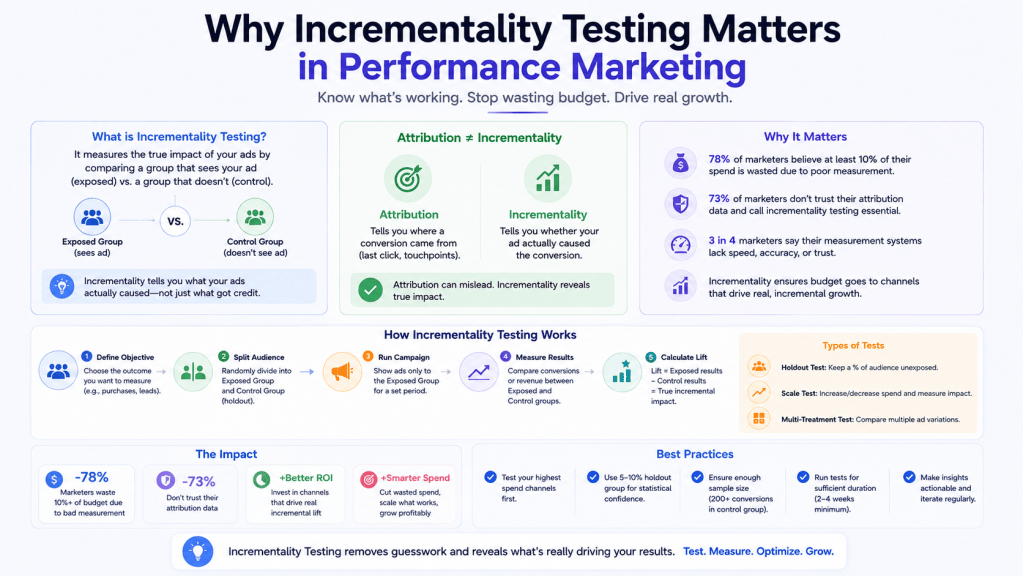
Incrementality measures the difference in sales that is directly caused by a piece of marketing. It separates the sales your ad genuinely created from the sales that would have happened even if the ad never ran. The only real way to prove this is through in-market experiments splitting people into a group that sees your ad and a group that does not then comparing what each group does.
This is very different from attribution, which’s what most marketers are used to looking at. Attribution tells you where a conversion came from based on clicks or touchpoints. Incrementality tells you whether your campaign created that conversion or if it just took credit for something that was going to happen. Those are two different questions and mixing them up is how brands end up wasting money on channels that look good but are not actually doing anything.
Why Ad Effectiveness Testing Cannot Rely on Attribution Alone?
Here is the truth. Last click attribution and more advanced models tend to overstate how much paid ads are actually doing because they cannot tell the difference between organic demand and demand your ads created. If someone already typed your brand name into Google because they saw you on TikTok yesterday and then clicked a branded search ad on the way to buying, attribution gives all the credit to that search ad. Did that ad really cause the sale? Probably not.
This is why ad effectiveness testing through experiments has become necessary. According to a report three in four marketers admit their measurement systems do not have the speed, accuracy or trust level they need. A separate study found that 73% of marketers do not trust their attribution data and consider essentiality testing as essential. That is not a problem that is most of the industry admitting the numbers on their dashboard might be wrong.
And it is not an attribution accuracy problem it is a real money problem. A study found that 78% of marketing decision makers believe at least 10% of their spend is being wasted because of bad measurement. That is not wasted spend from creative or bad targeting that is wasted spend from a brand not knowing what is working.
How Marketing Lift Measurement Actually Works?
Marketing lift measurement is the side of incrementality the actual process of quantifying how much extra impact a campaign created by comparing an exposed group against a control group that never saw it. It calculates the difference in conversions, revenue or even brand awareness that can be traced specifically back to the marketing itself.
Here is roughly how a basic lift test runs. You pick an objective maybe purchases or leads. You set aside a holdout percentage of your audience, usually between 5 to 10% , who simply will not see the campaign.The platform (or your own experiment setup) randomly splits people into the exposed group and this holdout group, tracks conversions in both, and calculates the actual lift between them. For this to be statistically solid, you generally want at least 200 conversions expected in the control group, otherwise the sample is too small to trust. The platform randomly splits people into the exposed group and this holdout group tracks conversions in both and calculates the lift between them.
There are actually three types of experiments marketers use: holdout tests, scale tests and multi-treatment tests. Audiences get split either by known users or by geography for channels where you cannot track individuals directly.
Incrementality Analysis and the Cost of Getting It Wrong
Doing proper incrementality analysis isn’t free, and it’s worth being honest about that upfront. Holdout groups mean you’re intentionally not showing ads to a chunk of your audience for a while, which does reduce short term reach. Running real experiments takes actual statistical rigor, and a lot of teams end up needing centralized data infrastructure to replace old school manual reporting spreadsheets.
But here’s the thing that makes it worth it anyway. The upside from incrementality analysis is asymmetric, meaning it’s way bigger than the cost. A single lift test that stops you from scaling up a channel that was never actually working can save you way more money than a whole year of fiddling with attribution models trying to squeeze out marginal optimization gains. One good test at the right moment can literally be worth more than months of smaller tweaks.
This is a big part of why more and more brands are treating incrementality testing less like a one-off project and more like a recurring habit. The recommended approach is to start with your highest spending channels first, run lift studies on a quarterly basis, and actually build incrementality into how budgets get planned in the first place, instead of just checking it once and moving on.
Let’s actually break down what the cost side looks like in practice, because “it requires infrastructure” can mean a lot of different things depending on the size of your team. For a smaller brand, the cost might just be the discomfort of not showing ads to 10% of your audience for a month, plus the time it takes someone to actually build the report at the end. For a bigger team running multiple channels at once, the cost is more real. You might need a proper data warehouse to sit all your conversion data in one place, someone with actual statistical know-how to design the test correctly, and a habit of documenting results so the next test builds on the last one instead of starting from zero every time.
There’s also an opportunity cost that doesn’t get talked about enough. Every rupee or dollar you hold back from your exposed group during a test is spent if you’re not actively pushing toward growth in that window. If you’re mid quarter and trying to hit an aggressive target, pausing part of your audience can feel like the worst possible timing. This is exactly why a lot of teams get cold feet halfway through a test and either shrink the holdout group or end it early, which quietly ruins the statistical validity of the whole thing and wastes the investment you already made getting it started.
The flip side of all this is the cost of not testing, which is much harder to see because it’s invisible until it isn’t. A channel that isn’t actually incremental doesn’t announce itself. It just sits there every month, eating budget, looking fine on a dashboard, showing decent ROAS, while quietly contributing nothing extra to your actual growth. Multiply that across months or even years and you get exactly the kind of number Haus found in their 2026 confidence index, where senior marketers themselves believe a meaningful chunk of their own spend, sometimes 30% or more, is being wasted purely because measurement never caught it (AI Digital).
There’s a real psychological cost too that’s worth naming honestly. Running an incrementality test means opening yourself up to finding out that a channel your team has defended for years isn’t actually pulling its weight. That’s an uncomfortable conversation to have internally, especially if the budget or headcount has been built around that channel’s supposed performance. But avoiding the test doesn’t make that risk go away, it just delays the moment you find out, usually at a point where more money has already been spent defending a story that wasn’t true.
The smartest way to think about all this is treating incrementality testing like an insurance premium rather than an expense. You’re paying a small, controlled cost now, in reduced reach and some analytical effort, to avoid a much bigger, uncontrolled cost later, which is scaling a channel for months or years based on a number that was never real in the first place. Brands that skip this step aren’t actually avoiding the cost of getting it wrong. They’re just deferring it to a future date, usually with interest attached, in the form of wasted budget that’s much harder to trace back once it’s already spent.
Performance Marketing Measurement Is Changing Fast
It’s worth zooming out here because performance marketing measurement as a whole has shifted a lot in the last couple of years, and incrementality is a big reason why. Privacy regulations, signal loss from things like Apple’s App Tracking Transparency, and the rise of AI-driven ad buying platforms have all made platform reported numbers less and less trustworthy on their own. Cookies are basically gone, cross device tracking is shaky, and multi touch attribution has been quietly falling apart for a while now.
Incrementality has stepped into that gap because it doesn’t actually need any of that stuff. It just needs solid experimental design and basic statistics, which makes it one of the few measurement methods that still works even as tracking keeps getting harder. This is exactly why it’s gone from being a niche data science thing that only big enterprise teams bothered with, to something that’s now considered a core part of how serious performance marketing teams operate.
There’s also a newer wrinkle here worth mentioning. AI powered optimization platforms can now move budget toward the placements, audiences, and creatives that are actually driving real incremental lift, instead of just chasing whatever conversions the platform itself is reporting, which tend to reward channels that are simply good at grabbing credit rather than actually creating demand. But there’s a catch. Adoption of AI in marketing has run way ahead of actual results. Adobe’s 2026 research found that only 7% of marketing teams have embedded AI in a way that’s actually delivering measurable business outcomes. The gap between using AI tools and actually profiting from them is, in large part, a measurement gap, and incrementality testing is exactly the discipline built to close that gap.
Example: Branded Search Is Not What You Think
One of the clearest examples of why incrementality testing matters shows up in branded search. Recent research on causal lift found a branded search iROAS (incremental return on ad spend) benchmark of around 0.70x, meaning for every dollar spent on branded search ads, the incremental value created was actually less than a dollar once you strip out the sales that would have happened organically anyway.
A lot of brands look at branded search performance and see incredible ROAS numbers, sometimes 10x or higher, and assume it’s their best performing channel. But without running an actual incrementality test, they have no idea how much of that “performance” was just capturing demand that already existed. This single example is basically the whole argument for incrementality testing in one stat. The dashboard said one thing. The actual causal impact said something very different.
How to Actually Start Running Incrementality Tests?
If all of this sounds intimidating it does not have to be. Here is a realistic starting point, for a team that has never run one of these before. Start with your channel by spend since that is where getting the answer wrong costs you the most money. Pick one objective you care about and resist the urge to test everything at once. Set up a holdout group. Make sure you are not touching it for the full duration of the test. Give it time to hit a real sample size and do not panic if the answer is not flattering. Finding out a channel is not actually incremental is an outcome because now you know where to stop wasting money.
Plenty of tools are available to make incrementality testing easier without building anything from scratch. Meta has its Conversion Lift product built directly into the Meta platform, which automatically calculates statistical significance and confidence intervals for you. Google Ads has a native option called Conversion Lift that runs the same kind of randomized holdout experiment directly within your existing Google Ads campaigns with no extra tracking setup required since it is built right into the Google Ads platform. For brands running experiments across channels at once dedicated third party tools also exist that specialize in geo based and user level testing at a bigger scale.
Before you even touch a platform though it helps to write down your hypothesis first. This sounds like a step but a lot of teams skip it and it costs them later. Something simple as “we believe Meta prospecting is driving incremental purchases not just capturing people who were already going to buy” gives your incrementality test an actual question to answer instead of just running a holdout and hoping the numbers tell you something useful on their own.
Next figure out your test duration before you launch, not through. Most incrementality tests need least two to four weeks to gather enough conversions and this depends heavily on your typical sales cycle. A brand selling a cost impulse product will hit its sample size way faster than a brand selling something people think about for weeks before buying. If you cut the incrementality test short because the early numbers looked exciting you are basically throwing away the rigor that makes the whole incrementality test worth running in the first place.
It is also worth deciding upfront how you will actually act on the result because this is the part teams tend to fumble. Decide in advance what lift number would make you scale a channel what number would make you hold steady and what number would make you pull spend entirely. If you wait until you see the result to decide what it means there is a risk of talking yourself into keeping a channel you already like regardless of what the data actually says.
One more thing that trips people up: do not run overlapping incrementality tests on the same audience at the same time. If you are testing incrementality on Meta and Google simultaneously using overlapping customer segments the two incrementality tests can contaminate each other. You will not be able to tell which channel actually caused the lift you are seeing. Stagger your incrementality tests or make sure your holdout groups do not overlap across channels so each incrementality test is actually measuring what you think it is measuring.
Finally treat your incrementality test as a pilot, not a verdict. The goal of your first incrementality test is not to overhaul your entire budget overnight it is to build internal trust in the method and prove the process works before you start making bigger more expensive decisions off the back of it. Once the team sees one clean incrementality test come through with an answer it becomes a lot easier to get buy-in for making this a recurring part of how budget gets planned, rather than a one-time experiment that gets forgotten about after the first report.
Bringing It All Together
Incrementality testing is not some fancy statistics exercise that only huge enterprise brands need to bother with. It is the difference between knowing what is working in your marketing and just guessing based on numbers that might be lying to you. Attribution and dashboards can tell you a story that feels true. Only real experiments, real holdout groups and real marketing lift measurement can tell you what is actually true.
As tracking keeps getting harder because of privacy changes and cookie loss incrementality testing is quickly becoming one of the measurement methods marketers can still fully trust. The brands getting this right are not the ones with the budgets they are the ones willing to run the experiment accept the answer even when it is not flattering and actually shift spend based on real incrementality analysis instead of comfortable looking dashboards.
Frequently Asked Questions
What is the difference between attribution and incrementality testing?
Attribution tells you which touchpoint technically gets credit for a conversion based on clicks or views. Incrementality testing tells you whether that conversion would have happened anyway without the ad. Attribution can overstate impact badly for channels like branded search since it can not separate organic demand from demand the ad actually created.
How does marketing lift measurement actually prove a campaign worked?
Marketing lift measurement works by comparing an exposed group who saw your campaign against a control group who did not then calculating the difference in conversions or revenue between the two. If the exposed group converts meaningfully more than the holdout group, that difference is your incremental lift.
Is ad effectiveness testing worth it for marketing budgets?
Yes though it usually makes the most sense to start with your spend channel first rather than trying to test everything at once. Even a single run incrementality test can prevent months of wasted spend on a channel that looked good on paper but was not actually creating new demand.
How often should incrementality analysis be run?
Most experts recommend running analysis on a quarterly basis, for your top channels rather than treating it as a one-time check. Markets shift, algorithms change and a channel that was incremental six months ago might not be incremental anymore so treating it as a habit rather than a single project protects your budget long term.
Write to us [wasim.a@demandmediaagency.com] to learn more about our exclusive editorial packages and programmes.