How AI Is Optimizing Performance Marketing Campaigns
Stay updated with us
Sign up for our newsletter
If you have been anywhere near a marketing dashboard lately you already know that AI performance marketing is not some off idea anymore. It is literally running the show. Marketers are handing over budget decisions, targeting choices and even creative testing to machines that learn faster than any human team ever could. Honestly the numbers back this up in a big way. The IAB’s 2026 Outlook Study found that United States ad spend is expected to grow 9.5% year over year with channels like social media and connected television leading the charge largely because of AI driven targeting and measurement tools. So yeah this is not a shift. It is basically a rewrite of how campaigns get planned, launched and optimized.
In this blog we are going to break down how AI performance marketing works in practice, why it is becoming the standard instead of the exception and what marketers actually need to know if they want to keep up. We will also get into AI ad optimization, machine learning advertising, AI campaign management and predictive advertising because these are the pieces that make the whole system click.
Why AI Performance Marketing Is Taking Over Ad Budgets?
Let’s start with the question. Why is everyone suddenly obsessed with AI performance marketing? The short answer is that it works better and it works faster than manual methods ever could.
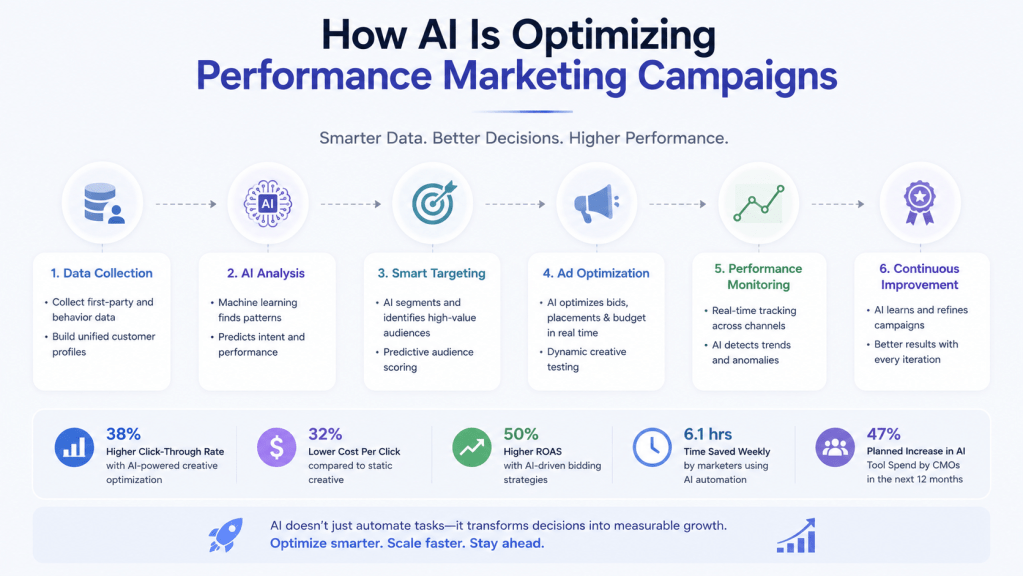
Think about it this way. A human media buyer can maybe test five or six ad variations a week if they are being really productive. An AI system can test dozens, sometimes hundreds and adjust spend in time based on which ones are actually converting. That is a difference in speed and scale. According to Gartner’s Chief Marketing Officer Spend Survey 81% of Chief Marketing Officers expect their AI tool spend to grow in the 12 months with a median planned increase of 47%. That is not a bump that is a signal that budget owners genuinely believe AI performance marketing pays for itself.
It is not just about spending time growing. It is about spending time working. Advertisers using creative optimization, which basically means AI automatically swapping out creative elements based on performance, are seeing 38% higher click through rates and 32% lower cost per click compared to static creative. So the case for AI performance marketing is not theoretical anymore. It is showing up directly in click through rates and cost per click numbers that marketers actually care about.
AI Ad Optimization: The Engine Behind Smarter Spend
This is probably the piece most people think of first when they hear AI performance marketing and for that reason. AI ad optimization is what decides where your money goes by second based on what is actually converting instead of what a media planner guessed would convert two weeks ago.
Google’s Performance Max is an example of this in action. As of 2026 45% of paid search campaign optimization was being driven by Performance Max, which’s basically Google’s AI system handling bidding, placements and creative combinations all at once. That is more than half of paid search running on autopilot. It is only growing from here.
The bidding side alone shows some wild results. AI driven pay per click bid management has been shown to cut wasted ad spend by around 37% while increasing ad return on investment by 50% compared to manual bidding strategies. Basically the system stops throwing money at clicks that were never going to convert and it reallocates that budget toward audiences and placements that actually move the needle.
What makes AI ad optimization different from school rule based bidding is that it is not static. It is constantly learning. Every impression, click and conversion feeds back into the model, which means the system gets sharper the longer it runs. That is a shift from the old way of doing things where a media buyer would set rules on Monday and just hope they still made sense by Friday.
Creative testing is another area where AI ad optimization is quietly doing a ton of lifting. Marketing teams using AI tools are now able to test 3.7 times content variations per campaign compared to manual workflows. That is a lot of shots on goal in the same amount of time and it means the system can figure out which headline, image or call to action is actually pulling weight much faster than a team running one or two A/B tests a month. For anyone running paid campaigns across platforms this kind of testing volume used to be impossible without a huge team behind it. Now it is basically baked into the platform itself.
Machine Learning Advertising and the Rise of Predictive Signals
Machine learning advertising is really the backbone that makes all of this possible. Without machine learning none of the automated bidding or creative testing would actually be intelligent; it would be automated guessing.
Here is where it gets interesting. Machine learning advertising models do not just look at what happened in the past, they use that data to predict what is likely to happen next. That is a deal because it means campaigns can shift before a trend even becomes obvious to a human analyst staring at a spreadsheet.
McKinsey’s Global AI Survey found that 24% of marketing and sales teams reported revenue gains of 6% or more attributable to AI over the past year. That is revenue, not just efficiency metrics or vanity statistics. When it comes to targeting specifically advertisers using first party data combined with AI based contextual targeting are seeing up to 2x higher return on ad spend compared to relying on third party targeting alone. With third party cookies becoming less reliable every year machine learning advertising built around party signals is quickly becoming the only realistic path forward for marketers who actually want consistent performance.
Meta’s Advantage+ campaigns are another example here. These AI powered campaigns have already crossed a 20 billion dollar annual revenue run rate and AI generated creative within these campaigns is showing a 47% increase in click through rates along with a 29% drop in cost per acquisition. That combination of engagement and lower cost per acquisition is exactly why machine learning advertising keeps eating up more and more of the paid media pie.
AI Campaign Management: From Manual Oversight to Autonomous Execution
Okay so this is where things start to feel sci-fi but in a good way. AI campaign management is moving past the assist stage. Heading straight into autonomous territory, where systems plan, launch and adjust campaigns with very little human hand holding.
The IAB’s Chris Bruderle summed this up well saying that AI is no longer a siloed initiative but the connective tissue linking media, measurement, creative and customer experience and that agentic AI is pushing things toward fully autonomous systems that can plan, activate and optimize with speed and scale. Two thirds of marketers are now focused on agentic AI for ad buying and campaign execution which tells you this is not a niche experiment anymore it is becoming the default approach for a lot of teams.
Practically speaking AI campaign management means a system can pace your budget across the day so you do not blow your spend by 10am shift creative combinations based on which ones are actually resonating and reallocate audience targeting without someone manually pulling reports every morning. Marketing teams using AI report saving an average of 6.1 hours per week with senior practitioners saving more around 8 to 10 hours weekly. That time savings adds up to 317 hours a year per marketer, which is basically eight full working weeks given back to actual strategy instead of manual busywork.
Course autonomous does not mean unsupervised. Human oversight is still critical for brand safety, creative quality and making sure the AI is not optimizing toward something technically correct but strategically dumb. The best AI campaign management setups treat the AI as a fast very tireless assistant rather than a replacement for actual marketing judgment.
This is also why measurement is becoming such a deal inside AI campaign management specifically. As more of the buying and optimization gets handed over to agentic systems marketers need a way to double check that the machine is actually doing what it says it is doing. The IAB found that cross platform measurement rose to 72% among advertisers in 2026 up from 64% the year precisely because teams want to connect AI orchestrated decisions back to real outcomes instead of just trusting the dashboard blindly. Basically the autonomous AI campaign management gets the more marketers are leaning into measurement as a check and balance not less.
Predictive Advertising: Getting Ahead of Customer Behavior
Predictive advertising is honestly the part that feels the most like a superpower. By reacting to what customers already did predictive advertising tries to figure out what they are about to do and then positions ads accordingly before the moment even arrives.
This matters a lot now because consumer behavior itself has become harder to read. The IAB found that adapting to changing consumer behavior is now the media investment challenge for advertisers in 2026 even ahead of concerns about the broader economy. Predictive advertising is basically the tool marketers are reaching for to deal with that uncertainty since it relies on pattern recognition across datasets rather than gut instinct about what customers might want.
Retail is a place to see predictive advertising in action. AI powered product recommendations, which are a form of advertising applied to individual shopping behavior can increase average order value by up to 369% in some cases and AI personalization overall is boosting ecommerce conversion rates by up to 10%. That is advertising working at the individual customer level not just the broad audience segment level.
There is a change happening in how people find brands. People are using intelligence to search for products and services. McKinsey says that half of the people are using intelligence to search. EMarketer says that AI will help 63.3 million shoppers in the United States in 2026.
Companies are trying to figure out how to use intelligence to show up when people are searching. They want to be seen when people are using intelligence to discover new things, not just when they are searching on Google.
The Trade Offs Nobody Talks About Enough
The thing is, using intelligence is not a magic solution. There are problems with it. One of the problems is that people do not have the skills to use intelligence properly. 58% Of marketers say that they do not have the skills to use AI. 17% Of marketers have gotten training on how to use AI.
This means that people are being given tools but they do not know how to use them. This is why some companies are not getting results from using AI.
There is also a problem with measuring how well AI is working. 91% of marketers are using intelligence but only 41% can say for sure if it is working. This is a problem because companies need to know if their money is being spent wisely.
If you are using intelligence to manage your marketing you need to figure out how to measure if it is working. This should be your priority.
How To Actually Start Using AI Performance Marketing?
If you want to start using intelligence for marketing, here is what you should do.
- You need to clean up your data. AI needs data to work properly.
- Second, you should start using intelligence to optimize your ads on the platforms where you spend the most money.
- You should use intelligence to predict what your best customers will do and then use that information to make decisions.
- Finally you should always have a human involved in the process especially when it comes to decisions.
You should also budget for training not for the tools. 81% of companies are planning to spend money on training for AI in 2026.
Buying the tools is the part. The hard part is getting your team to understand how to use them.
Where This Is All Heading?
AI is not going away. The market for intelligence in marketing is going to grow by 36.6% per year. It will go from $47.32 billion in 2026 to $107.5 billion by 2028. This is not a trend, it is the future of marketing. The companies that will succeed are the ones that use intelligence in a thoughtful way. They will invest in training. They will be honest about how well AI is working. They will also make sure that humans are involved in the process.
Frequently Asked Questions
Is AI ad optimization only useful for big budget advertisers?
Not really. AI ad optimization tools like automated bidding and dynamic creative testing are built into platforms like Google Ads and Meta, which means even smaller advertisers get access to the same underlying technology. The efficiency gains, like the 37% reduction in wasted spend mentioned earlier, actually matter more for smaller budgets since every rupee or dollar has to work harder.
How is machine learning advertising different from regular automation?
Regular automation follows fixed rules that a human sets up in advance. Machine learning advertising is different because it constantly learns from new data and adjusts its own decisions over time without someone manually rewriting the rules. That is what allows it to catch shifts in customer behavior faster than a static rule ever could.
Does AI campaign management replace the need for a marketing team?
No, and honestly it should not be used that way. AI campaign management handles the repetitive, data heavy parts of running a campaign, like pacing budget and testing creative combinations. Strategy, brand voice, and creative direction still need real human judgment, especially since AI can optimize toward the wrong goal if nobody is watching closely.
Is predictive advertising accurate enough to trust with a big budget?
It depends heavily on data quality. Predictive advertising models are only as good as the historical data they are trained on, so if your first party data is thin or outdated, predictions will be shaky. Most marketers start by testing predictive advertising on a smaller segment of high value customers before scaling it across the full budget.
Write to us [wasim.a@demandmediaagency.com] to learn more about our exclusive editorial packages and programmes.