Email Automation vs Journey Automation: What’s The Difference?
Stay updated with us
Sign up for our newsletter
Coca-Cola Chile ran into a pretty common problem. Tons of people were visiting their website, but most of them were leaving without buying anything. So instead of just sending more emails and hoping for the best, they started testing small onsite tweaks that worked together as part of a bigger, connected experience. First they added a coupon code popup for people who seemed hesitant, and that alone pushed their conversion rate up by 19% in just three months.
Then they tried something called InStory, basically short snackable product stories similar to what you’d see on Instagram, and it dropped their bounce rate by 29% while pulling in a thousand extra clicks in just three months. On top of that, they added social proof messages showing how many people had recently bought a product, and testing showed that actual purchase counts convinced shoppers way more than just view counts did, bumping conversions up another 12% in a single month. What’s interesting is none of this came from one single automated email, it came from connecting data and behavior across the whole site experience. And Coca-Cola didn’t stop there either, they later started exploring a proper cross-channel journey builder to figure out which mix of channels actually moves people toward buying.
If you have spent five minutes on a marketing tool you have probably seen both email automation and journey automation floating around and just nodded like you totally get it. Honestly most people mix them up all the time. This blog is going to break down email automation vs journey automation in a way that actually makes no sense, just real talk.
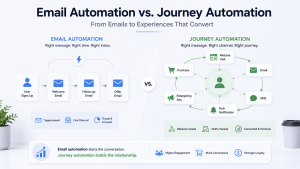
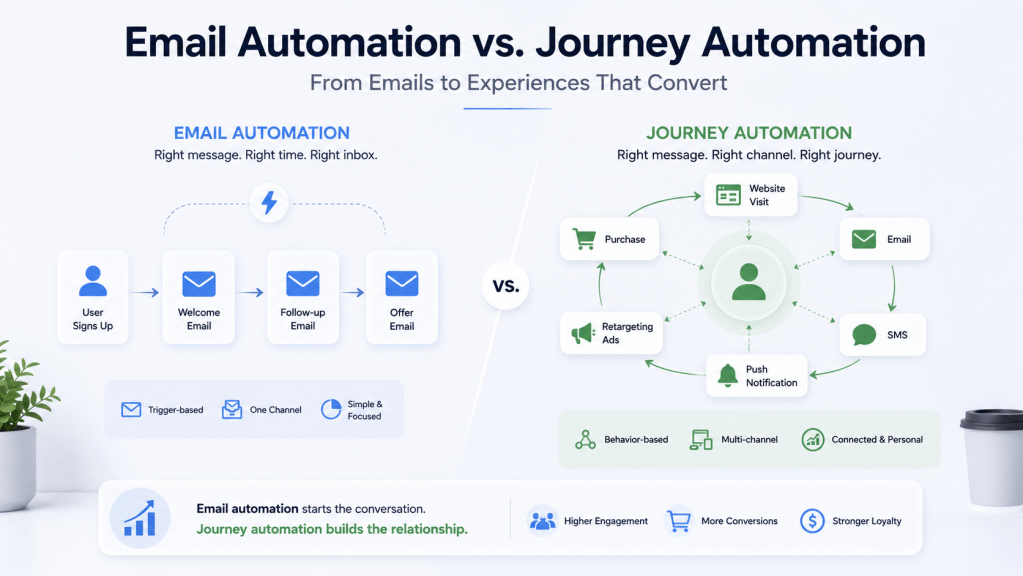
Here is the short version before we go deep. Email automation is basically about sending the email at the right time based on a trigger like someone signing up or leaving their cart. Journey automation is bigger than that. It is about mapping out the relationship a customer has with your brand across every channel, not just their inbox. Once you get that difference a lot of marketing terms suddenly click into place.
This matters more than you think. Email marketing is still doing well in terms of return on investment with brands earning somewhere between $36 and $42 for every single dollar they spend on it. That is way higher than what most other channels give back. But here’s the thing: just sending automated emails is not the same as running a connected customer experience. That is where journey automation comes in and that is what we are talking about today.
What Is Email Automation?
Let’s start simple. Email automation is when you set up a rule like “if this happens send that email” and then the system just does it for you without you clicking send every time. Think emails, abandoned cart reminders, birthday discounts, that kind of stuff.
The cool part is these automated sequences are not things. Automated emails made up 2% of total email volume in 2024 but they were responsible for a massive 37% of all ecommerce email revenue. That is wild when you think about it. A tiny slice of emails doing half the work.
Another stat that kind of blew my mind is that automated emails generate 320% revenue compared to regular one-off campaigns. When people actually click on an automated message, about 1 in 3 of them go on to make a purchase compared to just 1 in 18 for a normal scheduled campaign. So, email automation clearly works. It only covers one channel: the inbox.
This is where email marketing workflows come in. A workflow is basically the actual sequence of emails inside your automation like email 1 goes out immediately email 2 goes out three days later if they haven’t opened email 3 goes out with a discount if they still haven’t bought anything. These workflows are the building blocks of email automation. Honestly if you get these right you are already ahead of most brands.
Email automation vs journey automation is not really an either-or fight. Email automation is basically a piece of the journey automation puzzle. Keep that in mind as we go further.
What Is Customer Journey Automation Actually About?
Now let’s talk about the bigger picture. Customer journey automation is when a brand automates the experience a person has with them not just emails. This includes push notifications, SMS texts, in-app messages, website pop-ups retargeting ads even what a customer service rep sees when that person calls in.
Basically journey automation treats the customer like a human moving through different stages not just an email address sitting in a list. It tracks behavior across channels. Decides the best next move whether that move is an email, a text or literally nothing because bombarding them would be annoying.
A telling number here is that only 35% of marketers say their customer journeys are mostly or fully automated. That means most brands are stuck doing email automation only and calling it a day without connecting the dots across other channels. That’s a gap and honestly, a huge opportunity if you’re the one who fixes it first.
When people search for email automation vs journey automation what they are really trying to figure out is whether they need a more expensive tool that handles everything or if a solid email tool is enough for where their business is right now. Spoiler: it depends on how complex your customer base and product are.
Lifecycle Automation and Why It Matters More Than You Think?
Let’s bring in another piece of the puzzle: lifecycle automation. This is basically the idea that every customer goes through stages like lead first time buyer, repeat customer at risk of leaving and eventually a loyal fan or someone who churns completely. Lifecycle automation means your marketing adjusts itself depending on which stage that person’s currently in.
For example a brand new subscriber might get a welcome series. Someone who bought once but hasn’t come back in 60 days might get a “we miss you” nudge. Someone who buys every month might get access to new products instead of another basic discount code. That is lifecycle automation doing its job matching the message to where the customer is instead of blasting everyone with the same thing.
This connects directly to journey automation because lifecycle stages are basically checkpoints inside the bigger journey map. Without lifecycle thinking your automation just becomes a bunch of triggers with no real strategy tying them together.
Here’s a stat that shows why this actually pays off. Companies that nurture their leads through automation see a jump of up to 451% in qualified leads. That is not a typo. Getting your lifecycle stages right and automating around them can seriously multiply your results.
Automated Customer Journeys in Action
Lets make this less theoretical and talk about what automated customer journeys look like when a brand does them well.
Say someone visits your website, browses a product and leaves without buying. In an email automation setup they would just get one abandoned cart email a few hours later. That’s the end of the story.
Now in an automated customer journey here’s what could happen instead. They get a retargeting ad reminding them of the product the day. If they open the app but still don’t buy it, they get a push notification with a nudge. If they still don’t convert after a few days an SMS goes out with a limited time discount code. Only if none of that works does the system finally send a “still thinking about it?” email with social proof like reviews or a bestseller badge.
See the difference? One channel doing its thing versus multiple channels working together based on actual behavior. That is the value behind automated customer journeys and it is exactly why bigger brands with more resources are shifting in this direction.
It is also worth pointing out that segmentation plays a role here. Brands that use segmentation as part of their personalization strategy report increased customer engagement by 30%, and improve retention rates by 15% while reducing churn rate by 25%. The most effective email campaigns rely on some form of segmentation combined with personalization and automation. So within journey automation your email piece still needs to be sharp and well targeted; it just isn’t operating alone anymore.
Email Automation vs Journey Automation: The Real Comparison
Alright lets put it side by side so it actually sticks in your head.
Email automation lives inside one channel. It is rule based meaning if X happens then Y email goes out. It is usually simpler to set up cheaper and a starting point for smaller brands or teams without a huge budget. Tools like Mailchimp or basic Klaviyo flows handle this well.
Journey automation lives across channels at once. It is behavior based and often uses intelligence or predictive logic to figure out the next best step for each individual customer. It requires data, more integration between tools and honestly a bigger team or budget to manage properly. This is where platforms like HubSpot or ActiveCampaign start showing their strength since they can combine triggers with real time personalization.
The truth is email automation vs journey automation isn’t really a competition, it’s like a growth path. Most brands start with email automation because it’s easier and cheaper and they graduate into full journey automation once they have enough customer data and enough channels to actually make it worth building.
One more thing worth mentioning, artificial intelligence is changing this space fast. Reports show that artificial intelligence driven personalization can boost revenue by around 41% compared to automated sends and by late 2026 a huge chunk of enterprise email programs are expected to use artificial intelligence in at least one part of their campaign process. So whichever path you’re on artificial intelligence is basically going to be baked into it whether you plan for it or not.
How to Decide Which One Your Brand Actually Needs?
When you are trying to decide between email automation and journey automation, think about your brand and what you are trying to do. If your business is small, your product line is simple, and most of your customer interaction happens through email anyway, solid email marketing workflows are probably all you need right now. Don’t overcomplicate things just because journey automation sounds fancier.
You should also think about your budget and your team. If you have a team and not a lot of money, email automation might be the way to go. If you have a big team and a lot of money, journey automation might be the better choice.
It is also important to think about your customers and what they need. If your customers are all in one place like on your website email automation might be enough. If your customers are all over the place like on social media and, on your website journey automation might be the better choice.
So when you are trying to decide between email automation and journey automation just think about what you need and what you can handle. Do not forget to think about your customers and what they need. That is the important thing.
If you are sitting there wondering which one makes sense for you here is a way to think about it.
If your business is small and your product line is simple and most of your customer interaction happens through email then Email marketing workflows are probably all you need right now. Do not overcomplicate things just because journey automation sounds fancier.
If you’re running an ecommerce brand with a website, app, SMS list, and social presence all at once, and customers are jumping between these touchpoints constantly, that’s your sign to start building out proper customer journey automation. Trying to manage that kind of complexity with email alone is going to leave a lot of money on the table.
And no matter which one you pick, do not skip the lifecycle thinking. Whether you are doing email flows or a full blown omnichannel journey, mapping out where each customer sits in their lifecycle automation stages will make everything else work better.
Final Thoughts
To wrap this up, email automation vs journey automation is not really about picking a winner. Email automation is the foundation, it’s proven it is affordable and the return on investment numbers speak for themselves. Journey automation is the level up connecting every channel your customer touches into one smooth personalized experience.
Start where you are. If you are just getting into automation, nail your email workflows first. Once that is humming along. You have got the data and tools to expand start layering in journey automation piece by piece. That is honestly how successful brands got to where they are, not by jumping straight to the complicated stuff but by building up smartly.
Frequently Asked Questions
Is customer journey automation a fancier term for email automation?
Not really. Email automation only covers what happens inside a person’s inbox. Customer journey automation covers everything, emails, texts, app notifications, ads and even offline touchpoints like customer service calls. Email is one piece of the bigger journey.
Do I need journey automation if I already have good email marketing workflows?
Not right away. If email is your channel and it is working, keep optimizing your email marketing workflows first. Journey automation becomes more useful once you have channels and enough customer data to actually connect them meaningfully.
How does lifecycle automation fit into all of this?
Lifecycle automation is about matching your messaging to where a customer is, new lead, repeat buyer at risk of leaving and so on. It works inside both email automation and journey automation basically making sure whatever message goes out actually fits the customers stage instead of being random.
What’s the easiest way to start building automated customer journeys?
Start small. Map out your two or three most important customer moments, like a purchase or a cart abandonment and figure out every channel that could reasonably reach that person at that moment. Then slowly connect those channels together using a tool that supports multi channel triggers of just email alone.
Write to us [wasim.a@demandmediaagency.com] to learn more about our exclusive editorial packages and programmes.