Marketing Attribution Models: Which One Actually Works for Your Business?
Stay updated with us
Sign up for our newsletter
You are a CMO.
Your marketing team runs like six different campaigns over three months. They run paid ads, email sequences, a webinar, some LinkedIn posts, a few blog articles. At the end of it all, a bunch of deals close. Everyone is happy. But then someone asks the question that causes an argument in literally every marketing team on the planet: which campaign actually got us those deals? That is exactly the problem that marketing attribution models are supposed to solve. A marketing attribution model is basically a set of rules that decides how much credit each marketing touchpoint gets for a sale. And picking the right one is honestly one of the most important decisions you can make when you are trying to figure out what is working and what is not.
The problem is there are a bunch of different marketing attribution models to choose from, and each one tells a slightly different story. This blog is going to walk through the main ones, compare how they work, and help you figure out which one actually makes sense for your situation.
Why Marketing Attribution Models Matter More Than Most People Think
Before getting into the actual models, it is worth understanding why this stuff is such a big deal.
If you do not have a clear marketing attribution strategy, you end up in one of two bad situations. Either you give all the credit to the last thing someone did before buying, which makes your bottom of funnel stuff look amazing and your top of funnel stuff look useless. Or you just throw your hands up and say “we cannot track any of this” and then you have no idea where to put your budget.
Both of those are terrible for making decisions. If you think your LinkedIn thought leadership content is not doing anything because it never shows up as the last touch before a sale, you might cut it. But that content might be what is getting people interested in you in the first place. Without a proper attribution model, you would never know.
Getting attribution in digital marketing right is what lets you confidently say “we should put more budget into this channel” or “this campaign type is not worth the investment” and actually have the data to back it up.
The Main Marketing Attribution Models Explained Simply
Okay so here are the main models you are going to come across. I am going to explain them like a normal person, not like a textbook.
Single Touch Marketing Attribution Models
These are the simple ones. They give all the credit to just one touchpoint.
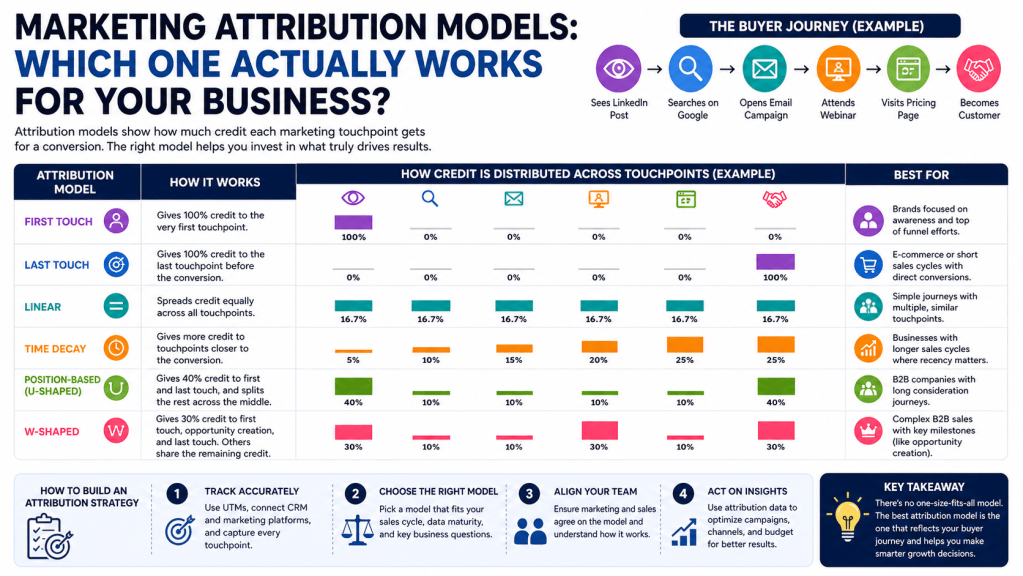
First Touch Attribution gives 100 percent of the credit to the very first thing that introduced someone to your brand. So if a person first found you through a Google search, that search gets all the credit no matter what happened after. This is useful if you really want to understand what is bringing new people into your world for the first time. But it completely ignores everything that happened between that first moment and the actual sale, which in B2B can be a journey of many months.
Last Touch Attribution is the complete opposite. It gives 100 percent of the credit to the very last thing someone did before becoming a customer. Clicked a sales email right before signing a contract? That email gets all the credit. This one is popular because it is simple and it shows a direct connection between an action and a sale. But it massively undersells all the earlier work that built up trust and interest over time.
Single touch models are fine if your buying journey is really short and simple. If someone sees an ad and buys the same day, last touch attribution makes total sense. But for most B2B companies where the buying process takes weeks or months, single touch models give you a very incomplete and often misleading picture.
Read More – B2B Demand Generation: How to Build a Pipeline Engine That Actually Scales
Multi Touch Attribution: A Much More Honest Picture
This is where things get more interesting. Multi touch attribution is the idea that instead of giving all the credit to one thing, you spread the credit across multiple touchpoints based on some kind of logic. This is a much more accurate reflection of how B2B buying actually works.
There are a few different versions of multi touch attribution and they each distribute credit differently.
Linear Attribution splits the credit equally across every single touchpoint in the buyer’s journey. If someone had five interactions with your marketing before buying, each one gets 20 percent of the credit. It is fair in a basic way but it treats a two-second visit to your homepage the same as a 45-minute webinar attendance, which probably does not reflect reality very well.
Time Decay Attribution gives more credit to the touchpoints that happened closer to the sale and less credit to the earlier ones. The idea is that the things that nudged someone over the finish line are more valuable than something that happened eight months ago. This makes some sense but it tends to undervalue your awareness and education content, which is often doing a lot of heavy lifting even if it does not look like it.
Position-Based Attribution (U-Shaped) is probably the most popular multi touch model for B2B teams. It gives a big chunk of credit, usually around 40 percent, to the very first touchpoint, another big chunk to the last touchpoint before a sale, and then splits the remaining credit among all the touchpoints in the middle. The logic is that both the moment someone discovered you and the moment they finally decided to buy deserve the most recognition, with everything in between getting some credit too.
W-Shaped Attribution takes this a step further and adds a third heavily weighted point: the moment a lead became a qualified opportunity. So you have three key moments getting the most credit and the rest of the journey sharing what is left. This one tends to work well for teams that have a clear lead qualification step in their process.
Attribution Model Comparison: Which One Is Right for You
Okay so here is the honest attribution model comparison that most blogs skip over.
There is no single marketing attribution model that is objectively the best. The right model depends entirely on your business, your sales cycle, and what questions you are actually trying to answer.
If you are a B2C company with short buying cycles and mostly single-channel customers, last touch or first touch models are probably enough for you. They are simple, easy to set up, and they give you actionable information quickly.
If you are a B2B company with long sales cycles, multiple decision makers, and lots of marketing touchpoints before a sale, you really need some version of multi touch attribution. Position-based or W-shaped attribution tend to work best here because they give proper credit to both the awareness building and the deal-closing activities.
If you are just starting to think about your marketing attribution strategy and your data setup is not very mature yet, start simple. Even a basic first touch or last touch model is way better than no attribution at all. Get something running, learn from it, and then layer in more complexity as your team and your tools get better.
How to Actually Build a Marketing Attribution Strategy
So knowing what the models are is one thing. Actually building a marketing attribution strategy that your whole team uses is another.
The first step is making sure your tracking is set up properly. This means UTM parameters on every campaign link, your CRM connected to your marketing platform, and every touchpoint being logged somewhere. If you have gaps in your data, your attribution is going to be wrong no matter which model you pick.
The second step is picking a model that fits your current data maturity. If you are not tracking every touchpoint yet, do not try to run W-shaped attribution. It will just give you garbage numbers. Start with something simpler and build up.
The third step is making sure everyone on the team understands and agrees on the model you are using. If marketing and sales are looking at different attribution data and arguing about who gets credit for what, you are going to waste a lot of time in meetings that go nowhere. Get aligned first.
The fourth step is using attribution data to actually make decisions. This sounds obvious but a lot of teams track attribution and then ignore it when it is time to decide on budgets. If your attribution in digital marketing is showing that your content marketing is influencing 60 percent of your closed deals, that should show up in your budget allocation. Otherwise what is the point?
Read More – Key Benefits of Combining AI CRM and Social Automation
FAQ: Marketing Attribution Models Explained
What is multi touch attribution and why is it better than single touch models?
Multi touch attribution spreads the credit for a sale across multiple marketing touchpoints instead of giving it all to just one. It is more accurate for B2B companies because most buyers interact with multiple pieces of content and multiple campaigns before making a decision. Single touch models miss most of that journey, which can lead you to cut campaigns that are actually really important.
Which marketing attribution model should a B2B company start with?
Most B2B teams do well starting with a position-based or U-shaped model because it values both the first touch that created awareness and the last touch that closed the deal, while still giving some credit to everything in the middle. It is a good balance between simplicity and accuracy for most B2B buying journeys.
How does attribution in digital marketing work when buyers use multiple devices?
This is genuinely one of the hardest problems in marketing attribution. Someone might see your ad on their phone, research you on their laptop, and then fill out a form on their work computer. If these sessions are not connected, they look like three different people in your analytics. The best way to handle this is to use tools that support identity resolution, where logged-in users or matched email addresses help connect sessions across devices. It is not perfect but it is much better than treating every device as a separate buyer.
What is the difference between an attribution model comparison and a full attribution audit?
An attribution model comparison is when you look at how different models would distribute credit for your existing data and compare what they say. It helps you understand which model fits your business best. An attribution audit is a broader review of your whole attribution setup, including whether your tracking is working correctly, whether your data is complete, and whether your current model is giving you accurate information to make decisions with.