AI Search Optimization: How AI Search Models Improve Product Discovery and Rankings in E-Commerce
Stay updated with us
Sign up for our newsletter
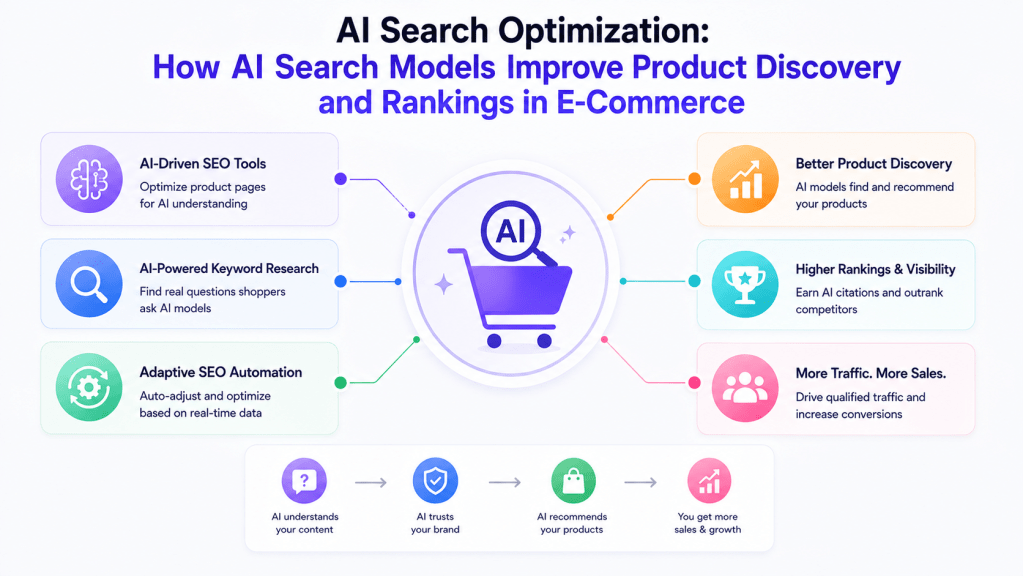
If you run a D2C e-commerce brand online, you have probably noticed something weird happening to your traffic lately. Some of it is not coming from Google the old way anymore. It is coming from ChatGPT, from Gemini, from AI Overviews, from Perplexity. This is where AI search optimization comes in, and if you are not thinking about it yet, you are already a little behind.
AI search optimization is basically the new version of SEO but built for a world where AI models read your product pages, understand them, and then decide whether to recommend you to a shopper. It is not just about ranking on a results page anymore. It is about getting picked by an AI that is doing the shopping research for someone else. And honestly, this shift happened faster than most marketers expected.
Traffic from AI sources to US retail websites shot up 393% year over year in the first quarter of 2026 alone. Some reports put generative AI referral growth even higher, with Adobe tracking a 4,700% year over year jump in traffic from generative AI sources to US retail sites. That is not a small trend. That is a full channel shift happening in real time.
In this blog, we are going to break down what AI search optimization actually means for e-commerce brands, how AI-driven SEO tools and machine learning in SEO are changing product discovery, how AI-powered keyword research works differently now, and what adaptive SEO automation looks like when you actually put it into practice. We will also get into the best AI search visibility tools people are using right now, because tool choice matters a lot here.
What Is AI Search Optimization and Why It Matters for E-Commerce
AI search optimization is the process of making your product pages, category pages, and content easy for AI models to read, trust, and recommend. Traditional SEO cared mostly about keywords, backlinks, and page speed. AI search optimization cares about all that too, but it adds a new layer: can an AI model actually understand what your product is, who it is for, and why it is a good answer to someone’s question.
Think about it like this. When someone types “best running shoes for flat feet” into Google AI Mode or asks ChatGPT the same thing, the AI is not just matching keywords anymore. It is reading through product descriptions, reviews, specs, and even Reddit threads to figure out what to say back. Google AI Mode alone passed 1 billion monthly users as of May 2026, and Google AI Overviews reached around 1.5 billion monthly users back in January 2026. That is a massive chunk of search happening in a totally different format than a normal results page.
For e-commerce specifically, this matters because product discovery used to be a linear thing. Someone searches, sees ten blue links, clicks one, buys or does not buy. Now the AI does a lot of that filtering before the shopper even sees a website. About 50% of consumers across every age group, including boomers, now intentionally use AI powered search for purchasing decisions. And during the 2025 holiday shopping season, 56% of US consumers used generative AI tools while shopping, which is way up from just 11% the year before.
So if your brand is not showing up when an AI model answers a product question, you are just invisible to a growing chunk of shoppers. That is the whole point of AI search optimization. It is not optional anymore, it is becoming the baseline.
There is also a real business case for this beyond just being present. Brands that get cited in AI Overviews often see a 35% increase in click through rates compared to standard search results, according to Yotpo data reported by Triple Whale. That is a big deal. It means AI citations are not just a vanity thing, they actually convert better because the shopper already trusts the AI’s pick before they even click.
AI-Driven SEO Tools Are Changing How Product Pages Get Built
A few years ago, SEO tools mostly told you which keywords to use and how many backlinks you needed. Now AI-driven SEO tools do a lot more. They can scan your whole product catalog, tell you which pages are missing structured data, suggest rewrites based on what AI models are actually citing, and even predict how a product description will perform before you publish it.
This matters a ton for AI search optimization because AI models do not reward the same things old school SEO rewarded. Stuffing a page with keywords does basically nothing for an AI model trying to understand your product. What actually works is clear, specific, factual content that answers real questions. AI-driven SEO tools help you spot the gap between what your page currently says and what an AI model would need to confidently recommend your product.
Adoption of these tools is already pretty high. Around 58% of B2B companies and 60% of B2C companies are using AI tools somewhere in their SEO process. And it is not just early adopters anymore, 83% of SEOs at companies with more than 200 employees said their SEO performance actually improved after they brought AI into the workflow. That is a strong signal that this is not hype, it is producing real results.
One thing a lot of e-commerce teams get wrong is treating AI-driven SEO tools like a magic button. You plug in a product name and expect a perfect copy. That is not really how it works. The best use of these tools is catching what a human writer misses, like inconsistent product specs across pages, missing FAQ content, or thin descriptions on your best selling items. The AI tool flags it, a human fixes it with actual product knowledge, and that is when AI search optimization actually moves the needle.
Something worth noting too, a full quarter of e-commerce brands are already leaning on AI to generate product copy at scale. But copy alone without real differentiation and fact checking will not stand out in AI summaries. It just becomes more noise for the model to sort through. So the tools matter, but so does what you actually feed them.
Machine Learning in SEO: The Engine Behind Modern Rankings
Machine learning in SEO is basically the technical backbone that makes all of this possible. It is the reason search engines and AI models can look at millions of product pages and figure out relevance way faster and more accurately than any manual process ever could.
Here is a simple way to think about it. Old search algorithms followed pretty rigid rules. Machine learning in SEO means the system is constantly learning from user behavior, click patterns, and content quality signals, and adjusting what it considers a good result. For e-commerce, this means your rankings are not static. They shift based on how real shoppers interact with your pages, not just what keywords you stuffed in.
This is also where things get a little more demanding for brands. Because machine learning in SEO models are learning continuously, a page that ranked well six months ago might not rank well today if user behavior signals have shifted. That is honestly one of the biggest challenges with AI search optimization right now, it is a moving target.
The market itself reflects how seriously the industry is taking this shift. The AI SEO tools market is projected to grow from 1.2 billion dollars in 2024 to 4.5 billion dollars by 2033, growing at a rate of about 15.2% per year. That kind of growth does not happen unless businesses are seeing real ROI from applying machine learning in SEO to their day to day operations.
For product discovery specifically, machine learning in SEO helps AI models understand things like which products are frequently bought together, which specs actually matter to buyers in a category, and which reviews are trustworthy versus fake. All of that feeds into how confidently an AI model recommends your product over a competitor’s. So when we talk about AI search optimization, machine learning in SEO is really the invisible engine doing the heavy lifting behind every recommendation.
AI-Powered Keyword Research: Finding What Shoppers Actually Ask
Keyword research used to mean typing a word into a tool and getting a list of related terms with search volume numbers next to them. AI-powered keyword research is a different animal entirely. Instead of just giving you variations of a phrase, it looks at actual conversational queries, the kind of full sentence questions people ask ChatGPT or Google AI Mode.
This matters a lot for AI search optimization because shoppers do not talk to AI the way they typed into a Google search bar. Nobody types “best waterproof hiking boots men wide feet” into ChatGPT. They ask “what are some good waterproof hiking boots for guys with wide feet that won’t fall apart after a few months.” That is a completely different query shape, and if your keyword research is not built around that, you are optimizing for search behavior that is quietly fading.
AI-powered keyword research tools solve this by analyzing question patterns, intent clusters, and even the kind of follow up questions people ask after their first query. This gives you a much clearer map of what content you actually need to build. Instead of one page targeting “running shoes,” you might end up with several pages targeting specific buyer situations, each one answering a real question an AI model is likely to get asked.
There is a data point worth mentioning here. About 35% of consumers now use AI tools at the very first stage of product research, the discovery and initial ideas stage, compared to just 13.6% using traditional search at that same early stage. That means the earliest part of the shopping journey, the part where brand awareness gets built, is shifting hard toward AI. If your AI-powered keyword research strategy is not covering that early discovery stage, you are missing the moment where a shopper first decides what brands to even consider.
A smart approach is combining AI-powered keyword research with actual customer support transcripts, reviews, and Q&A sections on your site. Real customer language almost always beats guessed keywords, and AI models tend to reward content that mirrors how people actually talk.
Adaptive SEO Automation: Keeping Up Without Burning Out Your Team
Here is the honest truth about AI search optimization. It moves fast, and no marketing team can manually track every algorithm shift, every new AI feature, and every ranking fluctuation across dozens or hundreds of product pages. This is where adaptive SEO automation comes in.
Adaptive SEO automation means setting up systems that automatically adjust your SEO strategy based on real time performance data, instead of waiting for a quarterly review to catch problems. For example, if a product page starts losing visibility in AI search results, an adaptive system can flag it immediately, suggest what might be missing, and even test small changes automatically to see what improves visibility.
This is a pretty big shift from how SEO used to work. Old school SEO was mostly reactive. You would notice a drop in rankings weeks later, dig through reports, and eventually make a fix. Adaptive SEO automation compresses that whole cycle. It is built for a world where machine learning in SEO systems are constantly recalculating relevance, so your response needs to be just as fast.
One area where this really shows up is content freshness. AI models tend to favor recently updated, accurate content over stale pages, especially for product info where specs, pricing, or availability change. Adaptive SEO automation can flag outdated product pages automatically instead of relying on someone remembering to check.
It is worth saying that adaptive SEO automation is not about removing humans from the process. It is about letting a system handle the repetitive monitoring work so your team can focus on the stuff that actually needs a human brain, like understanding what makes your product genuinely different from a competitor. Given that AI adoption in SEO workflows has already crossed the halfway mark for most organizations, with 56% actively integrating AI into their SEO processes in some way, adaptive SEO automation is quickly becoming less of a nice extra and more of a baseline requirement.
Best AI Search Visibility Tools Worth Testing Right Now
If you are trying to figure out which tools actually help with AI search optimization, the market has gotten pretty crowded pretty fast. But a few categories keep coming up when people talk about the best AI search visibility tools.
First, there are tools built specifically for tracking AI citations, meaning they tell you when and where your brand gets mentioned inside ChatGPT answers, Google AI Overviews, or Perplexity results. This is honestly one of the most useful categories right now because without it, you are flying blind. You genuinely do not know if you are showing up in AI answers unless you are tracking it directly. Microsoft Clarity, for example, recently made its Citations dashboard generally available, which shows the actual grounding queries behind AI citations across the Copilot ecosystem. That kind of visibility into what triggered a citation is genuinely new and genuinely useful.
Second, there are AI search visibility optimization tools that go beyond tracking and actually suggest content changes. These tools compare your content against what is currently getting cited by AI models in your category and highlight the gaps. If competitors are getting cited because they have detailed comparison tables and you do not, the tool will flag that specific gap.
Third, site search and product discovery platforms have gotten a serious AI upgrade. Algolia’s 2026 report found that 71% of B2B businesses are now using AI technology for their e-commerce search, up from 67% the year before. And 83% of respondents said they are more likely to choose a search and discovery solution specifically because it has AI capabilities. This tells you that AI powered on site search is becoming table stakes, not a luxury feature.
When picking from the best AI search visibility tools, do not just go by brand name recognition. Look at whether the tool covers your actual traffic sources. If most of your AI referral traffic is coming from ChatGPT, a tool that only tracks Google AI Overviews is not going to give you the full picture. Cross check a few tools against your own analytics before committing a budget to one.
AI Search Visibility Optimization Tools vs Traditional SEO Platforms
A question a lot of marketing teams ask is whether they still need their old SEO platform once they start using AI search visibility optimization tools. The honest answer is yes, for now, because the two do genuinely different jobs.
Traditional SEO platforms are still great at the fundamentals, things like site speed, crawl errors, backlink profiles, and keyword rank tracking on classic search results pages. AI search visibility optimization tools are focused on a narrower but increasingly important slice, how your brand shows up specifically inside AI generated answers.
The overlap is growing though. A lot of traditional platforms are bolting on AI visibility features because customers are demanding it. Nearly 21% of e-commerce SEO professionals in one survey said the growth of alternative search spaces like ChatGPT will be the single biggest factor shaping their strategy over the next two years, with another 20% pointing specifically to AI Overviews as the bigger factor. That is basically the whole industry agreeing that AI search visibility optimization tools are not a side project anymore.
If you are working with a limited budget, a reasonable approach is keeping your existing SEO platform for the technical foundation and layering in one dedicated AI visibility tool on top. You do not need five different tools tracking the same thing. You need one solid technical SEO base and one solid AI citation tracker, and then you build your AI search optimization strategy around what both of them tell you.
Read More – SEO vs AEO vs GEO: The Future of Search Optimization for B2B Marketing in 2026
AI Visibility Optimization for E-Commerce: What Actually Moves the Needle
When it comes to AI visibility optimization for ecommerce specifically, the tactics that matter most are a little different from general content SEO. Product pages need to work extra hard because AI models are often pulling very specific facts, like exact dimensions, materials, compatibility info, or return policies, and stitching those into an answer.
The single biggest lever for AI visibility optimization for ecommerce is structured, accurate product data. If your size chart is buried in an image instead of readable text, an AI model cannot use it. If your return policy is only mentioned on a separate page nobody links to, the AI model has no way of connecting that info to your product when someone asks about it.
Reviews matter here too, maybe more than people realize. Reddit alone accounts for roughly 29% of all third party sources that AI models cite when answering ecommerce related questions. That is a huge number for one platform. It means AI visibility optimization for ecommerce cannot just focus on your own website. You need a presence and a reputation in the places AI models already trust, and right now that includes forums and review heavy platforms just as much as your own product pages.
Personalization is another piece of this. AI powered personalization is already driving up to 40% higher revenue for e-commerce businesses that use it well, and personalized product recommendations alone contribute somewhere between 25% and 35% of total e-commerce revenue. AI visibility optimization for ecommerce and on site personalization actually work together. The clearer your product data, the better both external AI models and your own on site recommendation engine can match products to shoppers.
On site search is also part of this puzzle. About 43% of e-commerce traffic comes from on site search, which makes getting that search experience right just as important as external AI search optimization. Retailers who upgraded to AI powered on site search reported cutting search abandonment rates by up to 40%. So while a lot of the AI search optimization conversation focuses on external AI models like ChatGPT, do not sleep on your own internal search bar. It is doing more work than most teams give it credit for.
AI Search Visibility for B2B Marketing: A Different Kind of Buyer Journey
Most conversations about AI search optimization focus on consumer shopping, but AI search visibility for B2B marketing is arguably even more important, because B2B buyers do a ton of research before they ever talk to a sales rep.
The numbers back this up. The typical B2B buyer now completes around 70% of their decision journey before filling out a form or replying to any outreach. That means the AI generated shortlist of vendors or products often forms before your sales team even knows a buyer exists. If your company is not showing up in that AI generated research phase, you might be losing deals you never even knew were in play.
AI search visibility for B2B marketing requires a slightly different content approach than consumer focused AI search optimization. B2B buyers are usually looking for comparison content, technical specs, case studies, and proof points, not quick product descriptions. AI models pulling together an answer for a B2B research query need detailed, factual content to draw from, which means thin product pages or generic service descriptions just will not cut it.
Algolia’s research backs this up from the B2B side too. As mentioned earlier, 71% of B2B businesses are already using AI technology for ecommerce search, and 83% say AI capability is now a deciding factor when choosing a search and discovery vendor. That tells you B2B buyers are not just tolerating AI powered discovery, they are actively expecting it.
If you are building out AI search visibility for B2B marketing, prioritize content that answers the comparison questions your buyers are actually asking, things like how your product differs from a specific competitor, what implementation actually looks like, and what the real cost breakdown is. That kind of specific, factual content is exactly what AI models need to confidently recommend you in a B2B research query.
Read More – Is Answer Engine Optimization Killing Traditional SEO? A Practical Guide
How AI Search Models Actually Read and Rank Your Products
A lot of people hear “AI search optimization” and picture some mysterious black box, but it is actually a bit more mechanical than that once you understand the basic steps. AI models do not just skim your homepage and vibe check your brand. They pull structured signals from your pages, cross check them against reviews and third party mentions, and then decide how confident they are in recommending you.
Structured data is a huge part of this, and honestly it is one of the most underused pieces of AI search optimization right now. Around 71% of pages cited by ChatGPT include structured data, but only about 18% of e-commerce product pages actually have complete schema markup. That gap is basically free real estate for any brand willing to fix it. Separate research backs this up too, showing 65% of AI cited pages use structured data in some form.
The type of schema matters as well. Product schema combined with AggregateRating schema makes a product about 3 times more likely to show up in AI generated recommendations compared to using basic markup alone. Sites that added FAQ blocks alongside their existing content saw a 44% jump in AI search citations, according to a BrightEdge study. Even more broadly, content with proper schema markup has around a 2.5 times higher chance of showing up in AI generated answers, and sites with a complete schema setup see up to 40% more AI Overview appearances.
There is also solid academic backing for this, not just industry blog claims. A Princeton University study on generative engine optimization found that combining authoritative citations, real statistics, and structured data together produced up to 40% higher citation rates in AI generated answers. The important part of that finding is the word combining. Structured data alone is not a magic fix, it works best when it is backing up genuinely good, factual content, not replacing it.
It is worth being realistic about what schema can and cannot do though. Google has been clear that structured data reads more like a trust signal than a display trigger for its AI Mode and AI Overviews. Schema helps Gemini verify claims and establish entity relationships during answer generation, but it does not guarantee a citation on its own. So think of AI search optimization through schema as removing friction and doubt for the AI model, not as buying your way into an answer.
One more nuance worth knowing if you are deep in AI search optimization work, the AI Mode citation overlap with normal top 10 organic results has actually been shrinking, reportedly sitting somewhere between 17% and 54% in early 2026, down from around 76% in 2025. In plain terms, ranking well on a normal Google search page does not guarantee you show up in an AI generated answer anymore. These are becoming two separate games, which is exactly why AI search optimization needs its own dedicated strategy instead of just riding on the back of your regular SEO work.
Read More – From SEO to AI Visibility: The Next Evolution of Digital Discovery
Common Mistakes Brands Make with AI Search Optimization
Now that you know how AI models are actually reading your pages, it is worth talking about where brands mess this up, because the mistakes are pretty consistent across the board.
The first big mistake is treating AI search optimization like a one time technical fix. Teams add some schema markup, feel good about it, and move on. But since only about 18% of e-commerce product pages currently have complete schema, most brands are not even doing the basics consistently across their whole catalog. It is easy to fix your top 10 bestsellers and forget the other 400 products sitting quietly with thin, unstructured descriptions.
The second mistake is chasing outdated tactics. Google’s own documentation from May 2026 actually stated that things like llms.txt files, aggressive content chunking, AI specific rewriting, and special schema hacks are not required for visibility in its generative AI features (Passionfruit). This reframed a lot of common generative engine optimization advice floating around online. Some brands are still spending time and budget on tactics that Google has already said do not move the needle for their surfaces specifically, while ignoring the stuff that actually does, like clear factual content and legitimate structured data.
The third mistake is treating every AI platform the same. ChatGPT, Google AI Overviews, Google AI Mode, and Perplexity all pull from different sources and weigh signals differently. For example, only about 14% of AI Mode citations reportedly overlap with AI Overview citations. That means optimizing purely for one AI surface does not automatically carry over to the others. Brands that assume “we are covered because we show up in ChatGPT” often get blindsided when they check Google AI Mode and find they are nowhere to be seen.
The fourth mistake, and this one is sneaky, is ignoring FAQ content changes. FAQPage schema used to earn a visible rich result chip directly in Google search listings, but Google officially retired FAQ rich results on May 7, 2026. If your team was adding FAQ sections purely to grab extra space in search results, that specific benefit is gone now. The good news is genuine, well written FAQ content still helps with AI citations generally, it just is not earning that old style visual chip anymore, so the motivation for writing FAQs needs to shift from “look bigger in search” to “actually answer real buyer questions clearly.”
Lastly, a lot of brands skip the boring maintenance work. Boilerplate schema implementation, where someone copies a template and fills in the bare minimum fields, produces pretty weak results. Optional fields like author, image, date modified, and description are what actually give AI systems enough context to cite content confidently instead of skipping over it. AI search optimization rewards the brands willing to do the unglamorous, detailed work, not the ones looking for a quick shortcut.
Measuring Whether Your AI Search Optimization Is Actually Working
Here is something a lot of marketing teams skip entirely, actually measuring whether their AI search optimization efforts are paying off. It is easy to add some schema, publish a few new product descriptions, and just assume things are better now. But without tracking, you genuinely have no idea.
The first thing to track is citation frequency, meaning how often your brand or specific products actually get mentioned when someone asks an AI model a relevant question. This sounds obvious but a lot of teams have never actually run these test queries themselves. Set aside time every couple weeks to literally ask ChatGPT, Gemini, and Google AI Mode the kinds of questions your customers would ask, and see whether you show up at all.
The second thing worth tracking is referral traffic specifically coming from AI sources, separate from your normal organic search numbers. This category of traffic is becoming big enough that lumping it into generic “other” traffic in your analytics is a mistake. Most modern analytics platforms can now segment AI referral sources if you set it up properly, and it is worth doing sooner rather than later.
The third metric, and honestly one of the more useful ones, is comparing conversion rate of AI referred traffic versus your normal organic traffic. Brands cited in AI Overviews often see an increase in click through rate compared to standard search results. If you are seeing a similar lift, that is a strong signal your AI search optimization work is translating into real business value, not just vanity visibility.
Finally, keep an eye on your schema coverage as a percentage of your total catalog, not just your top products. Since AI models are increasingly using structured data to verify claims before citing a source, a rising percentage of properly tagged product pages should correlate with rising citation frequency over time. This is a slower moving metric, but it is one of the clearest levers you actually control, unlike algorithm changes which you cannot control at all.
Putting It All Together: A Practical AI Search Optimization Checklist
By now you have probably noticed that AI search optimization is not really one single tactic. It is a mix of AI-driven SEO tools, machine learning in SEO, AI-powered keyword research, adaptive SEO automation, and choosing the best AI search visibility tools for your specific traffic sources. Here is a simple way to start pulling it together without getting overwhelmed.
Start by auditing your top selling product pages for missing or unclear information, things like specs, sizing, materials, and policies. Then look into AI-powered keyword research to find the actual conversational questions shoppers are asking about your category. After that, pick one or two AI search visibility optimization tools to start tracking whether you are getting cited in AI answers at all. Once you have a baseline, set up some form of adaptive SEO automation, even something simple like automated alerts when a page’s visibility drops, so you are not finding out about problems weeks late.
Do not try to do everything at once. AI search optimization is a long game, and the brands winning right now are the ones treating it like an ongoing process, not a one time project. Given that traffic from AI sources grew 4 times year over year in early 2026 alone, even small improvements now can compound into a real advantage over the next year or two.
FAQs About AI Search Optimization
What is the difference between AI search optimization and regular SEO?
Regular SEO focuses mostly on ranking in traditional search engine results pages using keywords, backlinks, and technical site health. AI search optimization focuses on making sure AI models like ChatGPT, Gemini, and Google AI Overviews can understand, trust, and recommend your product or brand when answering a shopper’s question. They overlap a lot, but AI search optimization puts more weight on structured, factual, and conversational content.
Do I need AI-driven SEO tools if I already have a normal SEO platform?
You do not have to replace your existing platform, but adding AI-driven SEO tools on top usually helps, especially for tracking AI citations and finding content gaps that traditional keyword tools miss. Most teams end up running both together rather than picking just one.
How is AI-powered keyword research different from normal keyword research?
AI-powered keyword research focuses on full question style queries and conversational intent, since that is how people actually talk to AI models, instead of short fragment keywords typed into a traditional search bar. It also tends to surface earlier stage discovery questions that regular keyword tools often miss.
Is AI search visibility for B2B marketing really that different from B2C?
Yes, mostly because B2B buyers research a lot more before ever contacting a company, often completing around 70% of their decision before reaching out. AI search visibility for B2B marketing needs deeper comparison content, technical detail, and proof points, while B2C AI search optimization can lean more on quick, clear product info and reviews.
Write to us [wasim.a@demandmediaagency.com] to learn more about our exclusive editorial packages and programmes.