
Building Scalable Lead Nurturing Systems with Automation
Stay updated with us
Sign up for our newsletter
Meet Jake. He runs a B2B SaaS startup out of Austin and pulls in around 200 leads every month through his website. He sends them all the same three emails, hands the list over to sales, and hopes for the best. Sales dials a few numbers, most go to voicemail, and the rest of the leads just ghost completely. Three quarters later, Jake realizes he has been burning his ad budget to fill a bucket with a hole in the bottom.
Where exactly do you think Jake missed out on?
Jake got the leads but wasn’t able to nurture them and lost them.
That is why lead nurturing automation is so important. It is a way to send the message to the right person at the right time. You do not have to do it every time. When you build a system that can handle a lot of leads things start to change. Companies that use marketing automation for lead nurturing see an increase in qualified leads.
In this blog we will break down how to build systems that use automation to nurture leads. We will show you how to do it in a way that is not just sending the email to everyone.
Why Scalable Lead Nurturing Is a Bigger Deal Than Most People Think
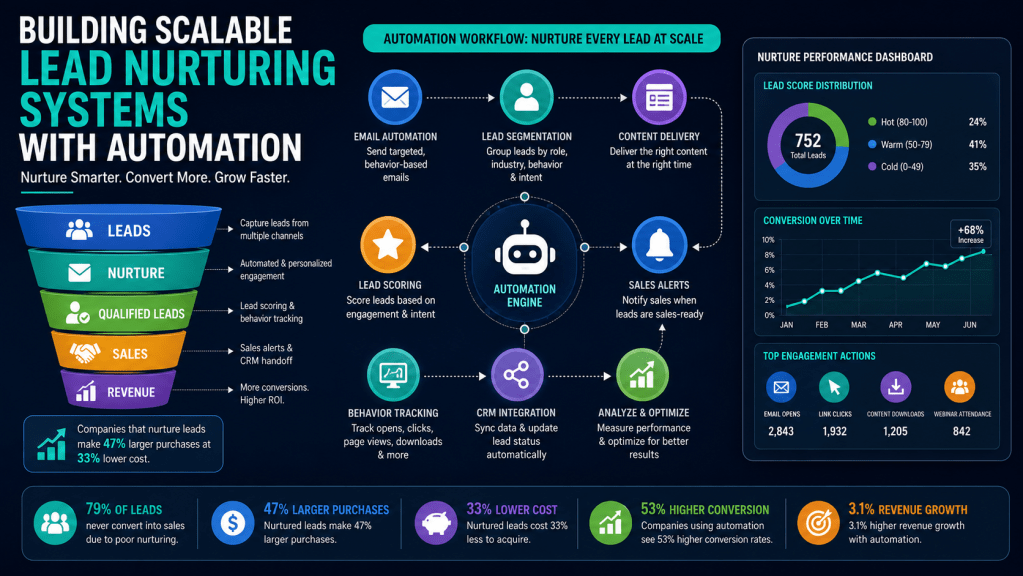
Most businesses think lead nurturing is just sending a few follow-up emails. That is not enough. According to Forrester, 79% of marketing leads never convert into sales, and a big reason for that is poor nurturing. A lot of marketing leads never convert into sales. This is because lead nurturing is not good. If you are not building a system that can handle a lot of leads you are losing money.
Scalable lead nurturing means your system can handle a lot of leads without you having to add staff. It is not about sending the content to everyone. It is about building a system that feels personal even when it is automated.
The companies that figure this out early have a massive advantage. Nurtured leads make 47% larger purchases than non-nurtured leads at 33% lesser cost. The companies that figure this out have an advantage. Leads that are nurtured make purchases than leads that are not nurtured.
Building the Foundation: Understanding Your Lead Nurturing System
Before you start setting up any tools you need to understand what your lead nurturing system is supposed to do. Every part of your lead nurturing automation setup should be doing one of these three things.
- Keep leads warm while they’re not ready to buy
- Educate them so they understand why your product or service is the answer
- Signal to sales when someone is ready to have a conversation
Every part of your lead nurturing system should be doing one of these three things. If it is not, you should stop doing it.
The foundation of a system is segmentation. Not everyone who downloads your whitepaper is the person. Some are researchers. Some are almost ready to buy. Some are competitors checking you out. Your job is to figure out who is who and talk to them differently.
This is where lead scoring comes in. You assign points to actions like visiting your pricing page or attending a webinar. Once someone gets a score they get passed to sales. HubSpot found that companies using lead scoring see a 77% improvement in lead generation ROI compared to those who don’t.
Automated Lead Management: Setting Up Your First Workflows
Okay so now we are getting into the build. When most people hear “automation workflows ” they think it is complicated.. It does not have to be.
Your first workflow should be your sequence. Someone opts in. Fills out a form. They get a series of emails over a day. These emails introduce your brand, show them what problems you solve and offer some content.
Here is a basic structure that works:
Email 1: Give them what they signed up for.
Email 2: Share a win or insight related to their problem.
Email 3: A case study or success story.
Email 4: Address an objection or misconception.
Email 5: A soft call to action.
That is a lead nurturing automation sequence. Where it gets powerful is when you add behavior triggers. If someone clicks the pricing link they should automatically get moved into a sequence.
B2B Automation Workflows That Actually Move People Through the Funnel
For B2B lead nurturing takes longer. The average B2B sales cycle is anywhere from 3 to 12 months. So your B2B automation workflows need to be built for the game.
Here are the key workflow types every B2B team should have:
Top of Funnel (Awareness) Workflows These are for people who’ve just discovered you. They’re not ready to talk to sales because they need awareness about your product. Think blog content, guides, and thought leadership. The goal is to be useful, not to sell.
Middle of Funnel (Consideration) Workflows These leads know their problem and are looking for solutions. Your content here should be comparison-style content, in-depth use cases, and product-focused resources. This is where lead nurturing automation starts doing serious heavy lifting because staying top of mind here is what wins deals.
Bottom of Funnel (Decision) Workflows These people are close. They’ve been engaging consistently, their lead score is high, and they’re probably talking to a few vendors. Your automation here should be personalizing hard. Free trials, limited-time offers, one-on-one demos, customer success stories that match their industry.
Top of Funnel, Middle of Funnel and Bottom of Funnel workflows all require different content. Companies using marketing automation across all three funnel stages see 53% higher conversion rates and 3.1% higher revenue growth than companies without it. Companies that use marketing automation across all three funnel stages see conversion rates and revenue growth.
How to Make Lead Nurturing Systems Feel Personal
One of the fears people have about automation is that it feels robotic.. Good lead nurturing systems are built to feel like someone actually paid attention.
Here are a few things that make a difference:
Dynamic content: Using merge tags to swap out whole paragraphs or images based on what industry someone is in.
Timing based on behavior: Sending emails on a fixed schedule triggers them based on what the person actually does.
Reply-style formatting: Emails that look like they came from a person consistently outperform highly designed marketing emails. One study found plain text emails get a 44% higher click-through rate in B2B contexts
Wrapping Up
Lead nurturing automation is not a nice-to-have anymore. If you are in B2B and trying to grow without burning out your sales team, it is basically a requirement. The companies winning right now are the ones that built scalable lead nurturing systems early and kept refining them based on real data.
Start with your welcome sequence. Add behavior triggers. Build out your funnel-stage workflows. Score your leads. Measure everything. Keep iterating.
The first version of your lead nurturing system will not be perfect and that is completely fine. What matters is that you build it, learn from it, and make it better every quarter. That is how you turn a pile of cold leads into a pipeline that actually moves.
FAQ: Lead Nurturing Automation Questions
How is lead nurturing automation different from just sending email blasts?
Lead nurturing automation is behavior-driven, segmented and designed to move people through a funnel step by step. It triggers lead scoring and dynamic content to make every interaction feel relevant.
What is the best cadence for B2B automation workflows?
The best cadence for B2B automation workflows depends on the sales cycle of the B2B business. A general rule for B2B businesses is to not send emails more than twice a week to people at the top of the funnel and once every one to two weeks to people at the mid-funnel stage. For people at the bottom of the funnel it is better to have frequent and personalized touchpoints because they are already engaged with the B2B business. The key is to let the behavior of the people dictate the cadence of the B2B automation workflows rather than sticking to a rigid schedule for the B2B automation workflows.
How do I know when a lead is ready to be passed to sales from my automated lead management system?
This is what lead scoring solves for the B2B business. The B2B business sets thresholds based on engagement signals like email opens, page visits, content downloads and demo requests from the leads. Most B2B teams find that a combination of fit, such as the right company size and industry and behavioral engagement is the most reliable way to identify sales-ready leads for the B2B business. When someone hits the threshold, an automated alert or task gets created in the CRM of the B2B business.
Can small teams really build lead nurturing systems without a big budget?
Yes small teams can really build lead nurturing systems without a big budget for the B2B business. Tools like ActiveCampaign and Mailchimp start at low monthly costs and have automation features that are more than enough for most small to mid-size B2B teams. The bigger investment is time to map out the customer journey, write the content and set up the logic for the lead nurturing systems of the B2B business. Once it is built a well-designed lead nurturing system runs with very little ongoing maintenance and keeps generating ROI around the clock for the B2B business.