
Data Activation Strategy: Turning Customer Data into Revenue (CDP Focused)
Stay updated with us
Sign up for our newsletter
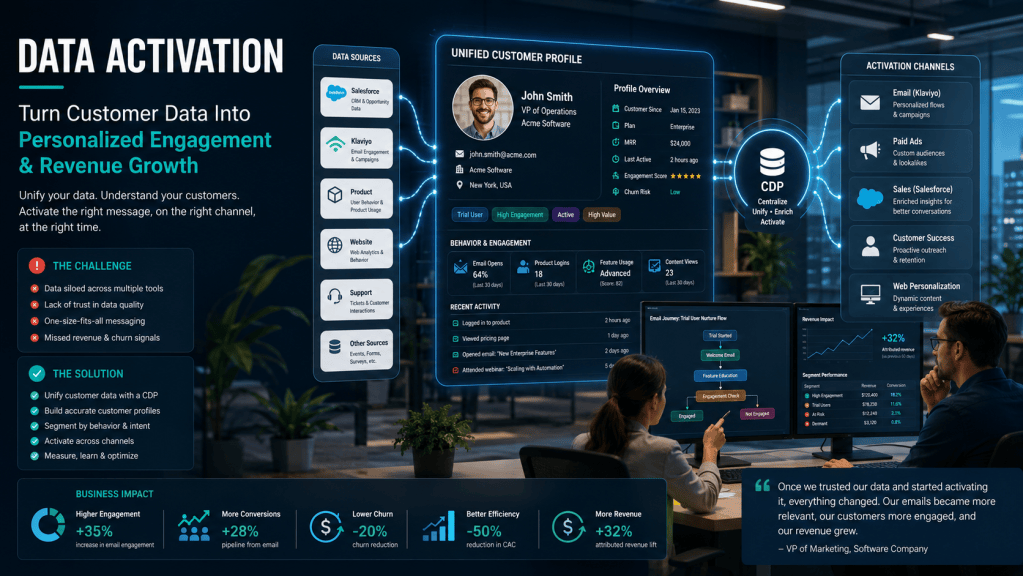
We started working with a software development company earlier this year. They had been running Klaviyo for about three years. Three years of customer data, behavioral signals, purchase history, email engagement, product usage patterns, all sitting in there. Their Salesforce was connected. The data existed. There was genuinely a lot of it.
And what were they doing with all of it?
Sending the same batch email to their entire list every single week. Same subject line format, same send time, same content regardless of where someone was in the buying journey, whether they were a trial user or a paying customer or someone who hadn’t opened an email in eight months. Everyone got the same thing.
That’s a data activation problem. And it’s one of the most common ones we see in B2B.
What Data Activation Actually Means and Why CDPs Matter
Data activation is the process of taking the customer data you already have. Actually using it to make marketing and revenue decisions. It is not about storing the customer data or reporting on it. It is about using the customer data to change what you send to the customers, who you target, when you reach out to them and what you say to them.
A customer data platform or CDP is a tool that makes this possible on a scale. It takes data from different sources, puts it together into a single customer profile and makes that profile available to every other tool that you use. This means that your email platform, your ad platforms, your sales team and your support team can all work from the complete picture of who the customer is and what they have done.
The reason CDPs are so important for data activation is that most companies have customer data spread out across different systems that are not connected. For example Klaviyo has information about what the customers do with their emails. Salesforce has information about the sales activity. The product that you sell has information about how it’s used. Your website has information about how the customers behave when they visit it. Without a CDP or some other way to bring all this data together each team is working with information and making decisions based on only part of the story. Unified customer data helps companies make money from each customer over time. Companies with data do better than those without it.
It costs 5 times more. Without customer data companies struggle to make the most of their customers. 91% of consumers shop with brands that offer them deals and recommendations. Unified data helps brands create experiences for each customer. This is based on the customer’s history with the brand across all channels.
We worked with a software company that had lots of customer data. They hadn’t put it all together or used it to make decisions. A customer data platform is important for making data work. It can make a difference in how well companies use customer data to drive marketing and revenue. The customer data platform helps companies use their data to make decisions. This leads to revenue and better customer experiences. Companies can tailor their approach to each customer. This is the key to long-term success.
The Real Reason Customer Data Activation Fails
With the software development client the data was available. Klaviyo had three years of it. Salesforce had contact records that went back further. The integration was already set up.. Due to some early issues with data quality the team had stopped trusting what they saw.
When you do not trust your data you do not act on it. You go with the option, which in email marketing means sending the same thing to everyone and hoping for the best. This happens often in companies that have grown faster than their data system. Someone sets up an integration without fully thinking through how the fields match. A few things sync incorrectly. A segment does not behave as expected. Someone sends it to the group. From that point on the team is cautious about doing anything more complex than a basic send to everyone.
The solution is not always technical. Sometimes it is about rebuilding confidence in the data through verifiable successes. You run one segmentation. You check the output manually. It works. You run another. You build trust slowly until the team is willing to use the data as intended. The team starts to trust the data. They begin to use it to make decisions. The data becomes an asset to the team.
They make the most of it.
CDP Data Activation: What Good Actually Looks Like
We started working with the software development client by doing a data audit. We looked at what was in Klaviyo and Salesforce to see if the information was correct.
Most of the data was accurate. They had fixed some problems that happened when the systems were syncing. The team had stopped trusting the data because of these problems. We found a few duplicate records and some old contact information that needed to be updated.
This was not a deal and we could clean it up in a week or two.Once the data was clean the team could see that it was accurate. Then we started working on using the data from the CDP. We created five groups of customers.
- People who tried our product but did not buy it after 14 days
- Customers who paid us but had not logged in for 30 days
- Customers who started using our product a lot in the last 60 days
- People who opened our emails but never booked a meeting with us
- People who did nothing with our emails for 120 days
Each group got a type of email.
The emails had content, a friendly tone, a clear call to action and we sent them at the right time. The people who tried our product but did not buy it got a series of emails that showed them how to use the features they had not tried yet in Klaviyo. The customers who started using our product a lot got a story about how another customer was successful and an offer to buy more from us.
The people who did nothing with our emails got a series of emails that gave them the option to stop getting emails from us cleanly.
After 60 days the money we made from emails increased a lot.
The team could send emails to the people because they were not sending emails to people who were not active at the same time as people who were active. The sales team started using the data to see which customers were active and which were not before they called them. This is what it looks like when you use customer data to market your product with Klaviyo and Salesforce. The client was happy with the results, from Klaviyo. The software development client saw the value in using their customer data to make money.
Read More – How AI Email Marketing Drives 1:1 Personalization at Scale
Data Activation Strategy Beyond Email
Email is usually where CDP activation starts because it’s the most direct channel and the easiest to test quickly. But a proper data activation strategy goes significantly further.
The same customer profiles that drive your email segmentation can feed your paid advertising. Upload your high-intent segments to Google and Meta as custom audiences. Build suppression lists from your existing customers so you’re not spending budget trying to acquire people you already have. Create look-alike audiences from your best customer profiles. Experian reports that Customer Match campaigns using first-party data deliver up to 20% higher revenue and 50% reduction in customer acquisition costs than standard interest targeting.
More than 75% of respondents said that stopping support for third-party cookies would have some effect on key performance areas which include audience matching, campaign management, reporting and user acquisition. The impact on core drivers of performance would not be the same for everyone, but definitely affect user acquisition.
And on the retention side, CDP data activation is what makes proactive customer success possible instead of reactive. If your product usage data shows a customer’s activity dropping significantly over three weeks, that’s a churn signal. A properly activated CDP surfaces to your customer success team before the customer has decided to leave, which is the only time an intervention actually works.
Using Customer Data for Marketing Without Losing People’s Trust
There’s a line in CDP activation between useful personalisation and personalisation that feels invasive. In B2B the line is generally more generous than in B2C because buyers expect vendors to know their situation. But it still exists.
The principle that works is relevance over precision. Using data to send the right content to the right person at the right time is welcome. Using data in a way that makes someone feel like they’re being watched too closely is not. “We noticed you’ve been looking at our enterprise pricing page” is probably too on the nose. “Here’s a breakdown of how enterprise teams use our platform” based on the same signal is useful without being unsettling.
Transparency helps. 79% of customers say they’re increasingly protective of their personal data.Being clear about what data you collect and how you use it, not buried in a privacy policy but actually communicated, makes people more comfortable with personalisation. Salesforce found 71% of customers are willing to share personal data when the reason is clearly explained. (Salesforce State of the Connected Customer, 2022) In B2B that translates directly to willingness to engage with personalised outreach.
Frequently Asked Questions
What is a data activation strategy and why does it matter for B2B?
Data activation strategy is the plan for how you take customer data you already have and use it to drive actual marketing and revenue outcomes. It matters in B2B because buying cycles are long, buyers expect relevance, and the cost of irrelevant outreach is high. Companies sitting on years of CRM and email data without activating it are leaving significant revenue on the table.
How is CDP data activation different from just using your email platform’s segmentation?
Your email platform only knows what happens in your email platform. A CDP pulls data from every source, your product, your CRM, your website, your support tool, and unifies it into a single profile. That unified profile is what makes real personalisation possible because you’re working from a complete picture of the customer rather than just their email behavior.
What’s the first step in building a customer data activation program?
Audit what you actually have before buying anything new. Most companies have more usable data than they think, sitting in tools they already own. Clean it, verify it’s accurate, build confidence in it through small testable segments, and start activating from there. The software and the data are rarely the constraint. The willingness to trust and act on the data usually is.
How do you use customer data for marketing without it feeling creepy?
Focus on relevance rather than demonstrating how much you know. Use behavioral signals to inform timing and content without making the signal itself visible in your messaging. Be transparent about data collection in plain language. And give people real control over their preferences. In B2B, buyers are generally comfortable with personalisation when it makes interactions more useful. The line gets crossed when it feels like surveillance rather than service.