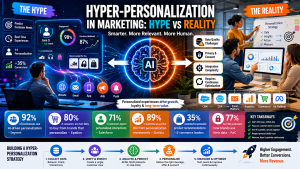
Using Conversational AI to Deliver Personalized E-Commerce Journeys
Stay updated with us
Sign up for our newsletter

Conversational AI has not only brought about the advent of support chatbots but also ones that have become a strategic force in personalizing the customer’s online shopping journey. With customers demanding instantaneous and individual communication, companies are using AI platforms that can understand the customer’s intention, emotions, and even their buying history within seconds.
The AI-powered marketing partnership nowadays relies on the perfect synergy among chatbots, recommendation engines, marketing automation, and collaboration tools. Whether through a voice assistant that prompts the right dress or an AI chat interface that helps cart recovery, conversational systems are controlling the brands’ engagement methods.
Nurturing Leads to Unique Promotions
The very essence of Conversational AI in the online shopping world is unique promotions. The earlier scenario was that users were categorized only as per their age, gender, or purchasing behavior when traditional marketing automation was being used. Thanks to the introduction of AI-driven personalization tools, personalization is now getting to know the users’ mood, circumstances, and tastes through ongoing interactions.
AI assistants are constantly studying the customer’s behavior to find the right time and way for the company to communicate. A returning customer could receive a casual product recommendation that is related to their previous purchase, while a new visitor is given a walk-through of the website as part of the onboarding process. These small details in personalization contribute to building customers’ trust, making them happier, and as a result, delivering higher conversion rates that might have been impossible with static campaigns.
Read More: How AI Resource Management Helps E-Commerce Brands Grow Without Chaos
The Role of AI-Powered Marketing Teamwork
Conversational AI is the backbone of every marketing experience, and it is the result of the AI-powered marketing teamwork. Marketing platforms that are AI-based are often employed by modern companies where human creativity intersects with the intelligence of algorithms. AI not only drives the conversations directly with the customers but also makes internal collaboration much smoother by making it easier for different departments to be on the same page when it comes to content, campaigns, and customer insights.
In the case of a fashion retailer, for example, it could automate its marketing workflow using AI, and as a result, it would get rid of the friction between its chatbot promotions, influencer content, and seasonal campaigns. Marketing, design, and customer service departments can now all participate in AI-assisted campaign planning, making sure there are no differences in communication between the customer and the brand through the entire customer cycle in terms of tone, offers, and messages.
Content and campaigns are no longer separate, but rather, they are part of the same intelligent ecosystem that is constantly adapting to the current trends.
From Browsing to Checkout
Think of a situation where a customer is looking at skincare products on a website. A Conversational AI agent is already there to greet and to carry on a contextual dialogue with the customer:
“Hello! If you have a dry skin type, the best choice for you would be our new vitamin C serum. Why not take a look at the customer reviews or check if it’s on offer?”
This is not a monotone exchange. It is a conversation that is constantly changing, and the whole process is backed by AI-driven marketing collaboration for B2B and enterprise teams. To formulate responses that come across as really useful, the AI pulls information from the CRM system, previous purchases, and social media attitudes.
Bridging Marketing and Customer Experience
The impact of Conversational AI is not only limited to enhancing the user experience but also changing the whole process of enterprise team collaboration tools. The conversation channels are nothing but data intelligence centers, and the whole interaction turns into a data set that is useful in product development, campaign targeting, and even the tone of the conversation in the future.
Marketing insights that are connected with the AI-powered collaborative marketing platforms are utilized by the marketing and customer experience teams. For instance, the sentiment analysis done by the automated systems can inform the teams if there is any customer dissatisfaction regarding the product size. The feedback loop gets created quickly, as the customer experience data gets transferred to the marketing workflow directly, allowing for immediate adjustment of either content or offer.
AI Collaboration as a Productivity and Creativity Tool
Marketing backend operations are being improved by Conversational AI in addition to customer interactions. The collaboration between AI and marketing for B2B has rendered the flow of ideas, writing, and running campaigns through the corporate lobbies effortless. Using tools like ChatGPT Enterprise, Jasper, and Notion AI, remote teams ideate quickly and adjust their personalized messaging on different platforms simultaneously.
By bringing together marketing automation and collaboration tools along with conversational insights, the teams not only get efficiency but also foresight. Predictive analytics offered by the AI marketing workflow automation determines which part of the campaign will be most successful.
Read More: The Rise of the AI-Integrated Marketing Team: Collaboration, Content, and Commerce
Overcoming the Personalization vs. Privacy Dilemma
As voice-operated systems get smarter, the competition between personalization and privacy becomes sharper. Consumers always want personalized offers, but they also want to know how their data is used. The AI-powered platforms for collaborative marketing campaigns facilitating cooperation between enterprise teams will be those that use data ethically and carry out communications based on consent.
Brands are implementing privacy-first strategies wherein consumers are aware of how AI personalizes the recommendations. The honest presentation, “the reason I am recommending this product is that you have shown interest in XYZ type of skincare,” builds up confidence. Ethical AI, in this case, turns into a plus point in the competition.
Conclusion
In the world of personalized e-commerce, Conversational AI is not just an add-on. It allows the companies to combine robotic interaction with human touch, making sure no customer is left unnoticed or unacknowledged. The combination of AI-assisted marketing teamwork, collaboration marketing platforms, and AI marketing workflow automation is opening up the period of uniting creativity and smooth personalization without friction.
Write to us [wasim.a@demandmediaagency.com] to learn more about our exclusive editorial packages and programmes.