Organic vs Paid Customer Acquisition Cost: Why SEO Delivers Better Long-Term Efficiency
Stay updated with us
Sign up for our newsletter
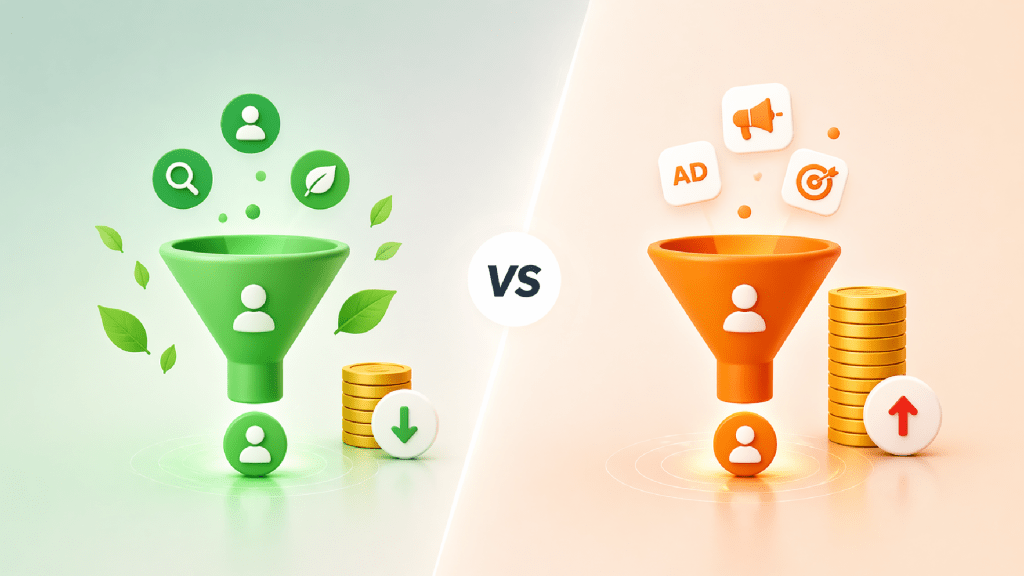
Every dollar you spend on marketing has a price tag on the customer it brings in. The real question is not just how much you spend but how long that spending keeps working for you. This is where organic and paid channels start to look very different from each other. Most businesses in the US go straight for the fastest option: paid ads. Set a budget, run the ads, get the leads. It feels like it is working. It looks like it is working. But when you look at organic vs paid Customer Acquisition Cost (CAC) over 12, 24, or even 36 months, the story changes a lot. SEO starts to look like one of the smartest investments you can make in your entire marketing budget.
This blog breaks down the real cost of getting customers through organic and paid channels, why customer acquisition cost SEO gets cheaper over time while paid keeps getting more expensive, and how to make a smarter call with your marketing dollars.
What Is Customer Acquisition Cost (CAC) and Why Should You Care?
Customer Acquisition Cost, or CAC, is basically how much money you spend to get one paying customer. It adds up everything: ad spend, agency fees, content costs, salaries, software tools. You take all of that and divide it by how many customers you actually got.
Smart businesses keep their CAC way below what a customer is worth over time. But here is the thing most people miss: CAC is not a fixed number. It changes depending on which marketing channel you are using and when you are measuring it. That detail matters a lot more than most people realize.
The Problem With Paid Ads
Paid advertising like Google Ads, Meta, or LinkedIn does one thing really well: it is fast. You can go from launching a campaign to getting your first lead in the same day. For newer businesses in the US that are trying to test an offer or fill up their sales pipeline quickly, that speed is actually useful.
But when you compare organic traffic vs paid traffic over a longer stretch of time, a big problem shows up. The second you stop paying, the traffic stops too. You are basically renting your spot in front of people rather than owning it. Every single click costs money. Every impression costs money. And as more businesses compete for the same keywords and audiences, the cost per click keeps going up. In a lot of industries, it goes up by 15 to 30 percent every single year.
A lot of marketers call this the paid ads treadmill. You have to keep running faster and spending more just to stay in the same spot. Your CAC has a minimum price set by whoever else is competing in your space, and that minimum only goes up over time.
Also, people who click on ads are usually just browsing around. But someone who types “best accounting software for small businesses” into Google and finds your page through organic search is actually looking to buy something. And they trust your result more because it did not say “Ad” next to it.
How SEO Actually Changes Your Customer Acquisition Cost
SEO works in a totally different way. You spend most of the money upfront on things like creating content, fixing your website, and building links. But after that, the results keep building on themselves instead of resetting every month like paid ads do.
Here is what customer acquisition cost SEO actually looks like over 24 months:
- Months 1 to 6: You are spending money but not seeing much traffic yet. Your CAC looks really high.
- Months 6 to 12: Your pages start ranking on Google. Traffic picks up. Your CAC starts going down.
- Months 12 to 24: Things start compounding. One article might bring in hundreds of leads every month and it is not costing you anything extra to run. Your CAC drops a lot.
With paid ads, your CAC stays pretty much the same every month. With SEO, your CAC gets cheaper the longer you stick with it. A blog post that cost you 2,000 dollars to write and ranks on Google for three years could bring in hundreds of customers. At that point your cost per customer could be just a few dollars.
Read More – SEO as a Revenue Channel: How Organic Search Drives Pipeline and Growth
Organic vs Paid CAC: A Direct Comparison
This marketing CAC comparison shows the key differences clearly:
|
Factor |
Paid Ads |
Organic SEO |
|
Time to first traffic |
Hours to days |
3 to 6 months |
|
CAC at month 1 |
Very high |
Highest (you are still investing) |
|
CAC at month 24 |
Same or higher |
A lot lower |
|
Traffic if budget stops |
Goes to zero right away |
Keeps going (rankings stay) |
|
Trust from buyers |
Lower (people see the “Ad” label) |
Higher (you earned that spot) |
|
Quality of audience intent |
Mixed |
High (they searched for you) |
|
Cost to scale |
You spend more to grow |
Gets cheaper as it compounds |
|
Do you build a long term asset? |
No |
Yes |
SEO vs Paid Ads ROI: Why Compounding Wins
The biggest reason to go organic is compounding. When you look at SEO vs paid ads ROI, the difference is not just about being more efficient. It is about what kind of returns you are getting.
Paid ads give you straight line returns. Spend twice as much and you get roughly twice the leads. SEO gives you compounding returns. A blog post that ranks for a good keyword keeps bringing in leads this month, next month, next year, and sometimes for years after that. On top of that, ranking one piece of content helps your whole website gain more authority, which makes your next piece of content easier to rank, which lowers your costs even more.
HubSpot found that inbound leads coming mostly from organic search cost 61 percent less than outbound leads. Research from Terakeet showed that big US brands were paying around 1,800 dollars per lead through paid ads but only 150 dollars per lead through organic search for the exact same keywords. Over time that gap gets even bigger.
Think of every piece of SEO content you publish as a salesperson who works around the clock, never calls in sick, and gets better at their job the longer they are there. A paid ad stops the second your budget does.
When Paid Ads Are Still the Right Call
A fair marketing CAC comparison has to be honest about when paid channels actually make sense. Paid ads are a good fit when:
- You need leads right now and have zero organic presence built up yet
- You are testing a new product or entering a new market before you commit to a content strategy
- Your niche is super specific and there are not many people searching for it organically
- Competitors are running ads on your brand name and you need to protect it
- You have a time sensitive promotion or event coming up
The issue is not using paid ads at all. The issue is treating them like a replacement for organic investment instead of something that works alongside it. The best US marketing teams use paid ads to bring in short term revenue while SEO builds up the long term foundation that eventually makes them less dependent on paying for every click.
Read More – SEO vs AEO vs GEO: The Future of Search Optimization for B2B Marketing in 2026
How to Start Lowering Your CAC With SEO
If the economics of organic traffic vs paid traffic make sense to you and you want to shift your strategy, here is where to start.
Focus on keywords that signal buying intent. Not all organic traffic converts the same way. Go after the bottom of funnel keywords, meaning the searches that people make when they are close to making a decision. Even if fewer people search for these terms, the ones who do are much more likely to become customers. That pushes your effective CAC down fast.
Create content that gets links naturally. Links from other websites are still one of the biggest factors in how Google decides to rank your pages. Put money into original research, really thorough guides, or free tools that people in your industry will want to share and link to.
Get your technical foundation right. Even great content will not rank if your website is slow or hard for Google to crawl. Make sure your site loads fast on phones, passes Google’s Core Web Vitals, and is set up so search engines can easily index every page.
Measure CAC by channel the right way. A lot of US companies accidentally make organic look worse than it is because they use last click attribution. The organic journey usually takes longer. Use multi touch attribution so you can see how much organic search is actually contributing to your final sales numbers.
Bottom Line: Playing the Long Game Pays Off
Most US companies overspend on paid ads and underinvest in organic not because they made a bad strategy call but because they are measuring things wrong. Paid looks cheaper in month one. Organic looks expensive. But a real marketing CAC comparison is not about one month. It is about where your costs are headed.
When you invest in SEO you are basically betting that your business will still be around in 18 months. That bet almost always pays off well. The brands that really get organic vs paid CAC are not just cutting their acquisition costs. They are building something that competitors cannot just outspend overnight: a real audience, strong domain authority, and a library of content that keeps working for years.
Paid ads get you customers today. SEO gets you customers today, tomorrow, and for years down the road. When you look at SEO vs paid ads ROI over the long run, the math keeps pointing the same direction. The only question is whether your business is ready to be patient enough to play that game.
“The best time to start investing in SEO was two years ago. The second best time is right now while your competitors are still stuck on the paid ads treadmill.”