
Treasure Data CEO Kazuki Ohta’s Exclusive Interview with MarTech Pulse on AI-Driven B2B Demand
Stay updated with us
Sign up for our newsletter
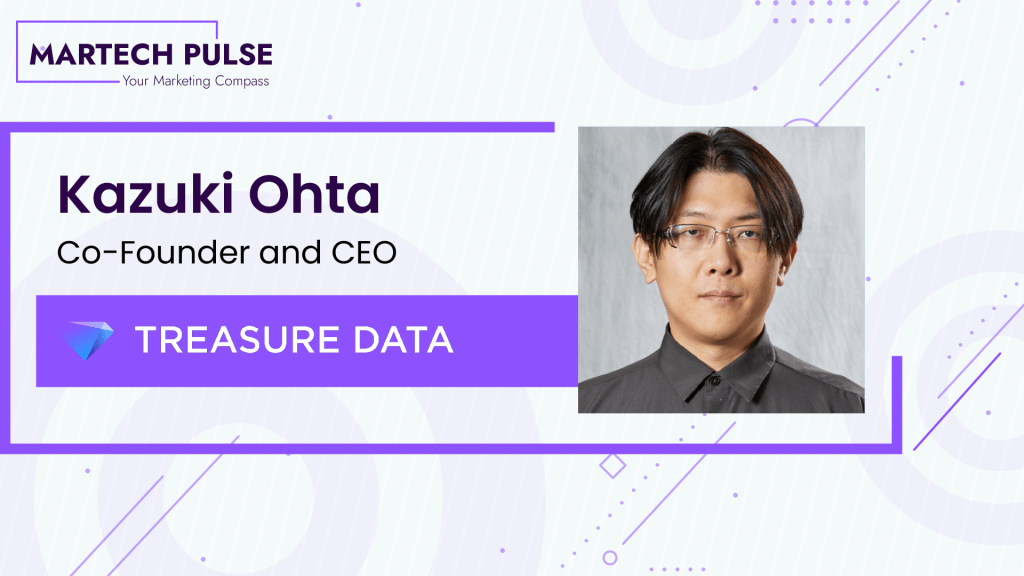
Kazuki Ohta’s HPC-to-CEO journey at Treasure Data shifts from scalable systems to revenue. His Marketing Super Agent vision: unified CDP intelligence, multi-agent orchestration, pipeline metrics over siloed vanity indicators.
Kazuki, you’ve scaled Treasure Data from CTO to CEO over 14+ years amid big data shifts. What 2-3 career pivots shaped you most, and how do you stay ahead in AI MarTech?
Three pivots stand out. First, my original background is HPC, high-performance computing, and I had the opportunity to work on the world’s fastest supercomputer early in my career—those experiences taught me to think in distributed systems and performance at massive scale, which is now essential for customer data platform (CDP) and AI workloads. Second, co-founding Treasure Data in 2011 before “CDP” was even a category forced us to invent the data foundation marketers needed, not just follow the market. Third, moving from CTO to CEO made me responsible for outcomes, not just architecture; it pushed me to stay obsessively close to CMOs, which is how we’ve evolved our product over time from a customer data platform (CDP) toward an agentic marketing platform.
Today I stay ahead by living with this technology every day: I use dozens of specialized agents in my personal and professional life, and I’ve set them up to handle everything from researching a customer before walking into a meeting to improving my golf game.
Marketing Super Agent just launched for full lifecycle orchestration. What’s the wake-up call for B2B CMOs on where 2026 demand gen really ignites?
The wake-up call is that in 2026, demand gen won’t be won by adding one more channel. The CMOs who win will use AI as a system that plans, executes, and optimizes the marketing lifecycle, not as a point tool for isolated tasks.
Read More: Highspot CEO Robert Wahbe’s Exclusive Interview with MarTech Pulse on Deal Agent
B2B channels like LinkedIn and email still siloed? How does Super Agent’s CDP view flip budgets and strategies?
At Treasure Data, we’ve built dozens of AI agents for customers on our AI Agent Foundry, which is the foundation of Marketing Super Agent. (Customers can also build their own agents.)
The Multi‑Touch Attribution Agent has proven popular with our customers. Instead of looking at LinkedIn, email, events, and search in isolation—or relying on last‑click reports from individual platforms—it analyzes channel performance across multiple attribution models on top of a unified CDP view. That means it can show how each touchpoint actually contributes along the full journey and recommend the optimal budget allocation and channel strategy, not just the “loudest” channel. In practice, B2B teams use it to see which combinations of ads, emails, webinars, and sales touches create qualified opportunities and revenue, then shift spend into those proven paths and away from channels that look good in a silo but don’t pull their weight in multi‑touch reality. We’re excited to extend this functionality into Marketing Super Agent over time so marketers can access from one unified canvas.
What’s your simple playbook for teams to set up Super Agent and launch campaigns within 90 days?
Start with fluency and first workflows. Start by running guided workflows end‑to‑end in a safe environment: a quick research task, a persona creation, a document review that turns into a SWOT, and then a full flow from research → creative brief → concepts → first‑round ads for a single campaign. That builds confidence in how the Super Agent Orchestrator proposes plans, coordinates task agents, and carries context across steps.
Move to real campaigns with a small squad. Choose one or two high‑impact use cases—like a new product launch or a regional demand program—and have a cross‑functional pod (demand gen, product marketing, marketing operations, sales) run them entirely through Marketing Super Agent, standardizing the prompts, agents, and output formats you use most. Run in parallel with your normal process to compare, and measure ROI from day one using our ROI Reporting Agent.
Standardize and scale. Promote the winning workflows into “official” playbooks, connect them to your activation paths, and treat them as part of your operating model so campaigns are launched and iterated with agents by default, not as a side experiment.
AI agents fight MarTech chaos – what are B2B’s top 2 CDP blunders and quick fixes?
In B2B, the first big mistake is treating the CDP like a giant lead list instead of an account‑based system—contacts aren’t grouped into real buying committees or hierarchies, so you can’t see which accounts are actually heating up. The fix is to model profile‑to‑account relationships, layer on account‑level scoring, and orchestrate journeys off account behaviors so sales and marketing are aligned on the same target list.
The second blunder is hoarding data without making it actionable for GTM teams—no predictive models, no ABM activation, and no clear signals for reps. The fix is to start small: stand up a few B2B propensity models in the CDP, push those scores into your CRM and ABM tools, and let agents and teams prioritize the accounts most likely to buy or expand.
Read More: How Salesforce’s 80,000 Employees Are Saving Up to 20 Hours a Week With Slackbot
For lean IT/HR Tech teams, what 2 underrated AI tactics explode visibility?
First, put responsible AI guardrails in place early and work with vendors that prioritize this into their systems and operations. When governance is clear, marketing can safely use agents without concern—so more work actually ships.
Second, run AI on a CDP with predictable pricing so teams can experiment fearlessly and IT can keep costs under control. Treasure Data prices on profiles and behaviors, not how many times you query or segment, so you can run experiments without worrying about runaway compute bills.
These underrated tactics make it much easier for marketing and GTM teams to try dozens of AI‑driven ideas and quickly surface the ones that move pipeline and retention.
Which 3 metrics for B2B marketers to track daily in 2026, and 2 vanity ones to drop?
I’d have B2B teams watch these things every day: (1) net‑new and expansion pipeline; (2) stage‑to‑stage conversion and pipeline velocity from MQL → SQL → opportunity → closed‑won, so you see friction where AI agents should go to work; and (3) cost per qualified opportunity. The two metrics I’d deprioritize are raw MQL volume and basic engagement stats like opens and impressions, which are useful diagnostics, but on their own they don’t tell you if marketing is actually growing revenue.
How will teams restructure around multi-agent AI like Super Agent – what’s one step today?
I believe marketing organizations will increasingly look like outcome pods surrounded by small, specialized AI agents—an orchestrator, a researcher, a persona role‑player, a campaign builder, a creative producer—all working together on a shared goal, rather than siloed channel teams. One step marketing leaders can do is to establish internal champions who model best practices for AI‑native workflows and encourage teams to follow their leads in weaving AI into everyday processes.
Thank you, Kazuki Ohta, for taking the time to share your insights with us.
Write to us [wasim.a@demandmediaagency.com] to learn more about our exclusive editorial packages and programmes.
Kazuki “Kaz” Ohta is the co-founder and CEO of Treasure Data, the AI-native marketing platform. Prior to becoming CEO, he was the founding Chief Technology Officer (CTO) at Treasure Data and helped steer the company to an acquisition by Arm in 2018.
Customer-centricity is Kaz’s mission and passion as an entrepreneur and a computer scientist. He uses his expertise in parallel and distributed computing to innovate in a world of exploding amounts for customer data. Kaz moved to the United States without knowing how to speak English, where he overcame this obstacle and majored in computer science. During that time, his professor built the world’s fastest supercomputer (essentially 500K computers combined into one), and Kaz was part of the team that built the file system.
Kaz also co-founded the world’s largest Hadoop User Group. A long-time open source advocate, he has made numerous contributions to open-source software and was instrumental in developing the open-source applications Fluentd, Embulk and Messagepack.
In his free time, Kaz enjoys building up his sake collection (importing cases from Japan every month), and during the pandemic, he learned how to properly cut sashimi-style sushi (Maguro O Toro is his favorite). In addition, Kaz is also really deep into gaming, specifically Fortnite.
Treasure Data provides global brands the trusted data foundation and intelligence to know and engage every customer with hyper-personalized experiences. The company’s Intelligent CDP, AI Agent Foundry, and AI Marketing Cloud together form the AI-enabled marketing platform to help companies reduce total cost of ownership and power revenue growth through more relevant engagement.