How Salesforce’s 80,000 Employees Are Saving Up to 20 Hours a Week With Slackbot
Stay updated with us
Sign up for our newsletter
Salesforce shares Slackbot’s evolution into a trusted AI agent grounded in real work data, explores why productivity in 2026 is about shared context rather than tools, and explains how embedding AI into everyday workflows helps teams cut through silos, save hours, and move from questions to action faster.
Slackbot launched as a personal AI agent grounded in Slack data. Where is productivity headed in 2026?
Productivity in 2026 shows up in small moments throughout the day when someone can prepare for a meeting in minutes instead of an hour, or get a clear answer without interrupting five colleagues. At Salesforce, Slackbot has become a go-to for these moments.
When 80,000 people save those minutes, that time goes back into customer work and moving projects forward. What we learned internally as Customer Zero is that productivity gains compound when AI is grounded in real work and real data for both individuals and teams We’re now seeing that same pattern with customers like Beast Industries and Xero, where teams use Slackbot to stay aligned as conversations move quickly, and with companies like Engine and reMarkable, where employees rely on Slackbot to instantly gain context and keep work moving without constant catch-up.
The common thread is that AI delivers impact when it’s embedded in everyday workflows and grounded in trusted business context.
How does Slackbot actually unify context across siloed workstreams like Slack, files, and CRM?
The reality is that work happens everywhere — conversations in Slack, decisions documented in files, updates reflected in CRM. The challenge has always been bringing those pieces together quickly. What we see internally is people using Slackbot to pull together the conversations, files, and customer data they need directly into their normal workflow so they can move forward with confidence.
We’re seeing customers experience the same thing. Teams at companies like Xero and Slalom don’t have to jump between systems or re-explain background — Slackbot connects the dots across conversations, unstructured files and systems of record, turning scattered information into a clear picture. The result is less back-and-forth and more time spent moving work forward together.
Read More: Bloomreach CEO Raj De Datta’s Exclusive Interview with MarTech Pulse on AI Personalization
What does a practical 90-day Slackbot deployment look like for enterprise teams?
The teams that get value fastest don’t overthink it. In the first few weeks, they use Slackbot to catch up on conversations, prep for meetings, and answer everyday questions. Once that becomes part of the routine, they start using it to create things like meeting notes, project summaries, and updates that the whole team can work from.
Over time, people share what’s working and adoption grows naturally. That’s exactly how it’s played out inside Salesforce, and it mirrors what we’re seeing with customers. As teams build confidence, usage expands organically, supported by shared prompts and best practices that make it easy for new teams to see value quickly.
What are the top barriers to trusted AI agent adoption, and how do you get past them?
One thing that consistently slows adoption is when people aren’t sure what an AI tool can see or whether they can trust it with their work. Inside Salesforce, being very clear about permissions and access was foundational. People need to understand exactly what data an AI agent can use and what it can’t, or they simply won’t rely on it. Another challenge is when AI feels separate from normal workflow. If employees have to go out of their way to use it, adoption drops off quickly.
A third barrier that’s easy to overlook is what I’d call AI shame. In some organizations, people hesitate to talk openly about how they’re using AI. They worry it reflects poorly on their skills, or they treat it as a personal productivity edge they shouldn’t share. We saw internally that adoption really accelerated when teams started sharing what worked, passing around prompts, and being transparent about how Slackbot was helping them do their jobs. That kind of openness creates a virtuous cycle where people learn from each other instead of starting from scratch.
Slackbot works because it lives where work already happens and understands the context around conversations, business data, and team activity. That lesson carried directly into how we built Slackbot and Agentforce for customers. Teams at companies like Engine and reMarkable trust Slackbot because it already understands their world, without requiring long explanations or setup. When AI is transparent, predictable, embedded into everyday work, and openly shared across teams, trust follows and adoption scales.
For lean operations teams, what are the most underrated Slackbot use cases that save hours on context hunting?
Two uses really stand out for us internally. One is what I’d call instant replay. People come back from being out, or step out of back-to-back meetings, and instead of scrolling through dozens of Slack messages, they ask Slackbot what was decided, why it mattered, and what they need to do next. We see this a lot with sales and cross-functional teams where conversations move fast — and we hear the same from customers like Beast Industries.
The other is meeting preparation. Before a meeting, employees ask Slackbot to prepare them and it will pull together recent conversations, relevant documents, and customer or project context so they can walk in prepared. Customers like Xero and Slalom have told us this changes the tone of meetings and handoffs — less time spent getting up to speed, and more time spent actually solving problems.
What metrics are tech leaders tracking in the agentic era?
What we pay attention to is whether people keep coming back to the tool — whether it’s giving them time back and helping teams move from questions to action more quickly. To date, Slackbot is the fastest-adopted feature in Salesforce history. More than 80,000 employees are already using it, which gives us strong real-time feedback even before broad external customer deployment.
We see similar signals from customers, who consistently point to time saved, reduced context switching, and faster decision-making as the metrics that matter most.
Read More: FirstComm CEO Paul Van Hyfte’s Exclusive Interview with MarTech Pulse on UCaaS Evolution
How are teams actually restructuring work around AI agents like Slackbot? What’s one step leaders can take today?
What’s been most interesting to watch internally is how differently teams use Slackbot while still benefiting from the same core idea: shared context. Sales teams use it to understand accounts faster. Engineering teams use it to surface past decisions. HR teams use it to pull together accomplishments across a year’s worth of work.
We’ve seen that same flexibility resonate with customers. Teams at companies like Beast Industries, Engine, reMarkable, Xero, and Slalom are all using Slackbot in different ways, but with the same outcome: less time spent hunting for information and more time spent moving work forward.
The key step leaders can take today is to start where work already happens. When AI adapts to how teams operate — rather than forcing new workflows — it stops feeling like a tool and starts feeling like part of how work gets done.
Write to us [wasim.a@demandmediaagency.com] to learn more about our exclusive editorial packages and programmes.
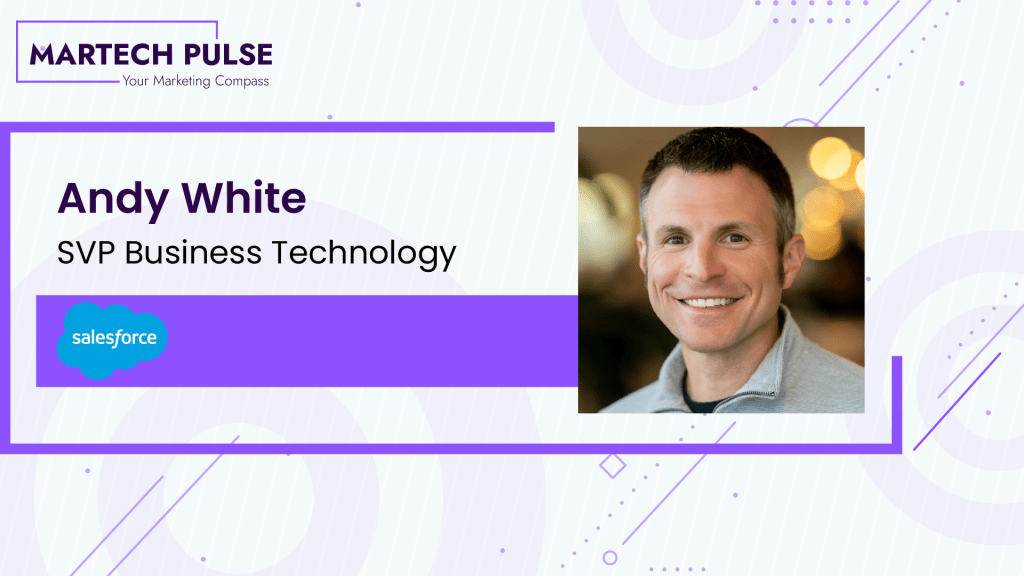
Andy White is Senior Vice President of Digital Enterprise Technology at Salesforce, leading the Salesforce on Salesforce Technology team. He drives Customer Zero initiatives, enabling AI-powered transformation across Salesforce’s global workforce through Agentforce, Slack, and Slackbot. Under his leadership, Slackbot became Salesforce’s fastest-adopted AI tool. Andy is passionate about eliminating bureaucracy through technology so teams can focus on customers, innovation, and strategic impact..
Salesforce helps organizations of any size become agentic enterprises — integrating humans, agents, apps, and data on a trusted, unified platform to unlock unprecedented growth and innovation. Visit http://www.salesforce.com for more information..