
Pattern, Chief Revenue Officer, John LeBaron’s Exclusive Interview with MarTech Pulse on Agentic Campaign Management
Stay updated with us
Sign up for our newsletter
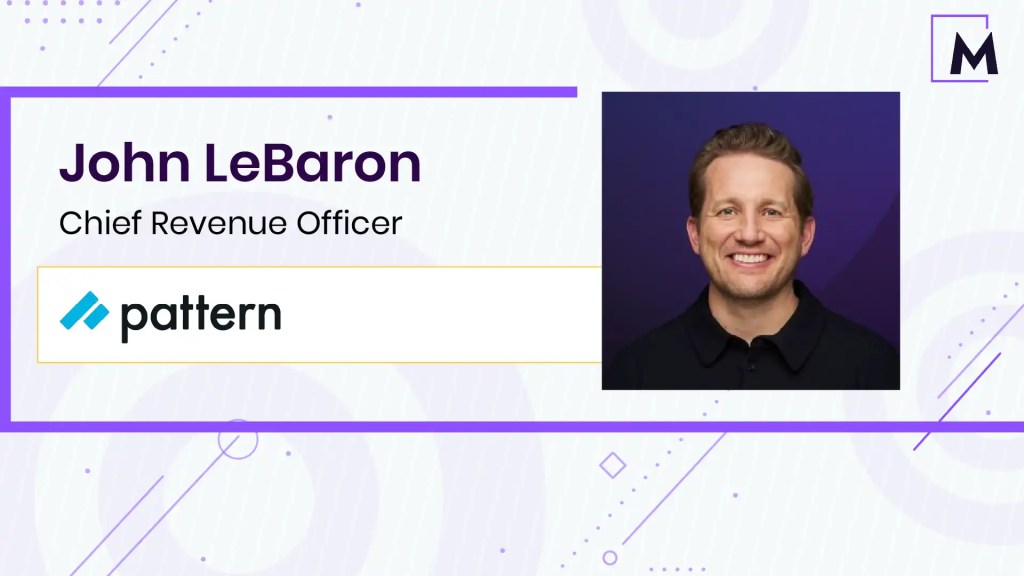
In an exclusive interview with MarTech Pulse, John LeBaron discusses Agentic Campaign Management, Pattern Intelligence, ChatGPT Ads, cross-channel ecommerce data, and the evolving role of AI in advertising execution.
John, you’ve spent your career moving between marketing and revenue leadership at companies like Apple, Cisco, Ciena, and Rackspace before joining Pattern. How has that path shaped the way you think about go-to-market in ecommerce specifically?
Enterprise taught me discipline. Ecommerce demands speed. I’ve had to build both into how I operate.
At Apple, Cisco, Ciena, and Rackspace, you’re selling complex technology to sophisticated buyers with long cycles and real accountability to revenue. You learn rigor because you have to. Ecommerce doesn’t give you that luxury of time. The market moves in days, not quarters, and a go-to-market plan that can’t adapt at that speed is already behind. The combination of rigor from enterprise and speed from ecommerce is exactly what shapes how I think about go-to-market at Pattern.
It also convinced me that the best go-to-market motion treats marketing and revenue as one function, not two. I’ve spent my career refusing to let marketing and sales operate in separate lanes, and in ecommerce that’s non-negotiable. The brands we work with don’t care where marketing ends and revenue begins. They care about growth. Every go-to-market decision at Pattern starts from that same place: marketing is accountable to the business outcome, full stop.
The products change and the channels change. What stays the same is how you build trust at scale: you earn a seat at the table by proving you can move the number, whether you’re selling networking gear to a Fortune 500 or helping a global brand win on Amazon and TikTok. That’s the discipline I brought with me, and it’s what shapes every go-to-market call we make here.
One of the primary things that working in technology taught me is to start to recognize patterns. For example, in the telecommunications space and cloud infrastructure space, there has been a large migration from on-premise. People used to want to do everything themselves: manage their servers, manage their storage, build data centers. The cloud evolved so rapidly, the pace of technology evolved so rapidly, and the monetization models evolved so rapidly that everyone eventually, with the exception of very large enterprises and educational institutions, migrated toward that new paradigm.
Ecommerce has a very similar parallel. Many brands historically have wanted to try to do this themselves, but the complexity has been so rapid that it has completely outstripped their capacity, in many cases, to do it themselves. The go-to-market has evolved for Pattern because, in effect, we are the cloud platform of many brands trying to do this themselves. By effectively outsourcing their workloads to us, we can do it better, faster, and cheaper, oftentimes, than they can do it themselves because of our scale, our intelligence, and our adaptability to rapidly changing trends.
Pattern’s news ties its ChatGPT Ads integration to more than 91 trillion ecommerce data points. Walk us through how that scale of data actually changes a campaign decision in real time, not just in theory.
If you look across the top advertisers in the world (Meta, Google, Amazon, TikTok, and Microsoft), they are generating more than $500 billion in revenue based on last year’s data. Unfortunately, we know from our research that much of that spend is wasted. Our primary competitive advantage on this front is synthesizing trillions of data points and mapping them to overt signals and insights that improve efficiency. For example, if you are advertising across hundreds of products on Meta or Snap, there is a strong likelihood that you are advertising inefficiently because:
- some of those products may be going out of stock
- they likely have disparate margin structures
- they are targeting different personas (e.g. repeat customers)
The ad platforms don’t always have access to this data, or brands are not able to leverage this type of data at scale because of expertise gaps. Pattern fills in those gaps through a very robust data infrastructure, and we are now managing more than $2 billion in ad spend.
Another example is that brands are increasingly paying to “rent” space on platforms like Amazon or increasingly LLMs like Open AI. I say “renting” because they have no plausible end state in which they will be owning that real estate via an organic presence. We have patented technology that helps brands dramatically improve their organic visibility on these platforms by using machine learning to predict the keywords on which they have mathematical propensity to win.
Not surprisingly, many brands are advertising on keywords and keyword phrases that they have no business advertising on because they will never organically win those spots. Again, this isn’t their fault. They just don’t have the expertise or data at their fingertips that would allow them to make such data-informed decisions. For reference, we are making more than 13 million bid changes every single day just on Amazon to accomplish this end game. It’s simply impossible for humans to do what AI is capable of with the right data in the right hands.
Our data is a live snapshot that updates continuously: every price change, every ad, every purchase across our brand portfolio. So when a creative angle is working on TikTok but not on Meta, we already know, in real time, instead of waiting on a report to tell us.
That scale also removes the guessing period on a new channel. Normally, a new ad platform means blind testing and burning budget just to learn what works. Because we can compare performance across Amazon, Google, Meta, Snap, and TikTok already, we bring patterns that are already proven on those platforms straight into how campaigns are targeted and optimized on ChatGPT, from day one.
The real unlock is what that scale enables: seeing performance across every major platform at once and acting on it immediately. That immediacy is what changes a campaign decision in real time: faster, better-informed calls, made because of the data rather than after it.
The announcement also references “agentic campaign management” through Pattern Intelligence (Pi). How much of a brand’s advertising execution is realistically ready to be handed to an AI agent today versus still needing a human in the loop?
The repetitive, high-confidence work is already automated today. Featured offer recovery, pricing adjustments, content fixes: Pi has already taken millions of these actions autonomously across our brand portfolio.
Judgment calls still go to a person, and that’s a deliberate design choice. When a decision touches brand judgment, like tone or positioning or anything that reflects on the brand itself, Pi surfaces it as an Action Item for a person to approve rather than acting on its own. Every action Pi takes is also logged in the Activity Center, so there’s a full, searchable record of what happened and why.
That line moves over time, but it doesn’t disappear. As the system builds more confidence in a given decision type, more of it shifts to automated execution. We’re not chasing full autonomy for its own sake. We’re chasing the right split between speed and judgment for each brand, based on what they’re comfortable handing off.
With Pattern now spanning Amazon, Walmart, TikTok Shop, Meta, Google, Snap, and ChatGPT Ads in one platform, what’s the pitch to a brand still running these channels through separate tools? Where can readers see Pattern’s full advertising stack in action?
Separate tools mean separate blind spots. If you’re running Amazon, Walmart, TikTok Shop, Meta, Google, Snap, and now ChatGPT through different platforms, you’re not just juggling logins. You’re missing the comparison that actually drives performance. You can’t see that a creative working on TikTok would also work on Meta if the two platforms never talk to each other. Pattern’s whole advantage is that they do.
One platform means one source of truth for what’s actually working. Instead of six dashboards giving six partial answers, brands get a single view of what’s converting where, and the ability to act on that instantly across every channel. That’s the pitch: a genuine performance advantage from seeing the whole picture, beyond consolidation for its own sake.
Pattern’s recent acquisition of ROI Hunter added product-level advertising and marketplace performance data to the platform. For brands and investors tracking Pattern’s growth, where’s the best place to follow what’s next: Pattern’s investor updates or the product roadmap itself?
It depends on which lens you’re looking through, because investors and brands are asking the same question in different currencies. Investors want to see how this shows up in the numbers: revenue growth, NRR, how a deal like ROI Hunter compounds with the rest of the platform. Brands want to see it show up in the product: new capabilities, new channels, what they can do today that they couldn’t yesterday. Both are true at the same time.
For investors, our quarterly updates are where the compounding story gets told. Our investor relations page, investors.pattern.com, lays out how acquisitions like ROI Hunter and partnerships like this one translate into the model: international growth, non-Amazon revenue, NRR, the underlying data advantage.
For brands, watch our product announcements, social channels, and press releases. The newsroom on pattern.com is the fastest read on what’s shipping next. A press release marks a milestone. The roadmap is where you actually see the platform evolve in real time.
Zooming out, where do you see AI-native advertising heading by 2027? Is ChatGPT Ads a one-off integration, or the first of several AI experiences brands will need to actively advertise within?
ChatGPT is the opening move, not the only one. Wherever people go to ask questions and get recommendations becomes a place brands need to show up, and ChatGPT is simply the most obvious first stop because of the scale of people already using it that way.
By 2027, “advertising” won’t mean the same thing it does today. The channels will keep expanding. Any AI experience where people discover and evaluate products becomes a new surface brands have to compete on. The brands that win won’t be the ones chasing every new platform one at a time. They’ll be the ones with a system that already knows how to show up and perform anywhere.
That’s the bet Pattern is making. We didn’t build our advertising stack around any single channel. We built it to plug in new ones as they emerge. ChatGPT Ads is proof of that model working. Whatever comes next, we intend to be there early, the same way we were early on TikTok Shop.
What’s one piece of advice you’d give marketing and revenue leaders who are still watching AI-driven advertising from the sidelines, unsure where to start?
Don’t wait for certainty. You won’t get it. Every leader wants a clear roadmap before they move on something new, and AI-driven advertising isn’t going to hand you one. The brands winning right now aren’t the ones who waited for the picture to become clear. They’re the ones who started testing while it was still forming.
Start where you already have a signal, not where it’s trendy. You don’t need to chase every new AI platform at once. Look at where your own performance data is already telling you something, whether that’s a channel, a product line, or an audience, and use AI to act on that faster. The sidelines feel safe, but they’re the most expensive place to stand still.
And find a partner who’s already done the testing, so you’re not starting from zero. This is moving fast enough that nobody has to figure it out alone. Whether it’s Pattern or someone else, the smartest move is partnering with a team that already has the data and the scars from testing this, so you’re not the one paying to learn the hard lessons first.
Write to us [wasim.a@demandmediaagency.com] to learn more about our exclusive editorial packages and programmes.
John LeBaron serves as Chief Revenue Officer and oversees go-to-market activities for Pattern and its partners. Prior to joining Pattern, John ran marketing for the Google Cloud business at Rackspace and has held a variety of global marketing roles with leading tech companies including Apple, Cisco, and Ciena. He holds an MBA from the Kellogg School of Management, an MSW from Columbia University, and a Bachelor of Arts in Communications from Brigham Young University.
Pattern accelerates brands on global ecommerce marketplaces by leveraging proprietary technology and AI. Utilizing more than 77 trillion data points, sophisticated machine learning and AI models, Pattern optimizes and automates all levers of ecommerce growth for global brands, including advertising, content management, logistics and fulfillment, pricing, forecasting and customer service. Hundreds of global brands depend on Pattern’s ecommerce acceleration platform every day to drive profitable revenue growth across more than 70 global marketplaces — including Amazon, TikTok Shop, Walmart.com, Target.com, eBay, Tmall, JD, and Mercado Libre.