
Fivetran’s General Manager, EMEA Simon Quinton’s Exclusive Interview with MarTech Pulse on Open Data Infrastructure
Stay updated with us
Sign up for our newsletter
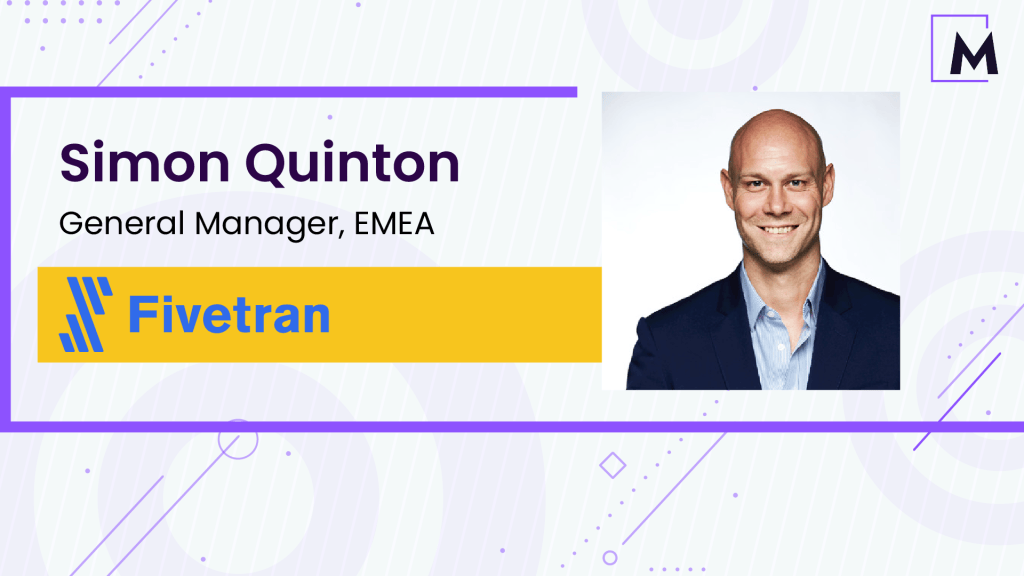
Simon, your career spans enterprise technology, regional leadership, and data innovation. Could you share how your professional journey led you to Fivetran and driving growth across EMEA markets?
I’ve spent most of my career working with enterprise customers across EMEA, whether that was at SAP, Infor, or more recently at Salesforce. A lot of that time was focused on helping companies adopt new systems and modernize how they operate.
But what I kept seeing, regardless of the technology, was that the real challenge wasn’t the tools themselves, it was the data behind them. As companies added more platforms, their data became more fragmented, harder to access, and harder to trust across the business.
What’s changed now is the urgency. With AI moving into production, data isn’t just something you analyze after the fact, it’s something that systems depend on in real time.
That’s what drew me to Fivetran. It’s focused on solving that core problem, making sure data can move reliably across systems and actually be usable wherever the business needs it.
And as more organizations start thinking in terms of Open Data Infrastructure, where they want more control and flexibility over how their data is used, that becomes even more important.
For me, leading EMEA is really about helping customers navigate that shift in a practical way and making sure they’re set up for what’s coming next, not just what worked in the past.
Today’s marketers rely on connected, real-time data… what challenges remain?
The challenge is that the role of data has fundamentally changed, but the infrastructure most organizations rely on hasn’t kept up.
Marketing today depends on real-time, connected data across dozens of systems, but that data is often fragmented, inconsistently defined, and in many cases, not fully accessible. As a result, teams are still compensating with duplicated datasets, stitched-together pipelines, and workflows that weren’t designed to operate at scale.
That gap becomes much more visible as companies try to move from analytics to AI-driven engagement. These systems depend on a consistent, governed data foundation, and without it, personalization and automation start to break down.
Why London for this next phase of growth?
London represents one of the most important intersections of enterprise scale, regulatory complexity, and AI adoption globally.
Organizations there are under increasing pressure to modernize how data is accessed, governed, and used across markets, while also preparing for AI to play a more central role in operations.
Expanding our presence allows us to engage much earlier in those architectural decisions. This is less about supporting incremental growth and more about being part of how companies design the next generation of their data infrastructure.
At the same time, it’s a very practical decision. London gives us access to a deep pool of technical and commercial talent, and it puts us closer to many of our key customers and technology partners. That proximity matters, because these aren’t transactional decisions anymore, they’re long-term architectural choices that benefit from close, ongoing collaboration.
What separates companies successfully scaling AI from those struggling?
What we’re seeing is a clear shift in where the constraint sits.
For the last decade, the focus was on tools and models. Today, the limiting factor is the data those systems depend on.
Organizations that are scaling AI successfully have invested in a foundation where data is consistently accessible, governed, and reusable across systems. They’ve treated data as shared infrastructure, not something that lives inside individual applications.
Those that are struggling are still operating with siloed or restricted data. And when AI systems begin operating continuously and at scale, those limitations aren’t incremental, they become structural blockers.
How does Open Data Infrastructure help marketing and business teams?
Open Data Infrastructure reflects a shift in how organizations think about control.
It’s an approach built on open standards that ensures data, and the logic around it, can move freely across systems without being bound to a single platform.
That creates a shared, governed foundation where data is defined once and used consistently across analytics, operations, and AI. For marketing teams, that translates into a more reliable view of the customer and the ability to activate that data across channels without rebuilding context in every tool.
As AI becomes more embedded in how decisions are made, that consistency and control become essential.
Read More – The Impact of AI Workflow Engines on Organizational Productivity
How important is local presence across EMEA?
It’s increasingly important because these decisions are not tactical, they’re architectural. Organizations are re-evaluating how they maintain control over their data in an environment where access is becoming more constrained and ecosystems are becoming more tightly coupled.
But just as importantly, this is about trust. These are long-term decisions that shape how a company operates, and they benefit from being made in close partnership. Being on the ground allows us to engage face-to-face with customers, understand regional requirements more deeply, and support them in a much more hands-on way.
London is the starting point for that approach. It gives us a strong foundation to build from as we expand further across EMEA – and the Middle East, where local presence will be just as critical.
What trends will shape martech and AI-driven decision-making heading into 2026?
The biggest shift is that data is no longer just informing decisions, it’s increasingly driving them.
As AI systems and agents become more embedded in operations, they require continuous access to consistent, governed data across systems. That’s fundamentally different from the periodic, human-driven access patterns the industry was built around.
At the same time, we’re seeing growing tension around data access itself. More vendors are restricting or monetizing access, which limits how freely organizations can move and use their data.
That’s why we’re seeing a broader move toward Open Data Infrastructure, where companies retain control over their data and can adapt as both the technology landscape and their AI needs evolve.
Write to us [wasim.a@demandmediaagency.com] to learn more about our exclusive editorial packages and programmes.
Simon Quinton is a seasoned business and technology professional with extensive experience in leadership, operations, and strategic growth. With a strong background in driving innovation and managing cross-functional initiatives, Quinton has built a reputation for delivering impactful solutions that align technology with business objectives. Throughout the career journey, Quinton has contributed to organizational growth through expertise in project management, client engagement, and operational excellence.
Fivetran, the global leader in data movement, helps customers use their data to power everything from AI applications and ML models, to predictive analytics and operational workloads. The Fivetran platform reliably and securely centralizes data from hundreds of SaaS applications and databases into any cloud destination – whether deployed on-premises, in the cloud or in a hybrid environment. Thousands of global brands, including Autodesk, Condé Nast, JetBlue and Morgan Stanley, trust Fivetran to move their most valuable data assets to fuel analytics, drive operational efficiencies and power innovation.